s02 (Ch 2) Paralytic, Levi & Sinners, Lord of the Sabbath (studied 1-Oct-2025)
The Book of Mark with Dr. Chuck Missler
The subsections of Chapter 2 (per LSB/NASB) are:

- John Mark — John was his Jewish name, while Mark was his Latin surname (Acts 12:12)
- John Mark was the son of a wealthy woman named Mary, probably a widow, whose home was large enough to serve as a meeting place for many of the early disciples after the Pentecostal outpouring (Acts 12:1-19)

- Israel had been promised immunity from disease if obedient to the law of God:
— “And ye shall serve the LORD your God, and he shall bless thy bread, and thy water; and I will take sickness away from the midst of thee.” (Exo 23:25)
- Every blind, deaf, crippled or diseased person among them was a witness to their failure in this respect (Deut 28:15-23 Consequences of Disobedience)
- In healing the sick, Jesus was undoing the work of the devil — “He went about doing good and healing all who were oppressed by the devil, for God was with Him.” (Acts 10:38 NASB)
— That’s a dimension of healing that is often overlooked
— We think in medical terms, but healing is also in theological terms
- In doing so, He was YHWH’s servant (Isa 35:4-6)
- Every form of disease healed by our Lord seems to picture some aspect of sin:
… a fever burning in the soul
… a leprosy polluting the whole being
… a palsy making one utterly unable to take a step toward God
… a withered hand incapable of true service
- Whatever form sin may take, Jesus can give complete deliverance from it
Mark 2:1 Jesus Heals a Paralytic

- “And”: appears 1,286 times in Mark
— a conjunction of action: no sentence can end with and
— “and” always leads to further action
— the style of Mark is brief and blunt, pertinent and pithy, short and sweet
- “… in the house”: Greek term implies that “He was at home”, as translated in NASB
- Some suspect that it was Peter’s house
- [Churches will have no attendance problem if is “noised that Christ is in their house”]
Mark 2:2
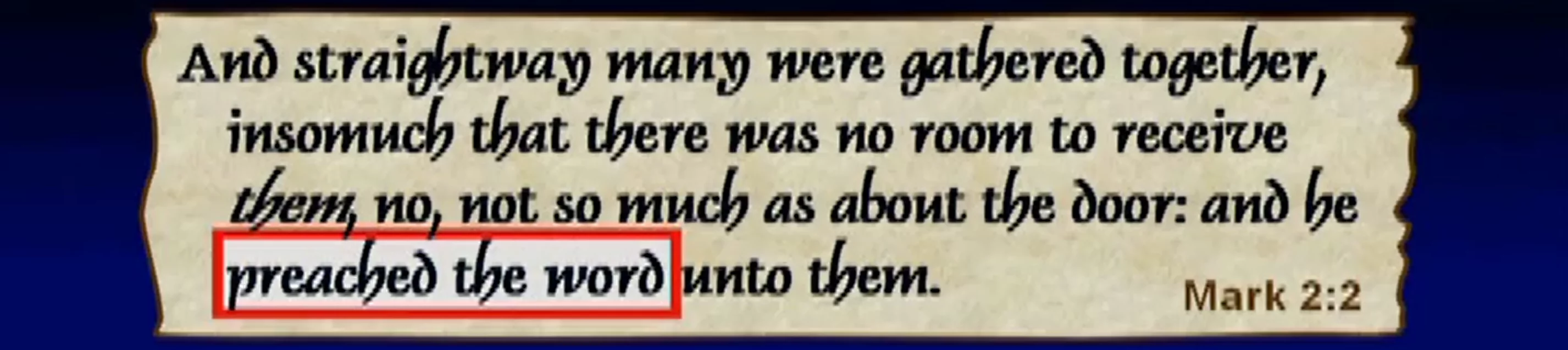
- “… preached the word”: Note the emphasis in Mark upon the integrity and inerrancy of the Word of God
- It will never return unto Him void:
— “So will My word be which goes forth from My mouth;
It will not return to Me empty,
Without accomplishing what I desire,
And without succeeding in the matter for which I sent it.” (Isa 55:11 NASB)
Mark 2:3

- This verse is a fine illustration of Mark’s vivid dramatic historical present: “And they come unto Him”
- “… palsy”: The man was literally “without strength” — palsy man thus pictures all men in their sins
(The Greek word παραλυτικός (paralutikos) from which we get the word paralytic)
- We are all spiritual cripples (spiritually, we all have palsy — by our strength, we accomplish nothing):
— “For when we were yet without strength, in due time Christ died for the ungodly.” (Rom 5:6)
Mark 2:4
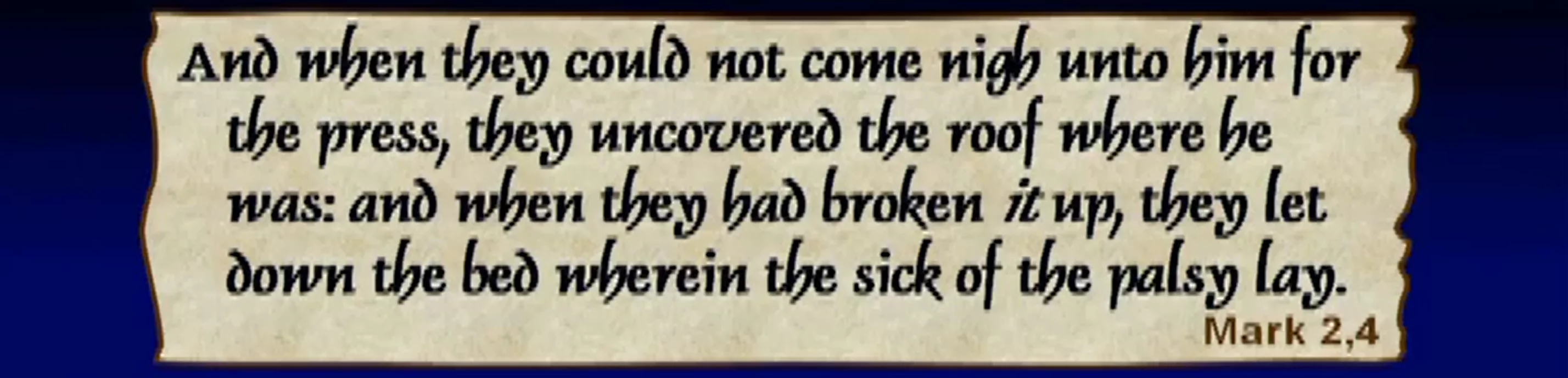
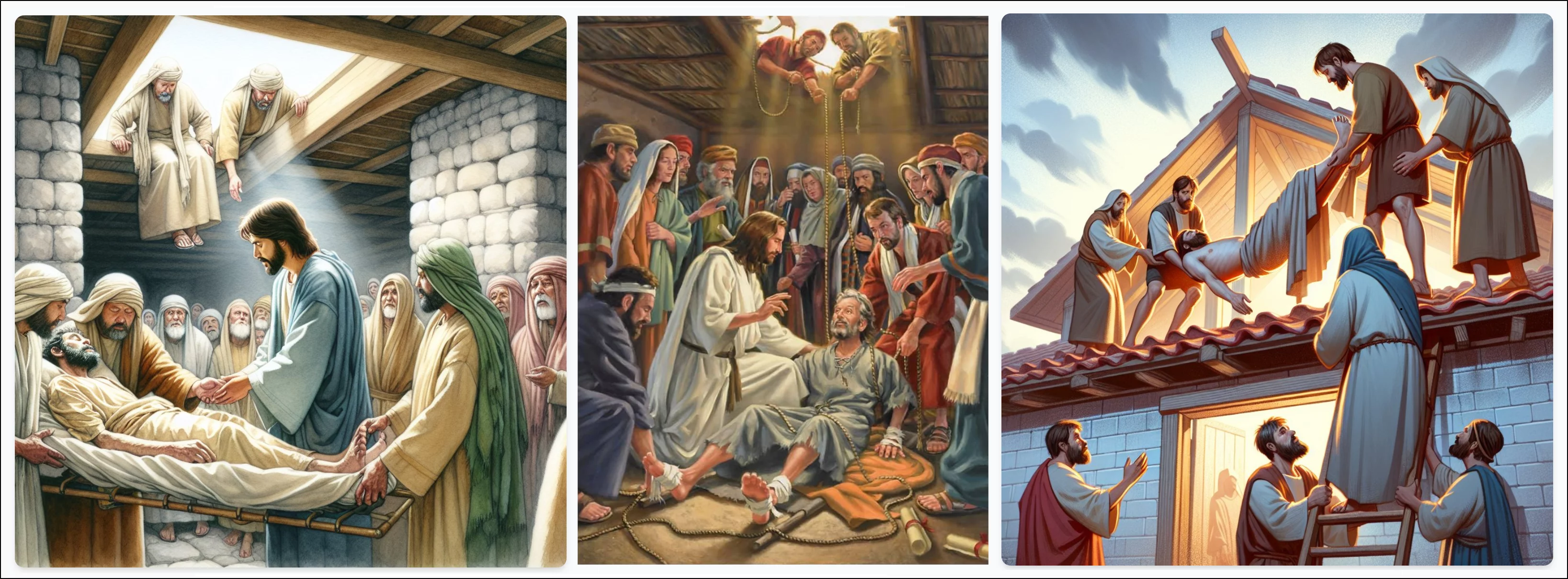
- We all have a tremendous obligation to bring our needy loved ones into the presence of Jesus — even if it was inconvenient and unconventional!
Mark 2:5

- “… Jesus saw their faith…”
— Faith is evidenced by works
— Actions speak louder than words
- In the OT, physical healing and forgiveness of sins were intimately connected:
— “Who forgiveth all thine iniquities; Who healeth all thy diseases;” (Ps 103:3)
— “…Thy saving health…” (Ps 67:2)
— “Then shall thy light break forth as the morning,
And thine health shall spring forth speedily:
And thy righteousness shall go before thee;
The glory of the LORD shall be thy rereward.” (Isa 58:8)
— Cf. Paul’s prayer of Gaius: “Beloved, I pray that in all respects you may prosper and be in good health, just as your soul prospers.” (3 John 2 NASB)
- While God may have some hidden purpose, we may still pray for healing
— “Therefore, confess your sins to one another, and pray for one another so that you may be healed. The effective prayer of a righteous man can accomplish much.” (James 5:16 NASB)
- “…Son, thy sins be forgiven thee.” — Jesus spoke to the conscience before He spoke to the body
- “The tap root of all misery is sin, and until it is dealt with, hacking at the branches is a sad waste of time”
[Source: Maclaren, The Gospel of Mark, p.52 (q.v. Barnhouse, p.36)]
- That is the problem with psychology
— it can only deal with the symptoms called guilt
— It cannot deal with the root cause, which is sin. That’s a Theological issue
Mark 2:6-7
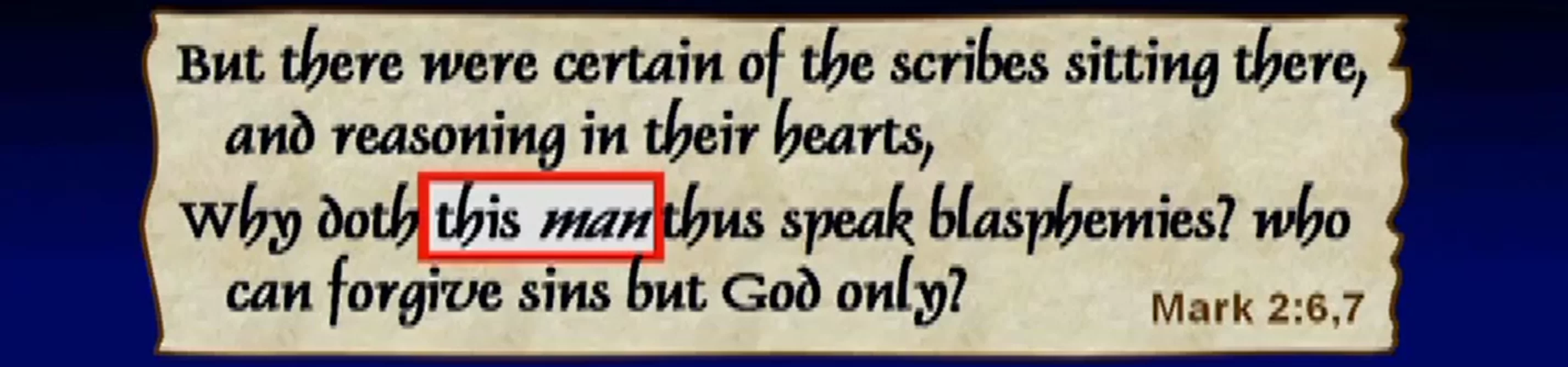
- Within themselves, not going to the Scriptures for insight. It is disturbing to note that the professional theologians were the last to understand the times…
- They were dead right: This prerogative belonged to God alone. And they were dead and right…
- “…this man” οὗτος οὕτως (hooto, hootos): this (man), thus (speak) = a derogatory construction in the Greek
We, again, owe a debt of gratitude to the Pharisees: whenever we might miss a key point, they always come to our rescue. Whenever they are upset, examine the text closely to uncover the reason why!
→ Cf. Luke 4:28-29 (Gentile election) Jesus spoke of God’s sovereignty of election. Each of the examples He mentioned were Gentiles (they were chosen by God and given a blessing) and that has upset the Jews (Pharisees)
→ Cf. Luke 19:39-40 (Daniel’s 69th week) Pharisees recognized that what the multitude were singing: “Blessed be the King that cometh in the name of the Lord”, was the exact fulfillment of prophecy Gabriel gave to Daniel five centuries earlier
Mark 2:8-9
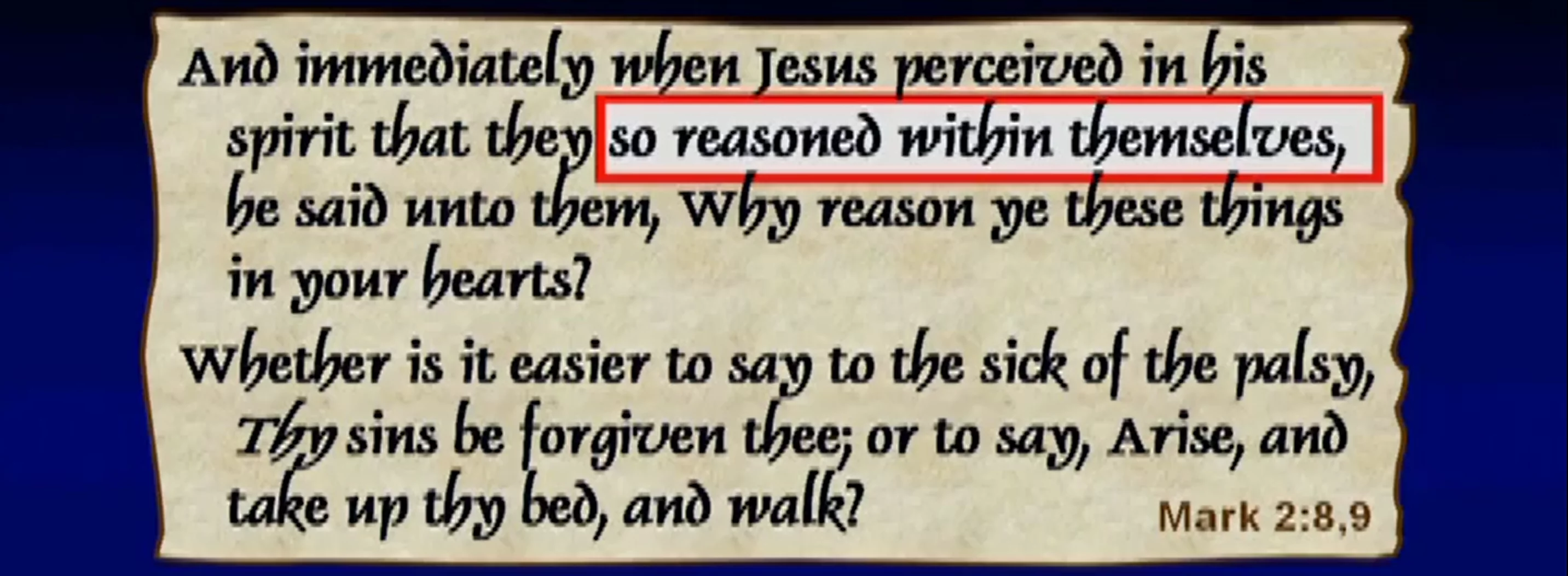
- “…so reasoned within themselves”: Jesus knew their thoughts
— “The LORD knoweth the thoughts of man, That they are vanity.” (Ps 94:11)
— “Thou knowest my downsitting and mine uprising, Thou understandest my thought afar off.” (Ps 139:2)
Mark 2:10-11
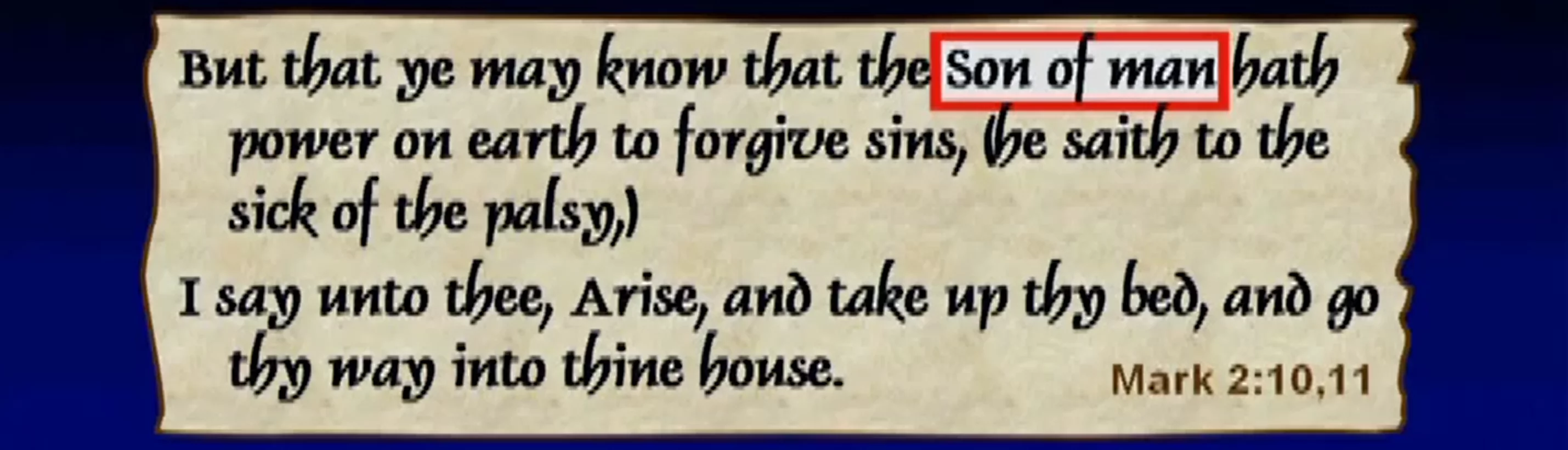
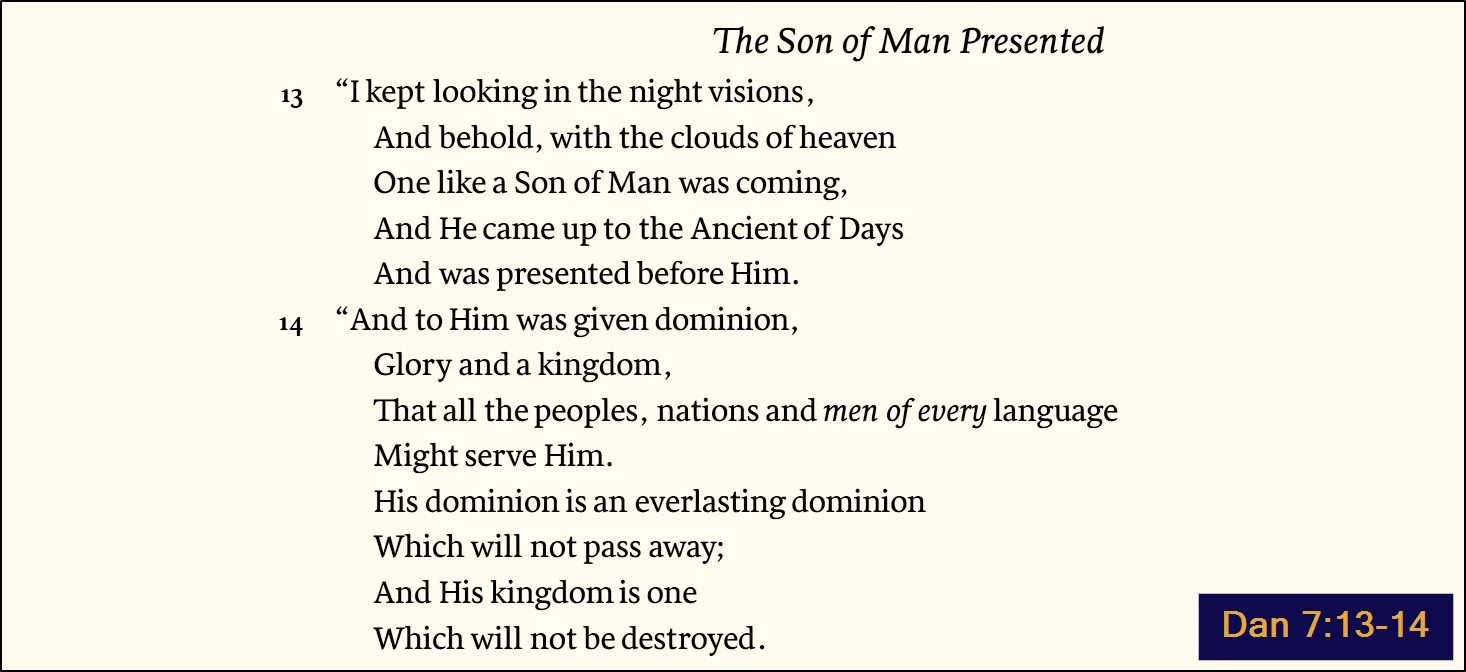
- “…Son of man”: Title used 14x in Mark’s Gospel; 80x in the Gospels. A Messianic title (Dan 7:13-14) — God in human form, allusion to the incarnation
- “…(he saith to the sick of the palsy)”: This remarkable parenthesis in the middle of the sentence occurs also in Matt 9:6 and Luke 5:24, suggesting that both Matthew and Luke followed Mark’s narrative
— (Mark’s Gospel was considered the earliest to have been written, although not with certainty)
Mark 2:12
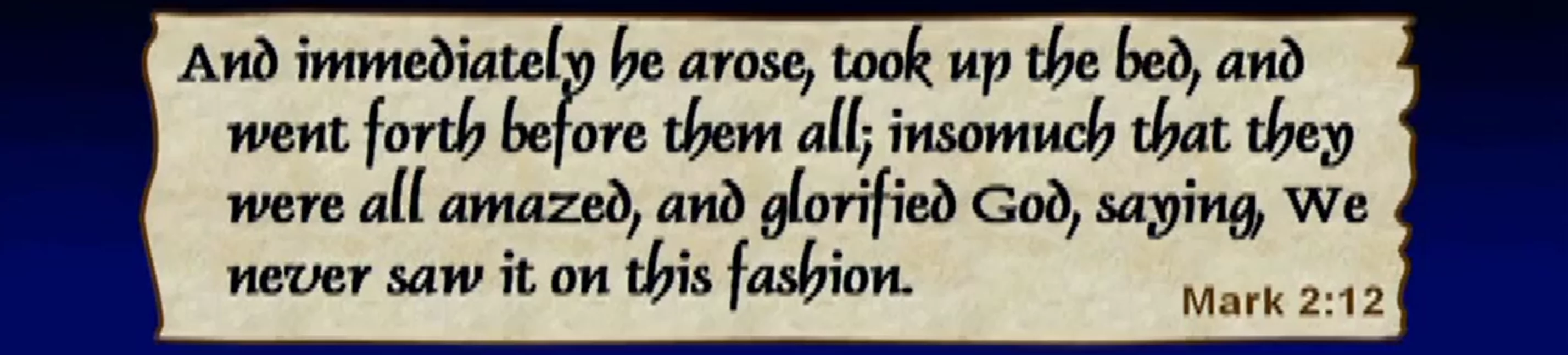
- But that is not enough. There is no emotion more transient or less fruitful than gaping astonishment. That piddling acknowledgment of God’s power led to nothing: Later Jesus would say of this very town,
— “And thou, Capernaum, which art exalted unto heaven, shalt be brought down to hell: for if the mighty works, which have been done in thee, had been done in Sodom, it would have remained until this day. But I say unto you, That it shall be more tolerable for the land of Sodom in the day of judgment, than for thee.” (Matt 11:23-24)
- The miracles in Capernaum had very little lasting impact
Mark 2:13

Mark 2:14 Levi (Matthew) and Sinners Called
- Matthew was a customs official. As such, he had to be skilled in shorthand. (That’s why his gospel details the main discourses: he probably took them down verbatim!)
- A common Greek term for a professional stenographer is mentioned in Septuagint (LXX) translation of David’s Psalm 45 (Your Throne, O God, Is Forever) — “…My tongue is the pen of a ready writer.” (Ps 45:1)
- Rapid writing was obviously known at least two centuries earlier — tachygrafos (ταχυγράφος)
[For a few more details, see Matthew note s06b]
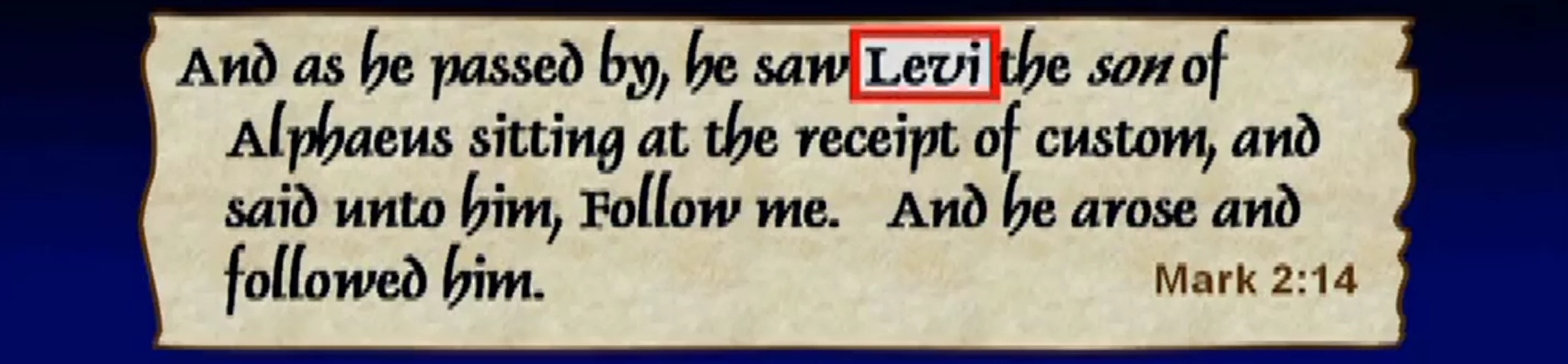
- Levi (Matthew), son of Alpheus was an unlikely specimen, sitting at the toll-gate (τελωνιον telōnion) on the Great West Road from Damascus to the Mediterranean. He was a publican (τελωνης telōnēs) who collected toll for Herod Antipas
- The Jews hated and despised these publicans and classed them with sinners (αμαρτωλοι hamartōloi)
- The challenge of Jesus was sudden and sharp, but Levi (Matthew) was ready to respond at once. He had heard of Jesus and quickly decided. Great decisions are often made on a moment’s notice
- “…Levi”: He was of the tribe of Levi (this is another one of the rebuttals of the myth of the “lost 10 tribes”, which is based on misunderstanding of 2 Chr 11 — the confusion of tribal geography with the tribal ethnology)
- The tax collectors were on an incentive: they purchased the franchise and had incentives to be rigorous
- Matthew knew he had burned his bridges. He could never go back. “He left everything behind” (Luke 5:28 NASB)
Mark 2:15
- Matthew (his new name: “Gift of God”) apparently celebrated his new calling and allegiance with a feast
Mark 2:16
- “…Publicans and sinners” Used 3x in two verses — lumped together → publicans ≈ sinners
- It was an offence for a Jew to eat with Gentiles at all, let alone this caliber of person. Even many of the early Jewish Christians felt this way (“You went to uncircumcised men and ate with them.” — Acts 11:3), and publicans and sinners were regarded like Gentiles (1 Cor 5:11)
- They were critical of the fact that Jesus was mixing with those “outcasts”
— They were obviously oblivious to Jesus’ mission
— So are too many even today! (Gossiping and backstabbing are not unique to our situation today…)
Mark 2:17
- Of course, that’s all of us (the sinners). There are, of course, “none righteous” (Rom 3:10)
- It is the confessed sinner who finds mercy
- [Re: National testimony of Star Parker https://www.youtube.com/watch?v=7DM-qVFllDM, a dramatic example of having been freed from the welfare trap characterizing the African-American community…]
- [Many Pharisees and priests ultimately did come to faith in Christ (Acts 6:7). But there are no records of a Sadducee—the liberals of the period—coming to faith… Liberals seem to be more impervious (unaffected by) to the Gospel]
- Beware the false physicians:
— “They have healed the hurt of the daughter of my people slightly (superficially), saying, Peace, peace; when there is no peace.” (Jer 8:11, cf. Jer 6:13)
- Christ is not only our Savior, He is also our Lord. Redemption involves much more than salvation from the guilt of sin and the judgment due to sin
- It includes our deliverance from the power and authority of Satan, the god of this world, and our glad subjection to the One who has purchased us with His own precious blood:
— “What? know ye not that your body is the temple of the Holy Ghost which is in you, which ye have of God, and ye are not your own? 20 For ye are bought with a price: therefore glorify God in your body, and in your spirit, which are God’s.” (1 Cor 6:19-20)
- [Review Romans 6: “It ain’t gonna reign no more!” — sin need not reign in your life if you are in Christ. If you are not in Christ, you are in bondage to the sin]
- We often hear it said that our wills must be broken, but that is poor psychology and even worse theology: A broken-willed man is no longer capable of making definite decisions:
— “Our wills are ours, To make them Thine” — Alfred, Lord Tennyson — from "In Memoriam", an acclaimed elegy that reflects the profound emotional and intellectual transformations the poet experienced following the death of his close friend, Arthur Henry Hallam, in 1833
— We aren’t to yield to Him anything that is “broken”. It should be of delight, not exhaustion
Mark 2:18
- Christianity is, indeed, a wedding. Jesus is echoing the words of John the Baptist:
— “He that hath the bride is the bridegroom: but the friend of the bridegroom, which standeth and heareth him, rejoiceth greatly because of the bridegroom’s voice: this my joy therefore is fulfilled.” (John 3:29, Cf. Psalm 45, Song of Songs…)
- Israel had been “married” to YHWH and they belonged to Him:
— “For thy Maker is thine husband; The LORD of hosts is his name;…” (Isa 54:5)
— “…In the day that I took them by the hand
To bring them out of the land of Egypt;
Which my covenant they brake,
Although I was an husband unto them, saith the LORD:” (Jer 31:32)
- Their unfaithfulness was the primary theme in Hosea
— [Even the Talmud absolves friends of the Bridegroom even from prayer for the several days after the wedding as they had but one duty: to rejoice]
Mark 2:19-20
Mark 2:21
- He came to introduce the new, not patch up the old
Mark 2:22
- Bottles here are the leather pouch type things (skins)
- Jesus would establish a new covenant with His blood:
— “And when He had taken some bread and given thanks, He broke it and gave it to them, saying, “This is My body which is given for you; do this in remembrance of Me.” 20 And in the same way He took the cup after they had eaten, saying, “This cup which is poured out for you is the new covenant in My blood.” (Luke 22:19-20 NASB)
- The Law would be written on human hearts, not stones:
— “You are our letter, written in our hearts, known and read by all men; 3 being manifested that you are a letter of Christ, cared for by us, written not with ink but with the Spirit of the living God, not on tablets of stone but on tablets of human hearts.” (2 Cor 3:2-3 NASB)
— ““But this is the covenant which I will make with the house of Israel after those days,” declares the LORD, “I will put My law within them and on their heart I will write it; and I will be their God, and they shall be My people.” (Jer 31:33 NASB, cf. Heb 10:15-18)
- The indwelling Holy Spirit would enable God’s people to fulfill the righteousness of the Law:
— “Therefore there is now no condemnation for those who are in Christ Jesus.
2 For the law of the Spirit of life in Christ Jesus has set you free from the law of sin and of death.
3 For what the Law could not do, weak as it was through the flesh, God did: sending His own Son in the likeness of sinful flesh and as an offering for sin, He condemned sin in the flesh,
4 so that the requirement of the Law might be fulfilled in us, who do not walk according to the flesh but according to the Spirit.” (Rom 8:1-4 NASB)
- Salvation is not patching up the old; you become a new creation:
— “Therefore if anyone is in Christ, he is a new creature; the old things passed away; behold, new things have come.” (2 Cor 5:17 NASB)
— Nowhere in the Bible is a human heart healed → It is replaced
- Blessed are the flexible for they shall not be broken. Ossification (the hardening of tissue into bone; things becoming rigid) is one of the reasons the Holy Spirit tends to use new channels of communication…
- How tragic it is to retain dead religious traditions when one gains living spiritual truth. Why cherish shadows when the reality has come?
— “For the Law, since it has only a shadow of the good things to come and not the very form of things, can never, by the same sacrifices which they offer continually year by year, make perfect those who draw near.” (Heb 10:1 NASB)
Mark 2:23 Question of the Sabbath / Lord of the Sabbath
- “…corn”: σπόριμος (sporimos) properly translated is grain fields (could be wheat, barley etc.)
- It is not corn as we think of it
- This was in accordance with the Law:
— “When thou comest into the standing corn of thy neighbour, then thou mayest pluck the ears with thine hand; but thou shalt not move a sickle unto thy neighbour’s standing corn.” (Deut 23:25)
- The same procedure was also ordained in the Law of Gleaning (Lev 19:9-10, Deut 14:19-21, Cf. Ruth 2)
Mark 2:24

- Even today, we let the trivial obscure the perception of the critical; formalism rather than substance; etc.
- These were proud, covetous, liars, lustful; but they put their “holiness” on display to the public
- [We are to be marked by love rather than doctrine] By their love they shall know them (John 13:35). Also, confer Letter to the Church of Ephesus: They have done their job - they’ve been very strict on their doctrine, but they lost the 1st love. They were so busy on the business of the King, that they didn’t have time for the King!
- We must not enthrone orthodoxy at the expense of the substance of Christ: LOVE
- It is our union with Him that needs to eclipse the exaltation of the trivial…
Mark 2:25-26
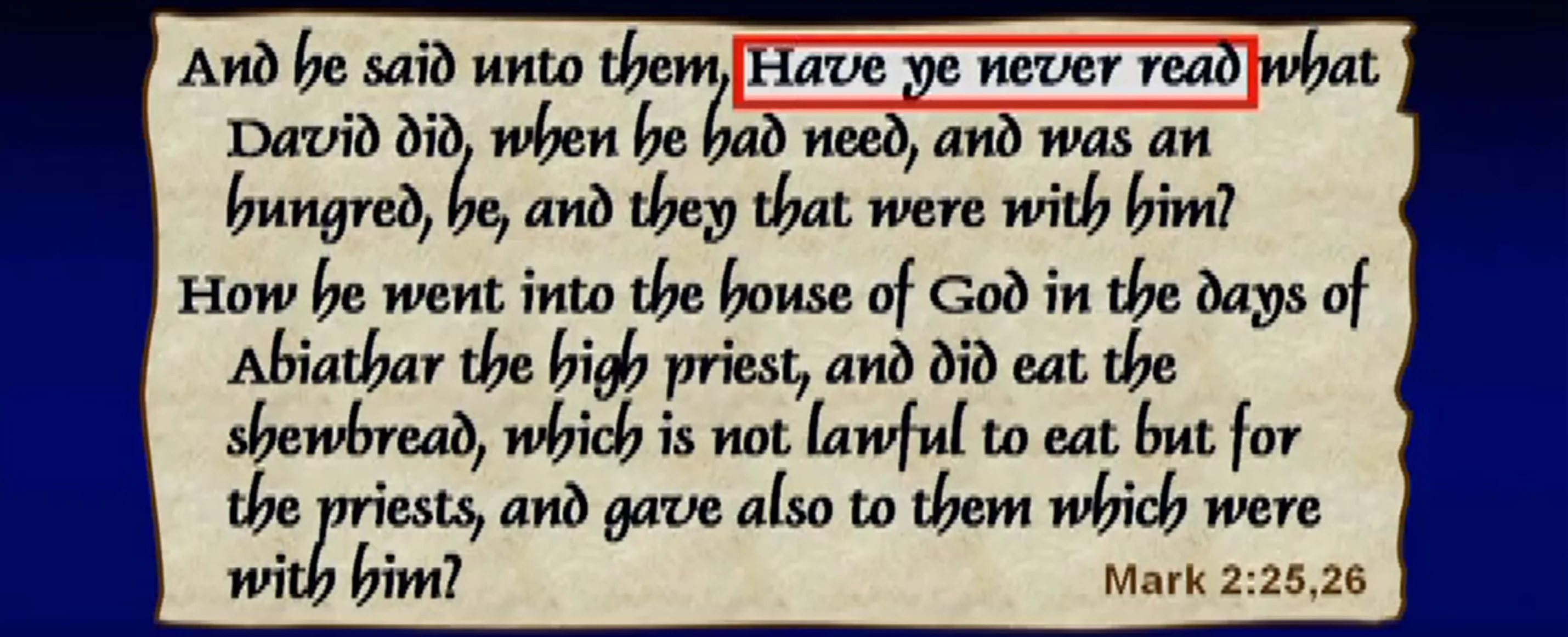
- “Have you never read…”: Have you done your homework? (Lev 24:9, 1 Sam 21:6)
- Note: Abiathar was the son of Ahimelech — both probably had both names, which creates confusion (1 Chr 18:16 & 1 Chr 24:6, 1 Sam 2:20 & 2 Sam 8:17)
- They had the most elaborate rules for the preparation of the shewbread (12 loaves for 12 tribes) (τους aρτους της προθεσεως tous artous tēs protheseōs), the loaves of presentation, the loaves of the Face or Presence of God
- It was renewed on the commencement of the sabbath and the old bread deposited on the golden table in the porch of the Sanctuary
- This old bread was eaten by the priests as they came and went. This is what David ate
Mark 2:27

- Verse 27 is A VERY key verse to absorb. Much can be said about this concerning the Sabbath. There seem to be two errors still widely prevalent:
1) Failing to “remember the Sabbath day” and
2) Ignoring our being freed from the Law
- The Sabbath was ordained long before the Law of Moses
— In Exo 16 they were accustomed to the practice of the observing the Sabbath; the Law was not given until Exo 20
— [How did Noah know which animals were “clean” and “unclean”? These were ceremonial definitions, probably given in Eden. Scripturally, only defined in the Book of Leviticus]
- Most discussions concerning the relation of the Christian to the Sabbath fail to recognize that:
— in the Millennium all nations will worship on the Sabbath (Isa 66:22-23) and
— the Millennial Temple will only be open on the Sabbath and the New Moon (Ezek 46:1)
- Yet, let us also remember our liberty in Christ:
— “Let no man therefore judge you in meat, or in drink, or in respect of an holyday, or of the new moon, or of the sabbath days:” (Col 2:16)
— “One man esteemeth one day above another: another esteemeth every day alike. Let every man be fully persuaded in his own mind.” (Rom 14:5)
Mark 2:28

- Indeed! He is the Lord of Everything!
— [Cf. Our briefing pack, The Seventh Day, for a fuller discussion of the Christian and the Sabbath. Anyone who thinks this is a simple topic hasn’t studied it carefully!]
- In the early church, if you were caught trying to observe Jewish things, you were excommunicated
- This Sabbath incident in the field and the Sabbath incident which we will find at the beginning of Chapter 3 should go together

