s04 (Ch 4) Parables Sower & Mustard, Calms Storm (studied 8-Oct-2025)
The Book of Mark with Dr. Chuck Missler
The subsections of Chapter 4 (per LSB/NASB) are:

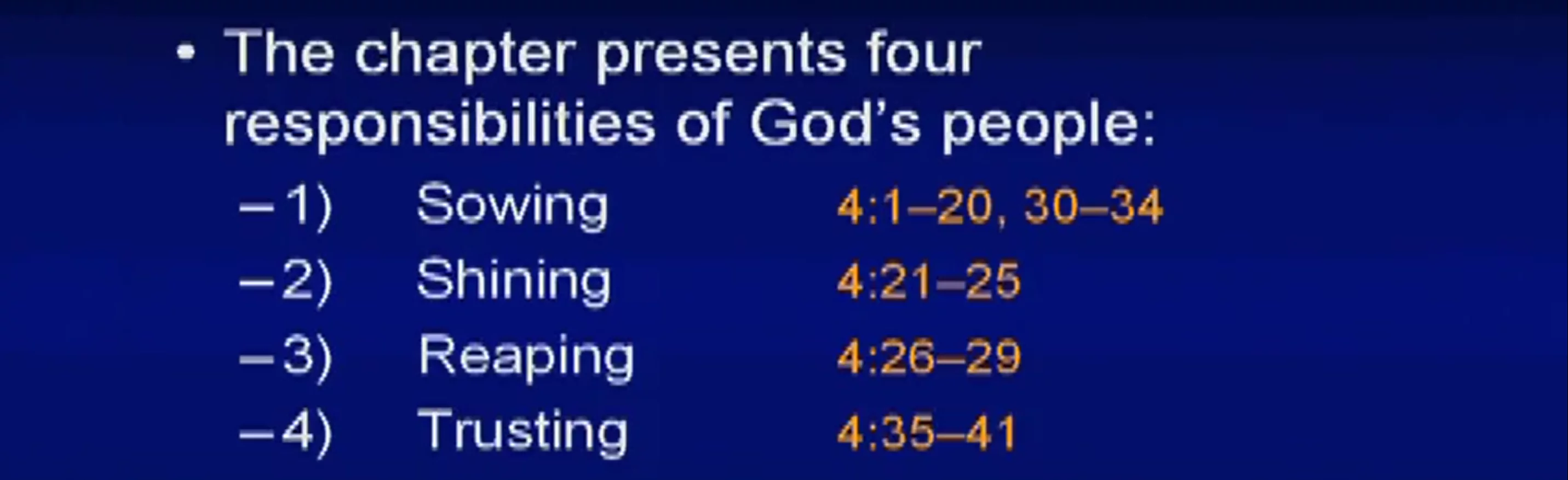
Four responsibilities of God’s people is one way we can segment this chapter:
- Sowing → Mark 4:1–20 & Mark 4:30–34
- Shining → Mark 4:21–25
- Reaping → Mark 4:26–29
- Trusting → Mark 4:35–41

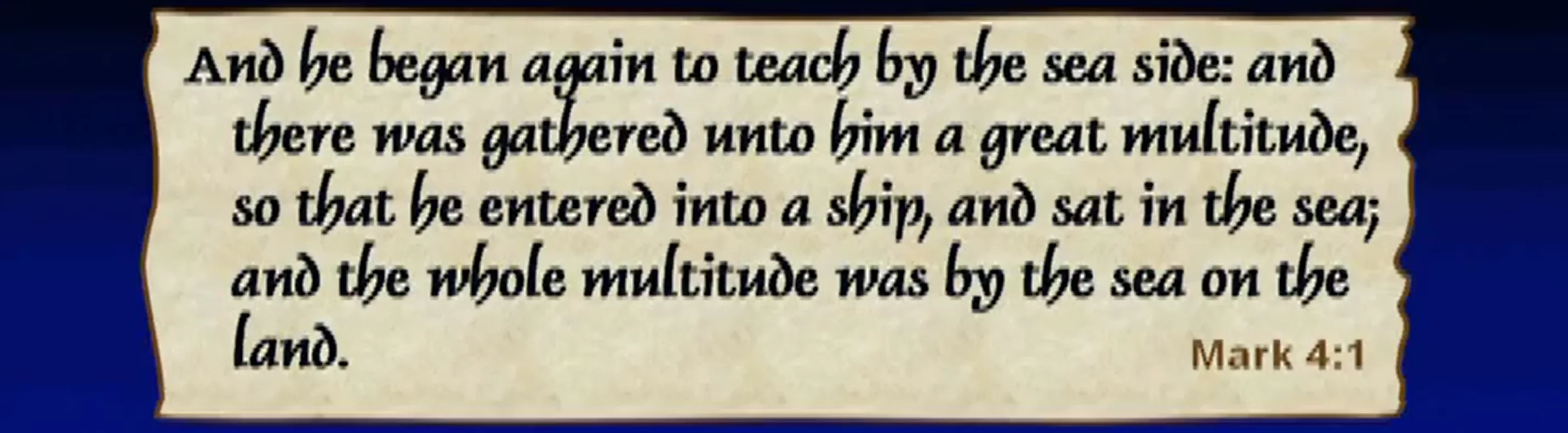
Mark 4:1
Mark 4:2

- “…by parables”: Why did He speak in “parables”?
— Most people would say to make things clearer as a way of instruction (that may hold for analogies, not parables)
— The opposite is true: so the public would not understand, but His own people would
- The Kingdom Parables (Matthew 13): “Without a parable spake He not unto them” (Matt 13:34, Cf. Mark 4:34)
- Mark introduces the word “parable” in Mark 3:23 and uses it seven times in this chapter (Mark 4:2, Mark 4:10-11, Mark 4:13, Mark 4:33-34)
— The word “parable” means “to throw alongside”. Jesus used familiar images to help explain the spiritual truths in His message about “the kingdom” (vv. 11, 26, 30)
— He used this approach so that He could arouse the careless and instruct the concerned, and yet conceal the truth from His enemies who would use it against Him (vv. 10–12)
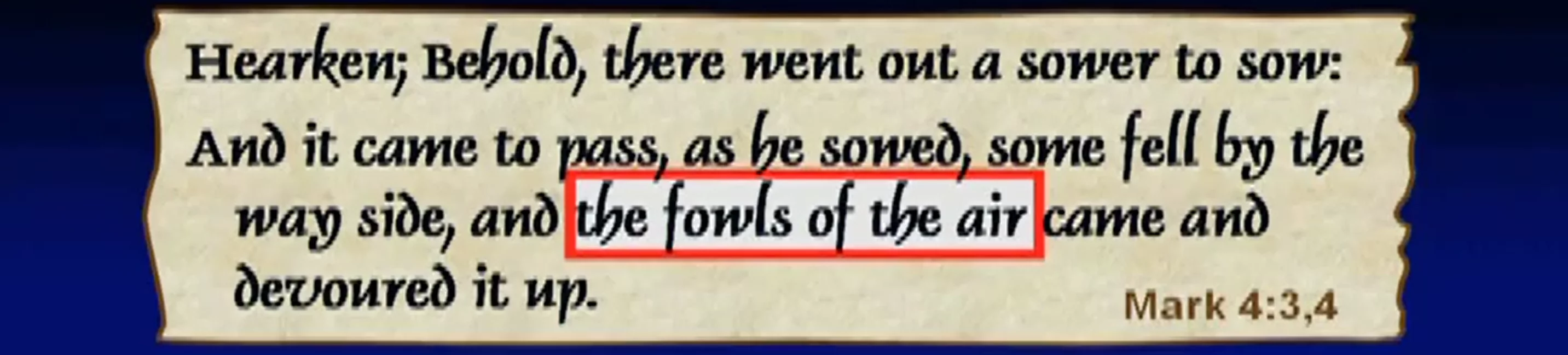
Mark 4:3-4
- We are going to discover there are 4 soils that the sower is going to sow the seed on
- This is the 1st soil: “by the way side” (“beside the road” NASB)
- The Hard Heart: vv. 4, 15 (Mark 4:14-15 sent to TS)
- “…fowls of the air”: The Hard Heart resists the Word of God, making it easy for Satan (the birds) to snatch it away
- Hard hearts must be plowed up before they can receive the seed and this can be painful
— “For thus says the LORD to the men of Judah and to Jerusalem, “Break up your fallow ground, And do not sow among thorns.” (Jer 4:3 NASB)
— “…Break up your fallow ground…” (Hos 10:12)
Mark 4:5-6
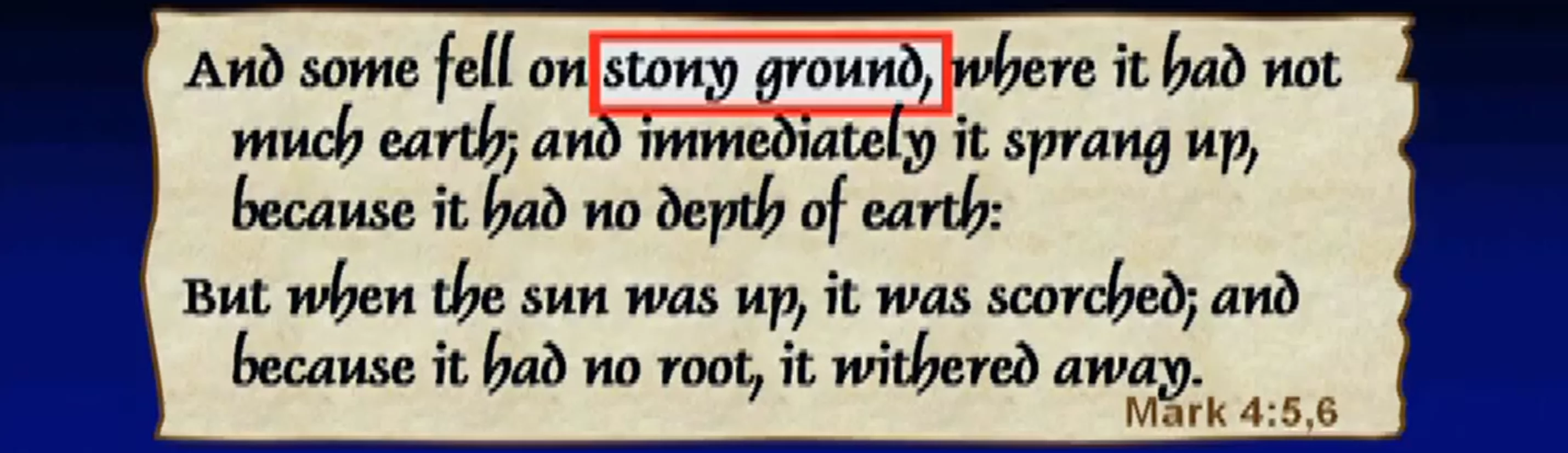
- This is the 2nd of the 4 soils: “stony ground” (“rocky ground” NASB)
- The Shallow Heart: vv. 5-6, 16-17
- “…stony ground”: Having no depth, nothing can last without roots
- Shallow hearts are the emotional hearers, not realizing the cost to be genuine. Always chasing the next “experience”
Mark 4:7

- The 3rd of the 4 soils: “among thorns”
- The Crowded Heart: vv. 7, 18-19
- “…among thorns”: Those who do not truly repent and remove the weeds: the worldly cares and the lust for things
- The careful farmer is commanded to “break up the fallow ground, and sow not among thorns” (Cf. Jer 4:3, Hos 10:12)
Mark 4:8
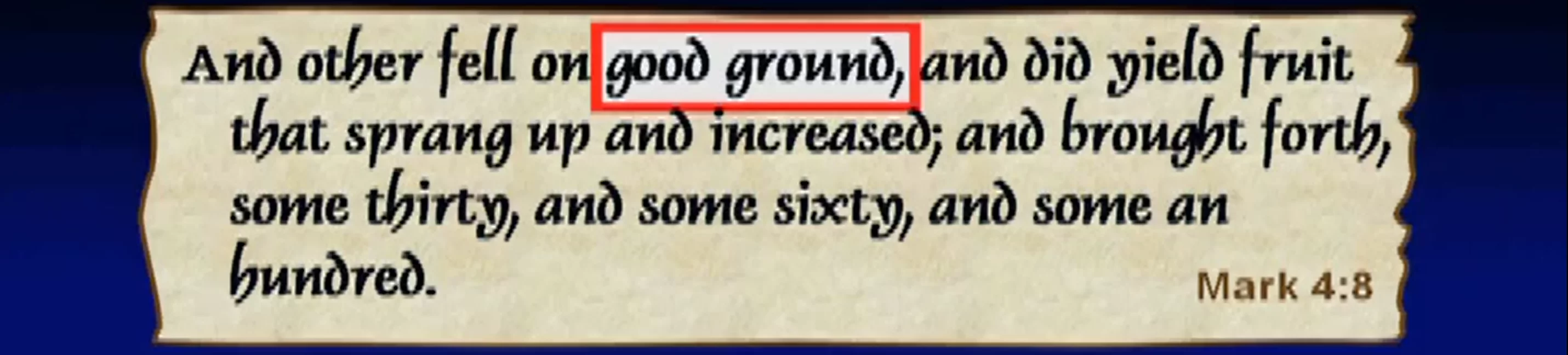
- Finally, and fortunately, the 4th soil: “good ground” (“good soil” NASB)
- The Fruitful Heart: vv. 8, 20
- “…good ground”: The true believer evidenced by a changed life
— “Therefore if anyone is in Christ, he is a new creature; the old things passed away; behold, new things have come.” (2 Cor 5:17 NASB)
— “Now the deeds of the flesh are evident, which are: immorality, impurity, sensuality, 20 idolatry, sorcery, enmities, strife, jealousy, outbursts of anger, disputes, dissensions, factions, 21 envying, drunkenness, carousing, and things like these, of which I forewarn you, just as I have forewarned you, that those who practice such things will not inherit the kingdom of God.
22 But the fruit of the Spirit is love, joy, peace, patience, kindness, goodness, faithfulness, 23 gentleness, self-control; against such things there is no law.” (Gal 5:19-23)
- The life should show some changes for the ones who are born again. That is not why they are saved, but it is a byproduct of being saved
- It’s interesting that “good ground” bore fruit, but not all equally, some more than others, some less
Mark 4:9

- This phrase is a marker of some kind. Besides in 7 Letters to 7 Churches, it appears 7 other times in the Gospels
- [A key phrase with strategic significance (what might be dubbed a Remez (hint of something deeper): Cf. v. 23)]
Mark 4:10

- They are not in public now, they are in private, and disciples are asking for an explanation
Mark 4:11
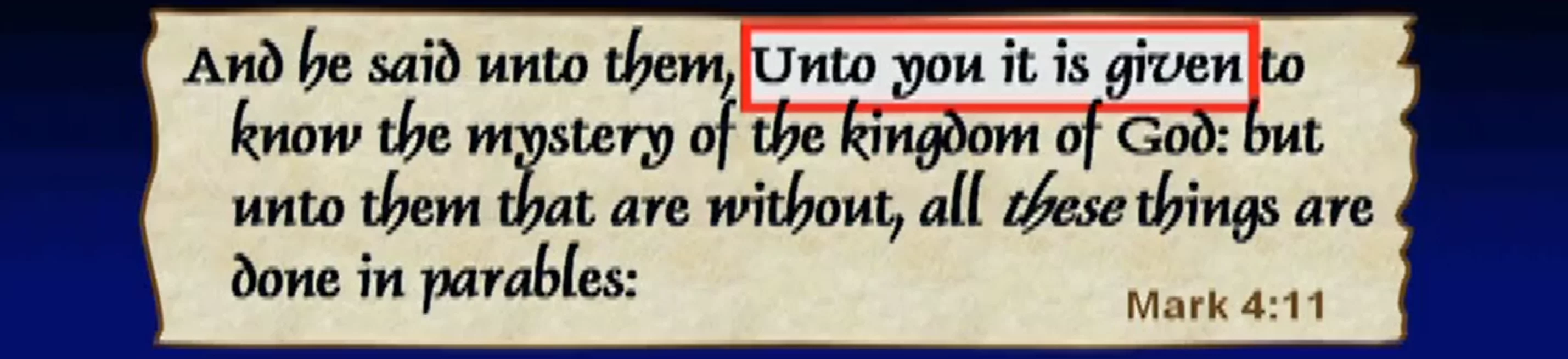
- If you are in the Kingdom, He lets you know what’s going on. If you are outside the Kingdom, He doesn’t
- There are some Christian groups that argue that the Gospels are not for the Christian, but for the Jew. That the only thing that pertains to Christians are the epistles. That perspective could be labeled hyper-dispensationalism. Actually, this is an example that there is some material that is not for the non-believer and yet “unto you”, that is His disciples, it is given. Disciples are part of the Church.
— Paul tells us in Rom 15:4: “…whatsoever things were written aforetime were written for our learning, that we through patience and comfort of the scriptures might have hope.”
— No one should partition the Word of God and say “this isn’t for you”. We believe in whole counsel of God (Acts 20:27: “For I did not shrink from declaring to you the whole purpose of God.” NASB)
— In 2 Tim 3:16, Paul says:
- “All Scripture is God-breathed and profitable for teaching, for reproof, for correction, for training in righteousness,” LSB
- “All Scripture is inspired by God and profitable for teaching, for reproof, for correction, for training in righteousness;” NASB
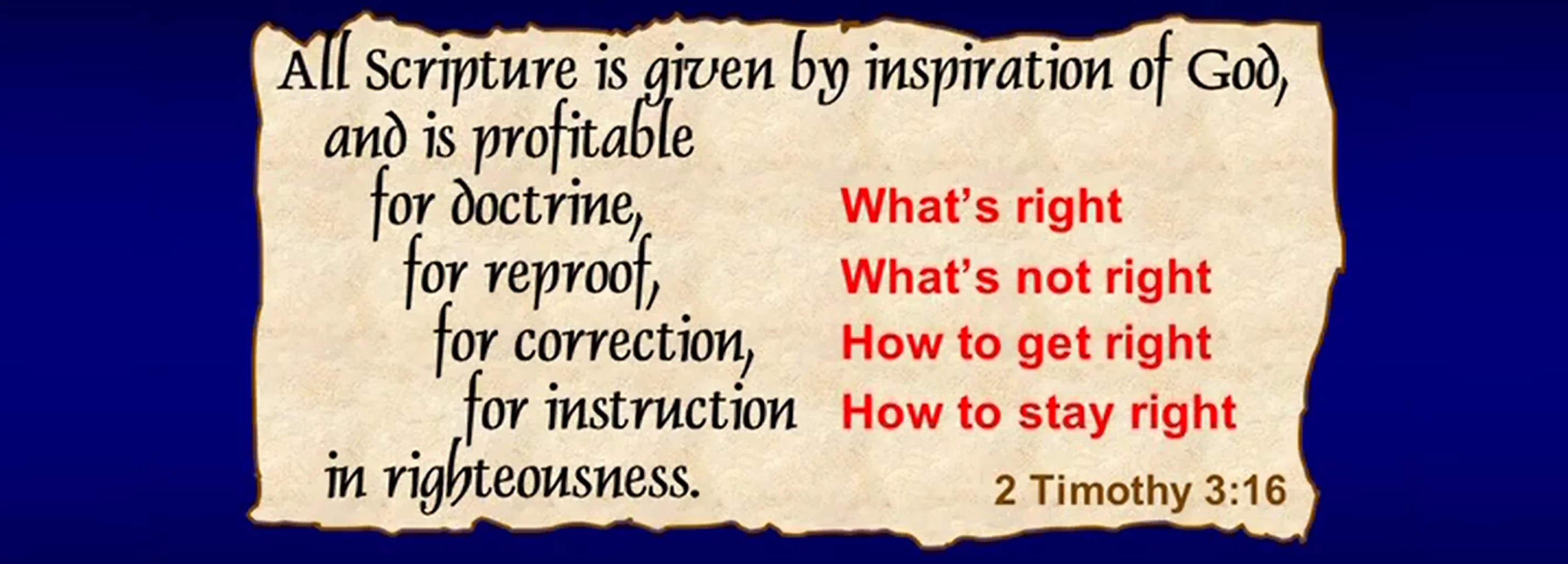
- “All scripture is given by inspiration of God, and is profitable for doctrine, for reproof, for correction, for instruction in righteousness:” KJV
- Doctrine (teaching) → What is right
- Reproof → What is NOT right
- Correction → How to get right
- Instruction (training) → How to stay right
- There are things here (in the Gospels) that are specifically targeted to Jesus’s own (disciples)
- To the unbelieving public, it was not given
- However, why was it given to disciples? — obviously so it would bear fruit
Mark 4:12
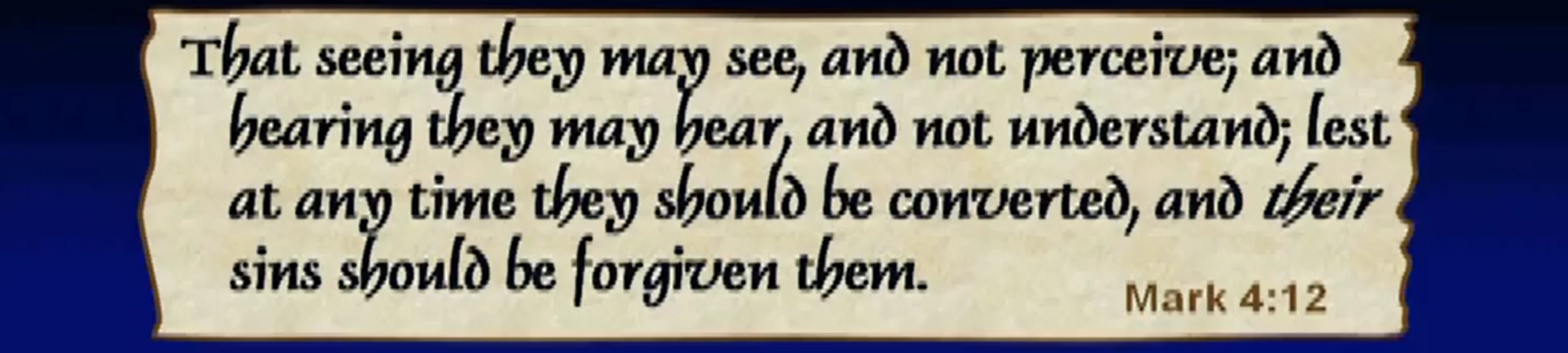
→ Isa 42:18-20

→ Isa 6:9-10
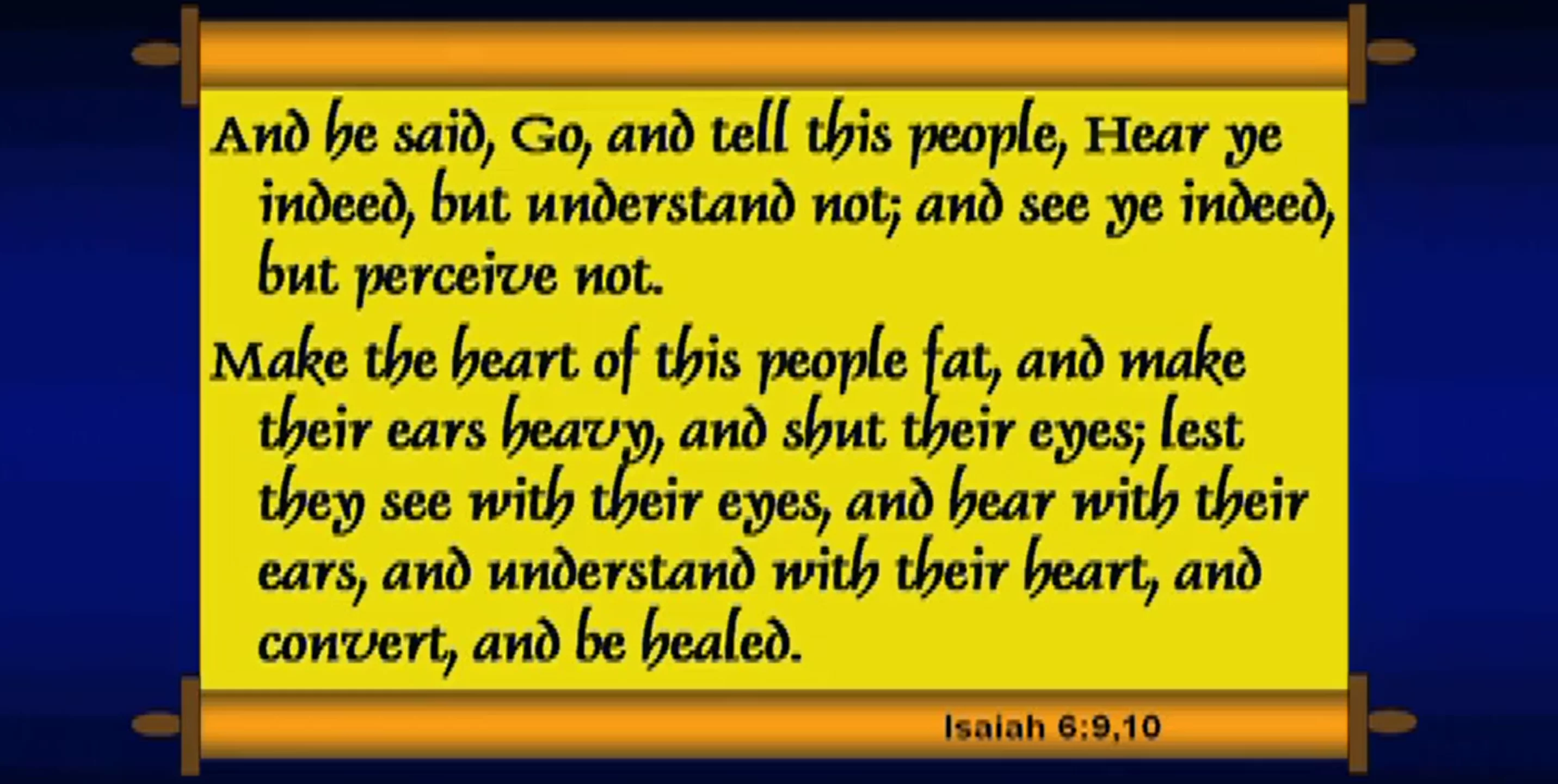
- Sins of abandonment (Chuck inaudible). That’s one of the judgments of God — when He backs away
Mark 4:13-14 The Parable of the Sower Explained

- Jesus’ interpretation: the seed = the Word. [These idioms are consistent within the seven parables…]
- Symbolism doesn’t change (the principle of expositional constancy) — when the Holy Spirit adopts an idiom (metaphor), it is used consistently throughout the text, in this case throughout parables
Mark 4:15
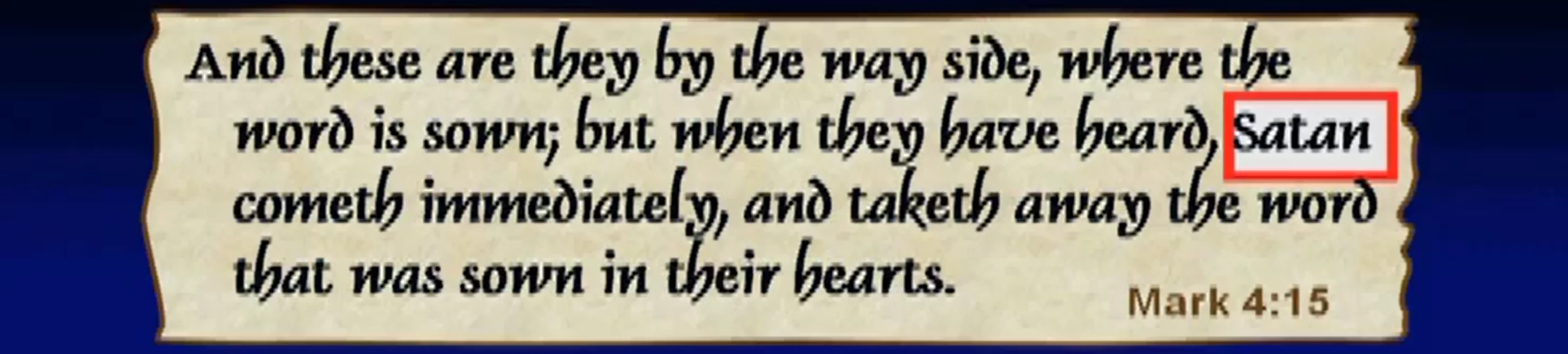
- “…Satan”: The birds are the ministers of Satan (Judas Iscariot must have been standing right there during this presentation…)
- There are always birds in the branches:
— Judas among the disciples
— Ananias and Sapphira in the Jerusalem church (Acts 5:1-11)
— Simon Magus in the church in Samaria (Acts 8:9-24)
— Satan’s ministers boldly invaded the Corinthian church (2 Cor 11:13-15)
- The bigger the net, the greater the possibility of catching both good and bad fish (Matt 13:47-50)
- If you are looking for false teachers, don’t overlook the pulpits
Mark 4:16-17
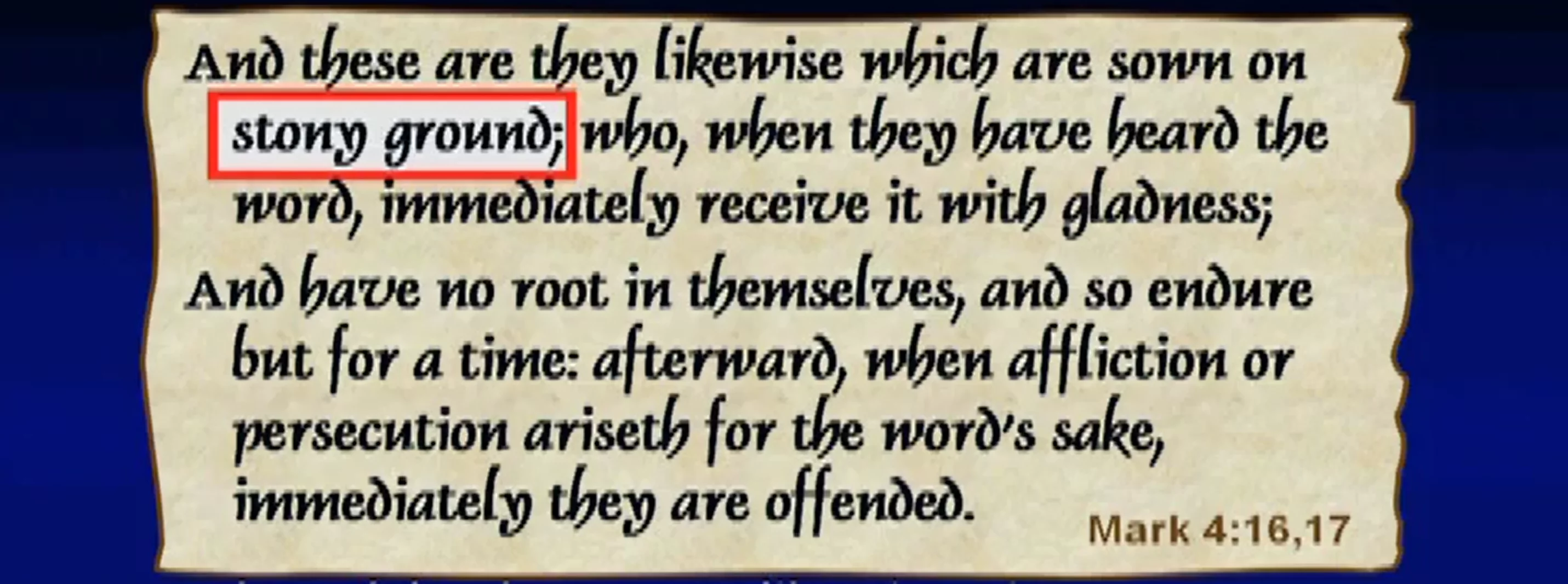
- “…stony ground”: Impulsive hearers without roots…
- How tragic that is — some people are so quick to pick up on it, and yet so superficial, so shallow, even fickle
- “they are offended” KJV; “they fall away” NASB; “they are caused to stumble” NASB lit note
- You need roots. And you get roots by digging into the Word. Not just reading it devotionally
Mark 4:18-19
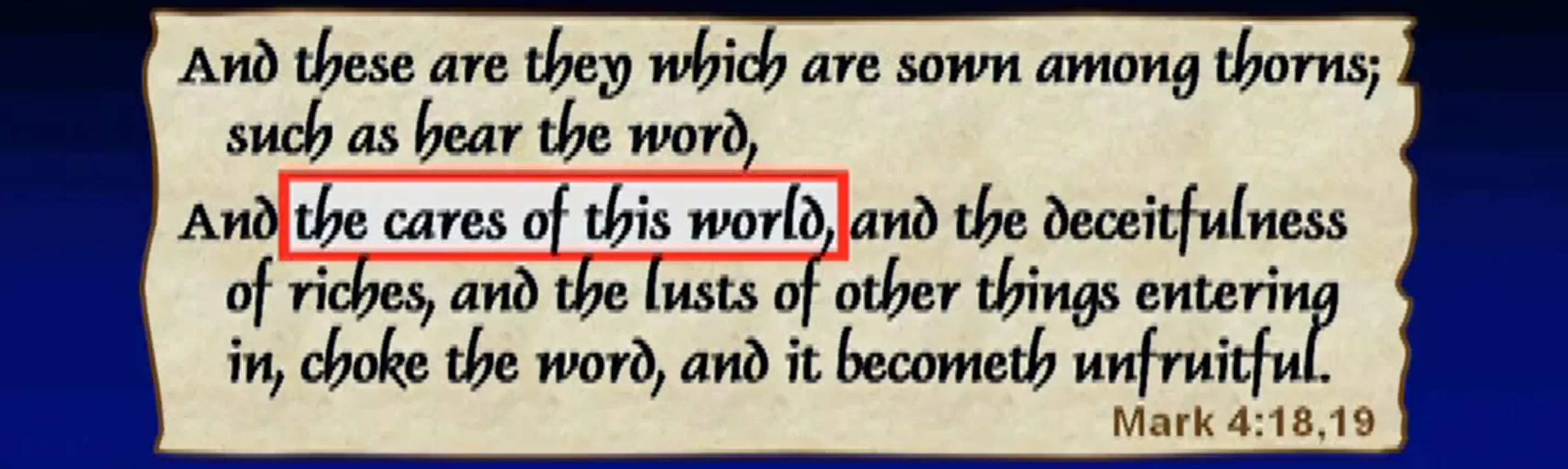
- There are many of us like that — we hear it, we get excited maybe for a while, but “the cares of this world”, the pressures of business, the career, the family etc, “the deceitfulness of riches, and the lusts of other things entering in, choke the Word”, squeeze it out, it loses priority “and it becomes unfruitful”
Mark 4:20
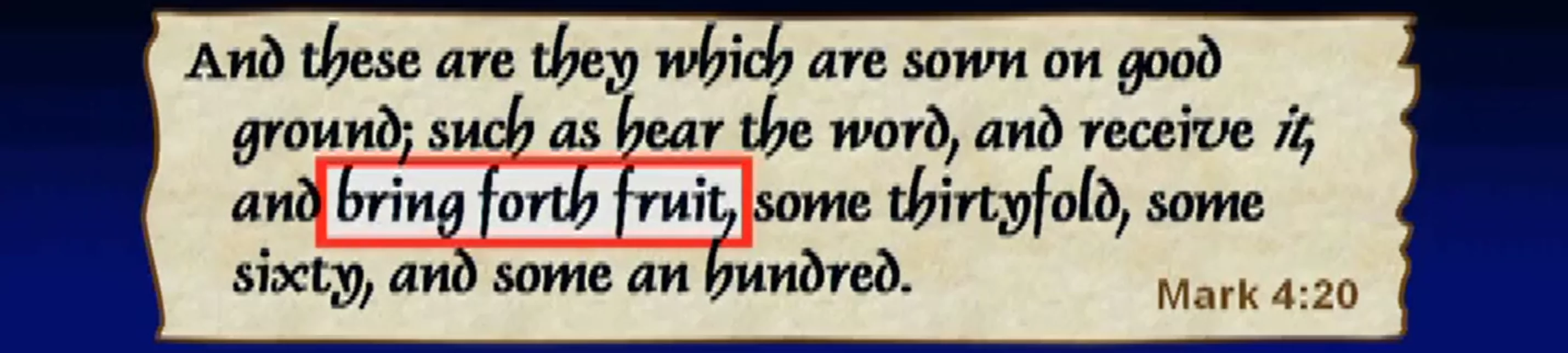
- “…bring forth fruit”: That’s really what it’s all about
- There are specific forces that fight against the seed-bearing fruit:
— The devil snatches the seed from hard hearts (vv. 4, 15)
— The flesh produces a temporary response in shallow hearts (vv. 5–6, 16–17)
— The world smothers the growth in crowded hearts (vv. 7, 18–19)
- The good ground represents the prepared heart that receives the seed and produces a harvest in varying degrees: “fruit . . . more fruit . . . much fruit” (John 15:1–8)

- Four soils ► four different hearts ► four different results:
— The Hard Heart (vv. 4, 15) resists the Word of God, making it easy for Satan (the birds) to snatch it away. Hard hearts must be plowed up before they can receive the seed and this can be painful
— The Shallow Heart (vv. 5-6, 16-17). Having no depth, nothing can last without roots. The emotional hearer, not realizing the cost to be genuine. Always chasing the next “experience”
— The Crowded Heart (vv. 7, 18-19). The one who does not truly repent and remove the weeds: the worldly cares and the lust for things. The question of priorities
— The Fruitful Heart (vv. 8, 20). The true believer evidenced by a changed life
- Each of the first three represent a different enemy:
– In the Hard Heart, the devil snatches the seed
– In the Shallow Heart, the flesh produces counterfeits
– In the Crowded Heart, the things of the world smother the growth and prevent a harvest
- These are the great three: the world, the flesh, and the devil (Eph 2:1-3)
- It is significant that three-fourths of the hearts did not produce fruit (they were never truly born again), and the hearts that were fruitful did not all produce “a hundredfold” (different fruitfulness → non-equality in Heaven)
- As we sow the seed in our preaching, teaching and witnessing, we must not become discouraged (Gal 6:9, Ps 126:5–6) for God will use His Word as He sees fit, and it will not be wasted (Isa 55:8–11)
- Neither should we become elated over a false growth (Mark 4:30–34 Parable of the Mustard Seed)
— A mustard seed is tiny but, when grown, produces a large shrub, not a tree. There is the suggestion here that Satan (the birds in the tree, v. 15) will encourage a false growth that will give opportunity for the enemy to work
— In Scripture, a large tree can symbolize a great worldly kingdom (Ezek 17:22–24, Ezek 31:3–9, Dan 4:20–22)
- Who is the “Sower”? Jesus, of course. Except, of course, He is also sending us:
— “As my Father hath sent me, even so send I you” (John 20:21)
— We need to sow abundantly: “But this I say, He which soweth sparingly shall reap also sparingly; and he which soweth bountifully shall reap also bountifully.” (2 Cor 9:6)
— We need to sow passionately: “He that goeth forth and weepeth, bearing precious seed, shall doubtless come again with rejoicing, bringing his sheaves with him.” (Ps 126:6)
— We need to sow patiently: “And let us not be weary in well doing: for in due season we shall reap, if we faint not.” (Gal 6:9)

Mark 4:21

Mark 4:22

Mark 4:23

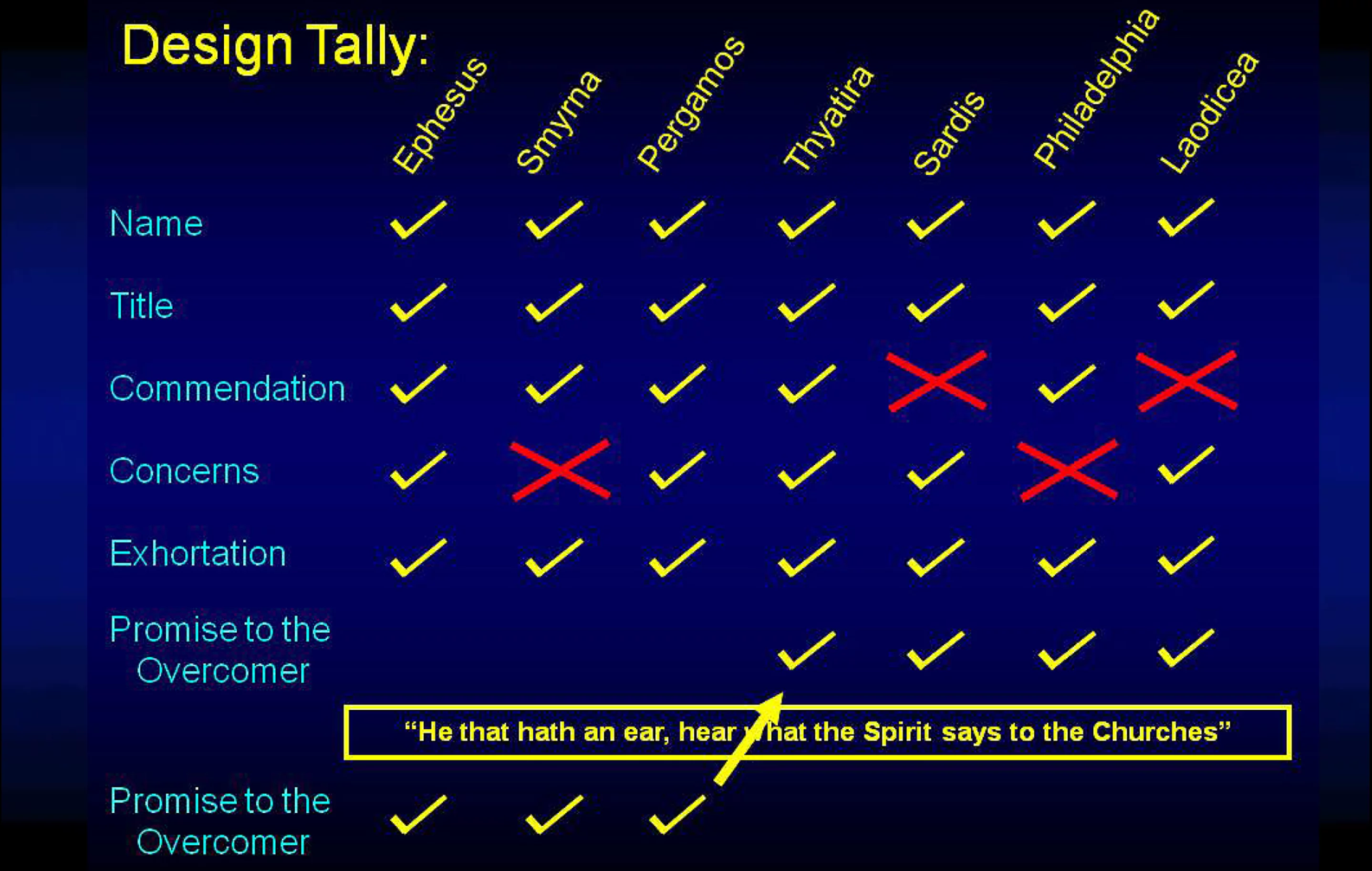
- “…ears to hear, let him hear”: This strange phrase occurs seven times in addition to being the “closing phrase” in Jesus’ letters to 7 churches in Revelation 2 & Revelation 3 (Jesus’ own epistles)
Mark 4:24
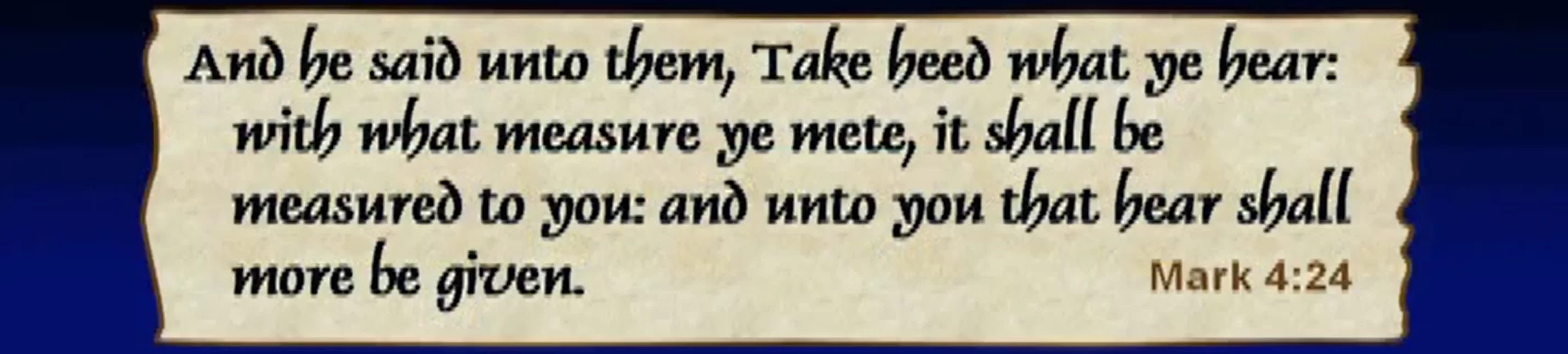
Mark 4:25

- What on earth does that mean? Taken out of context, this sounds like a doubletalk, doesn’t it
- The Lord gives you some truth and sees how you receive it and what you do with it. That will determine the next step… If you use it diligently, you’ll receive more
- The word “hear” is used 13 times in this chapter and refers to the receiving of God’s truth into the inner person, just the way soil receives the seed (not a surface thing, but inside thing)
- We must be careful how we hear (Luke 8:18) and what we hear (v. 24) → for this determines what we have to share with others
- We do not receive the Word so we can enjoy it by ourselves. We receive that we might share, just as a lamp gives itself to provide light for the house (cf. Matt 5:15–16, Luke 11:33–36)
- Many people come to these Bible study conferences and at home, they hoard bookshelves full of notes. They never share what they’ve learnt with others. They only receive. They don’t use it, spread it, share it…
- There are two seas in the Bible (in the land of Israel):
— Symbol of fruitfulness: Sea of Galilee up north, fed by the Jordan river, and around it is all the agricultural abundance one can imagine
— Symbol of death: Dead sea receives and receives and receives… but ain’t going anywhere

Mark 4:26-28 The Parable of the Seed
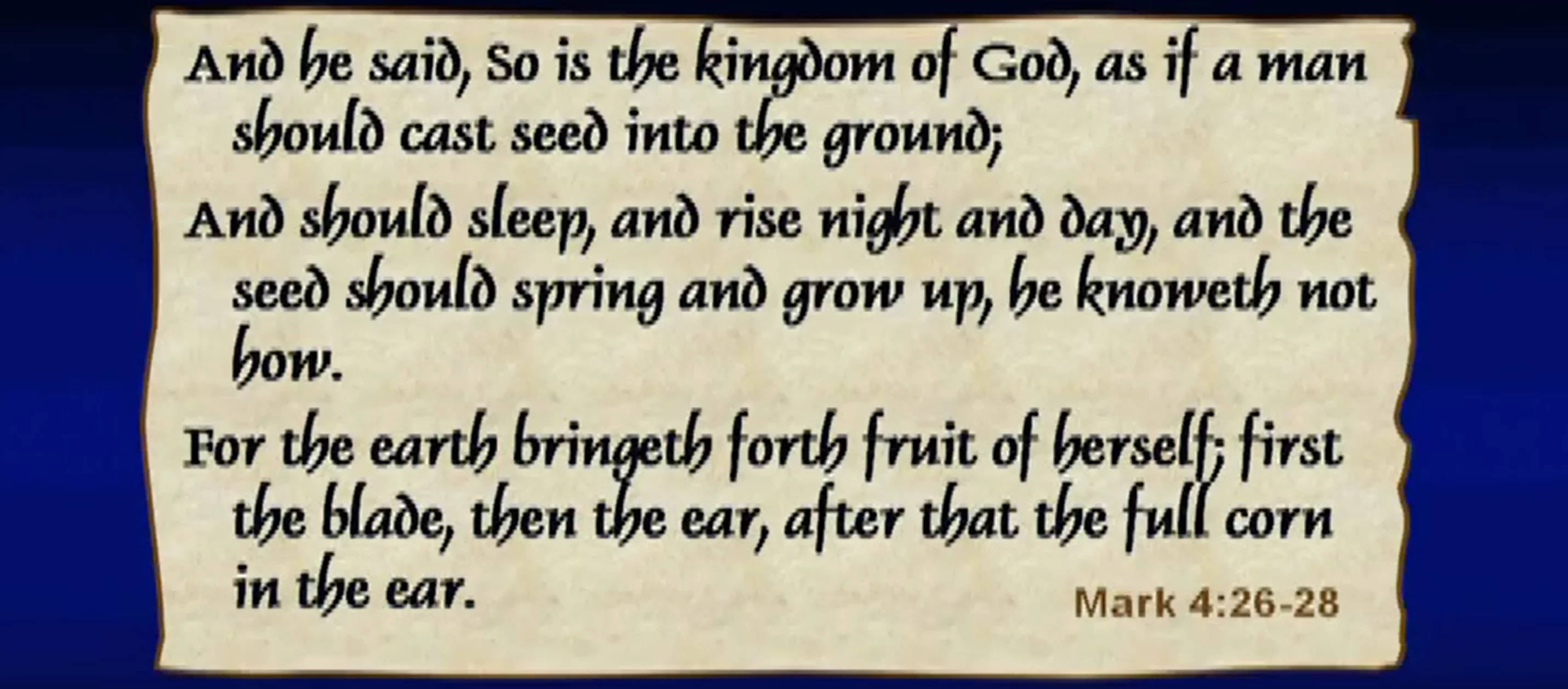
- Man plants the seed, but God gives the increase. God provides growth. We don’t do anything
- [Men do not suddenly become mature saints. “Grow in grace,” etc.]
Mark 4:29

- This parable can be summarized in four words:
1) sowing, v. 26
2) sleeping, v. 27
3) growing, v. 28 and
4) reaping, v. 29
- All we can do is sow the seed. God alone can give the increase
— “I have planted, Apollos watered; but God gave the increase. 7 So then neither is he that planteth any thing, neither he that watereth; but God that giveth the increase.” (1 Cor 3:6–7)
- We cannot make the seed grow. In fact, we do not fully understand how the seed grows. Our task is to sow the seed and be alert when the harvest is ready (John 4:35–38)
- While sleeping is sometimes a picture of sin (Rom 13:11–14, 1 Thes 5:1–11 The Day of the Lord), here it simply reminds us that hard-working people need their rest (see Mark 6:31)
- If workers do not take care of themselves, they cannot do the work God has called them to do. We need to take care of ourselves
— An anecdote about Charles Spurgeon on a train involves him responding to a preacher who criticized him for traveling first class. The preacher said, "I'm traveling third class, saving the Lord's money", to which Spurgeon replied, "I'm traveling first class, saving the Lord's servant". This story highlights Spurgeon's belief that it was important to care for himself to better serve others, rather than making unnecessary sacrifices that could impact his ability to minister

Mark 4:30-32 The Parable of the Mustard Seed
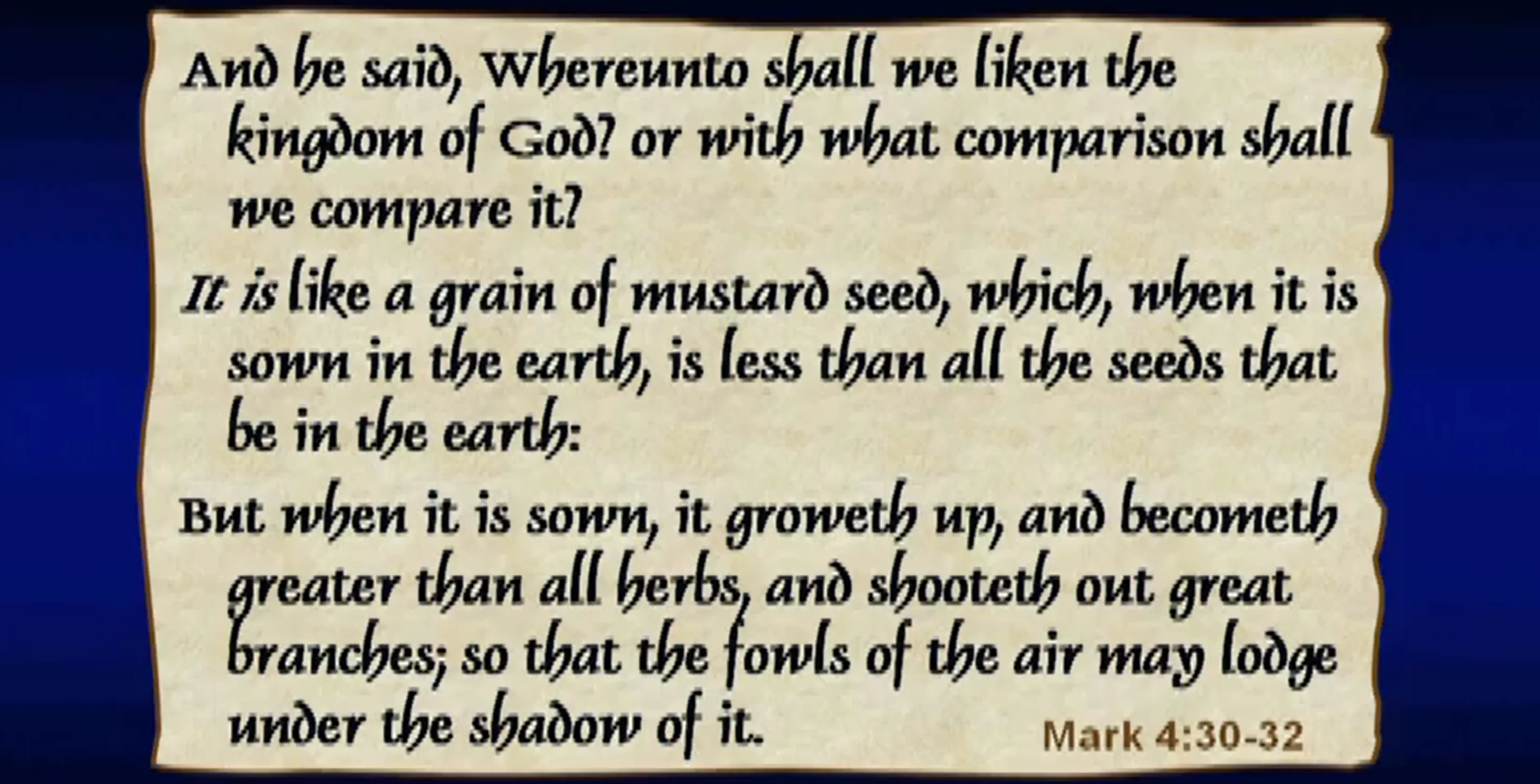
- Mark’s account of Muster Seed is an echo of Mathew’s account (Matt 13:31-32)
- Mustard seed grows into a tree, but it’s not supposed to. This one did. That’s part of the point
- Are these the same “fowls of the air” that stole the seed in v.4?
— Fowls of the air = emissaries of Satan… (don’t go shoot birds because of this. This is just an idiom)
- The Mustard bush (tree?) is an imitation of a great world-power:
— The cedar tree of Assyria (Ezek 31:3-6)
— The great tree of Babylon (Dan 4:10-12)
Mark 4:33-34
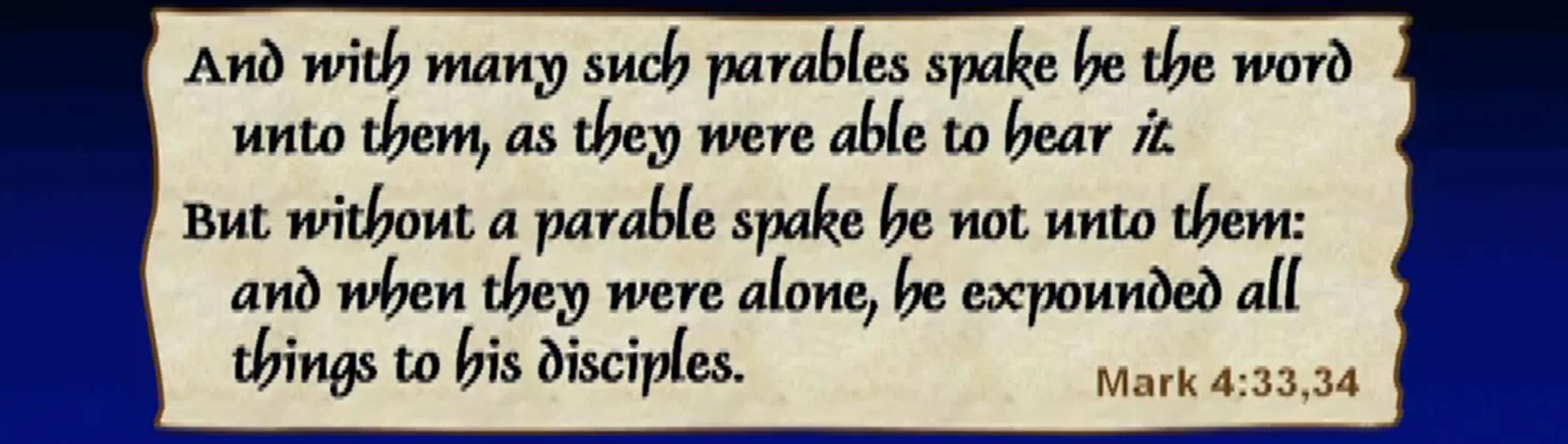
- Matthew’s account is more detailed in a sense that includes a total of seven parables. (He took them down in shorthand…)
- “…without a parable spake he not unto them”: This is astonishing — He only spoke in public with parables (this occurs after they accused Him of the unpardonable sin), explaining it only to His disciples in private
- The turning point in Mark is Mark 3 (equivalent to Matthew 12), when they ascribed His actions to Satan…
- Review:
a) The Seven Letters to Seven Churches
b) Matthew 13
c) Paul’s Letters (Epistles) to Seven Churches
The 7 Letters of Jesus Christ to 7 Churches
- Every element in each of those letters has a purpose (eg the name of the church turns out to be significant to its purpose, the title Jesus selects from the 24 titles that are in chapter 1)
- Commendation — that which you did good
- Concerns — those things that you are NOT doing so good
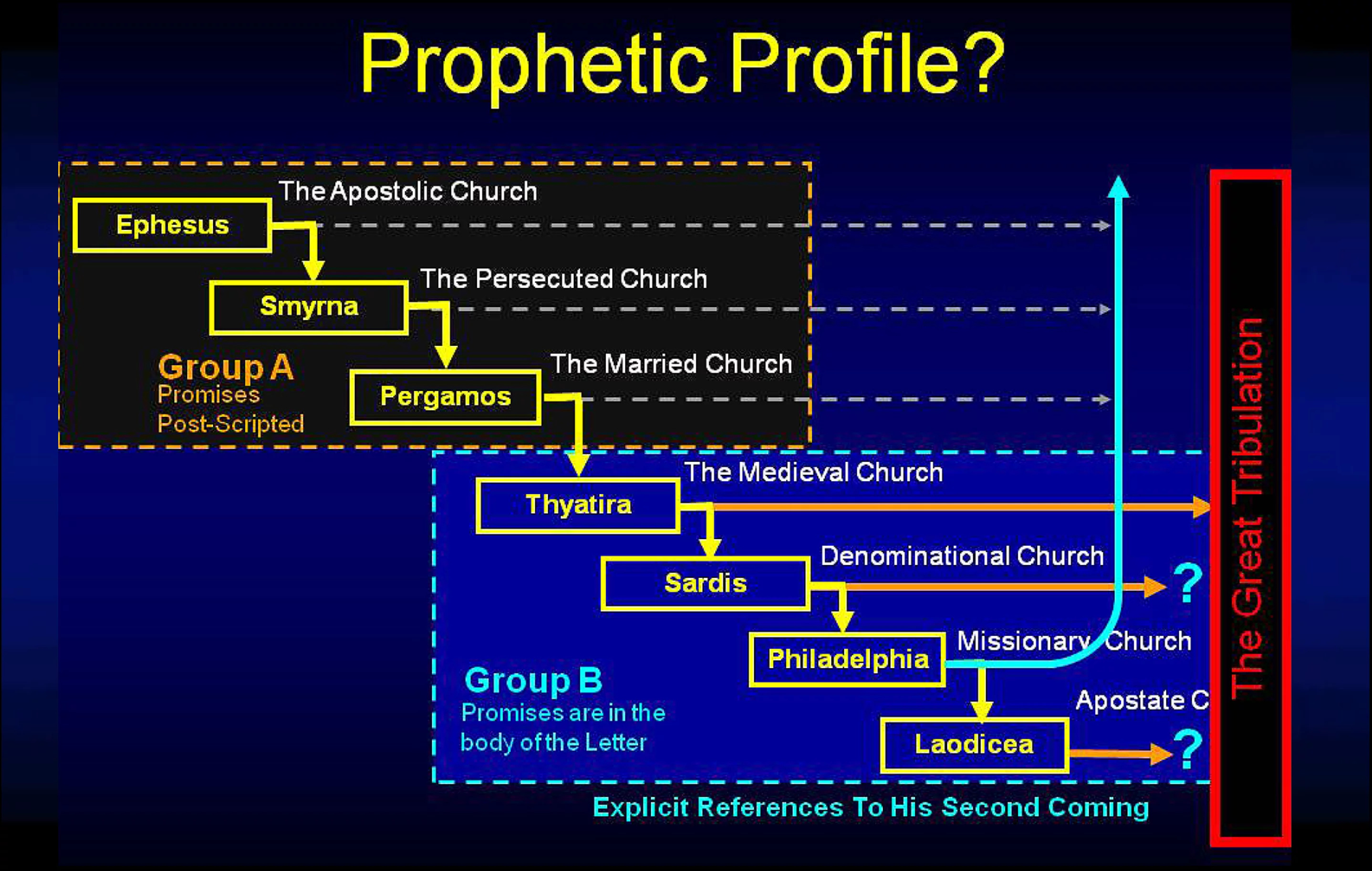
Prophetic overcast
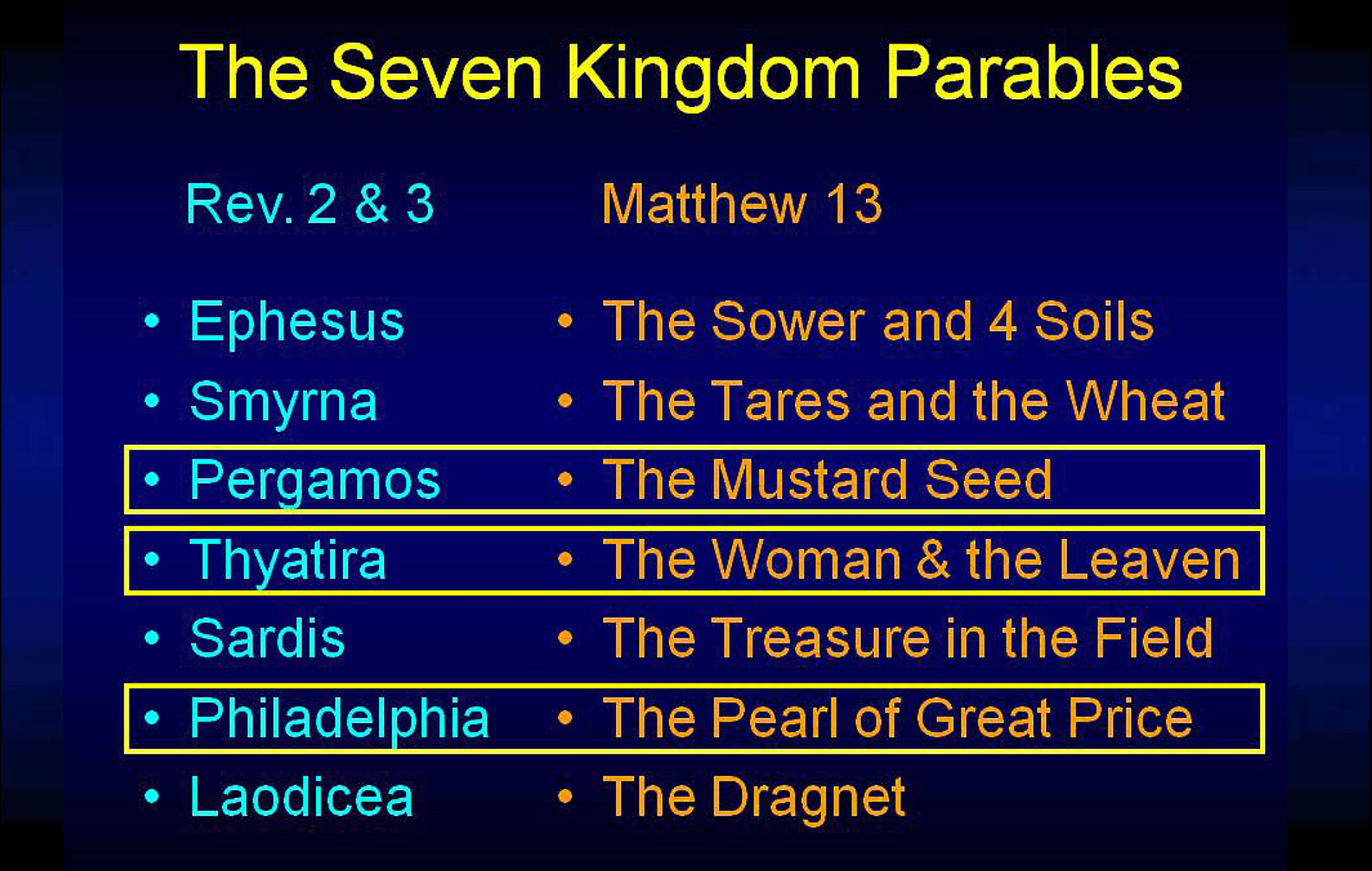
7 Kingdom Parables of Matthew 13 (see also Matthew note s09)
- Parables match up with Christ’s 7 Letters
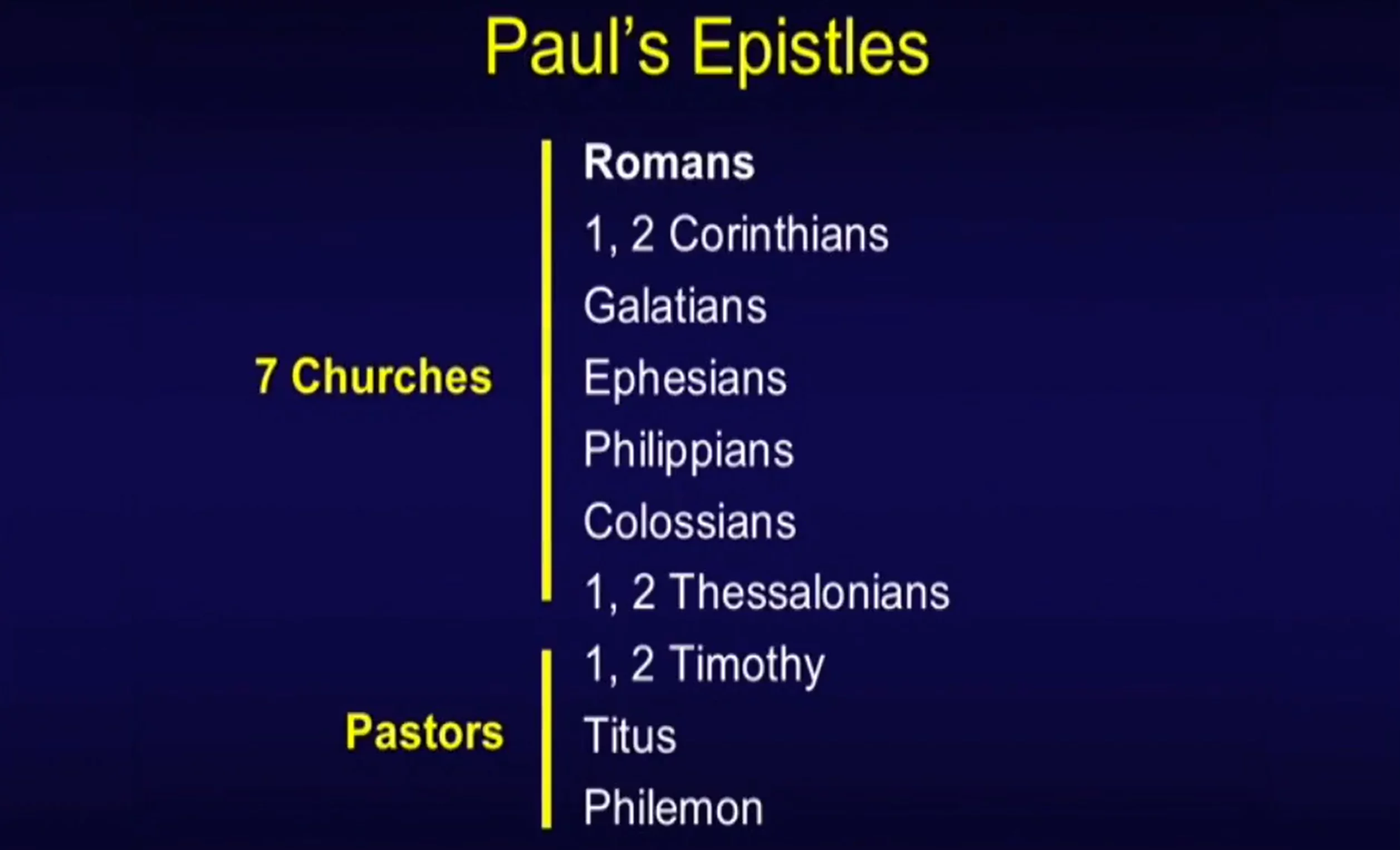
Paul’s epistles to the 7 churches (content taken from Matthew 13 note s09)
- We can ignore Hebrews because Paul did not sign it for some very good reasons
- 3 of the epistles are written to pastors
- Thus, out of 10 addressees, there are 7 churches!
Let’s try to match 7 churches of Jesus to Paul’s church epistles:
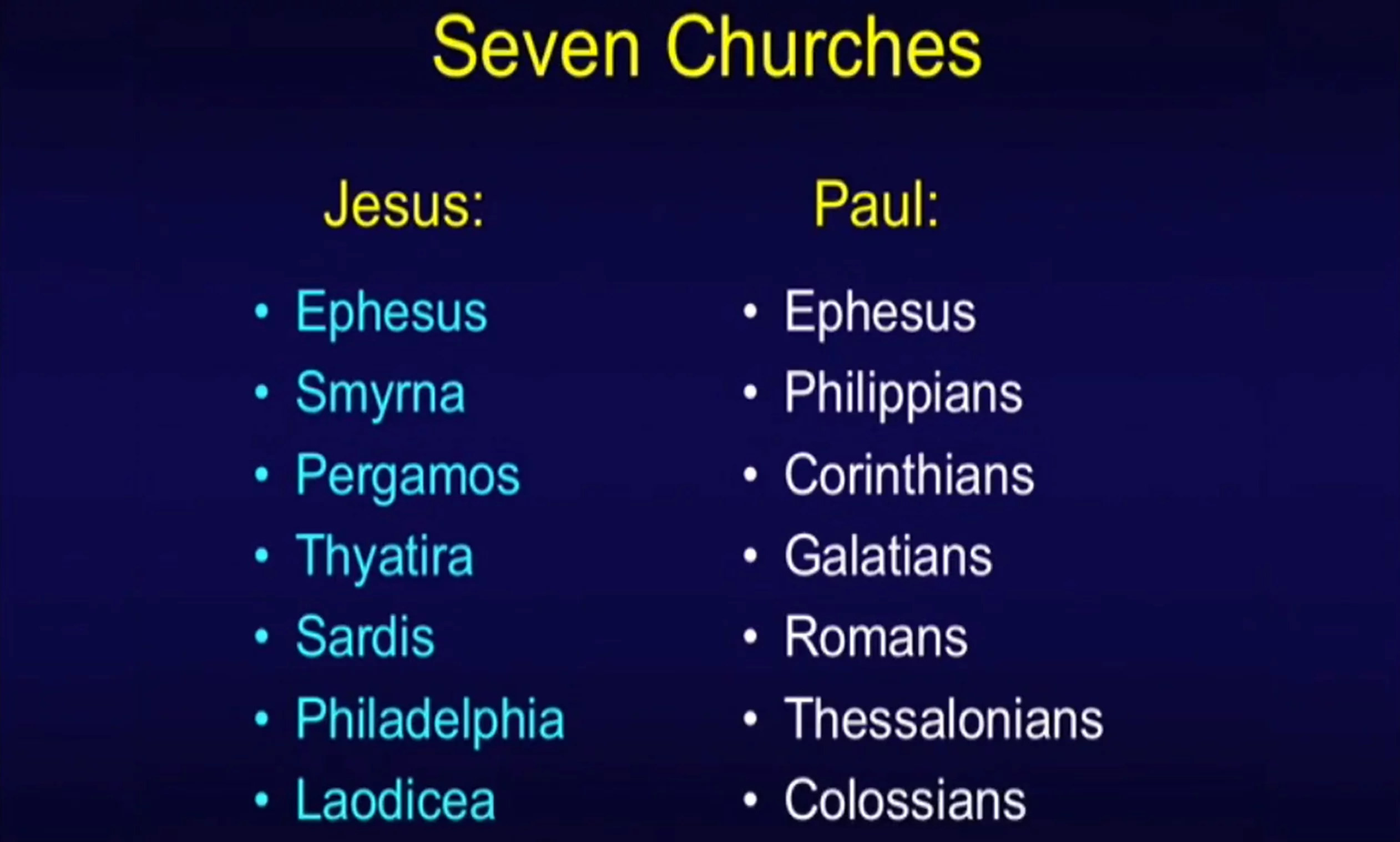
- Ephesus is pretty straightforward
- Philippians is a letter that speaks of joy thru suffering
- Corinthians is a letter that is written to the worldly church. By a figure of speech, an adulterer was called “a Corinthian”. That was synonymous with a fornicator
- Original name for Thyatira was Semiramis. Galatians is suggested as a match
- Romans is suggested as a match for Sardis
- Philadelphia is the Rapture church, so Thessalonians of course
- That leaves Colossians as a match for Laodicea. There are phrases in Greek that appear only in Laodicea and Colossians (certain figures of speech). Also Colossae (sometimes Colosse - an ancient city of Phrygia) was 1mi from Laodicea and they were instructed to exchange letters
Paul was a practical guy, writing practical letters, trying to put out fires and address practical problems churches were facing, so these parallels are another fingerprint of the Holy Spirit.
12 Kingdom Parables in the Gospel of Matthew
- Matthew has additional 5 parables, so it actually contains 12 Kingdom Parables
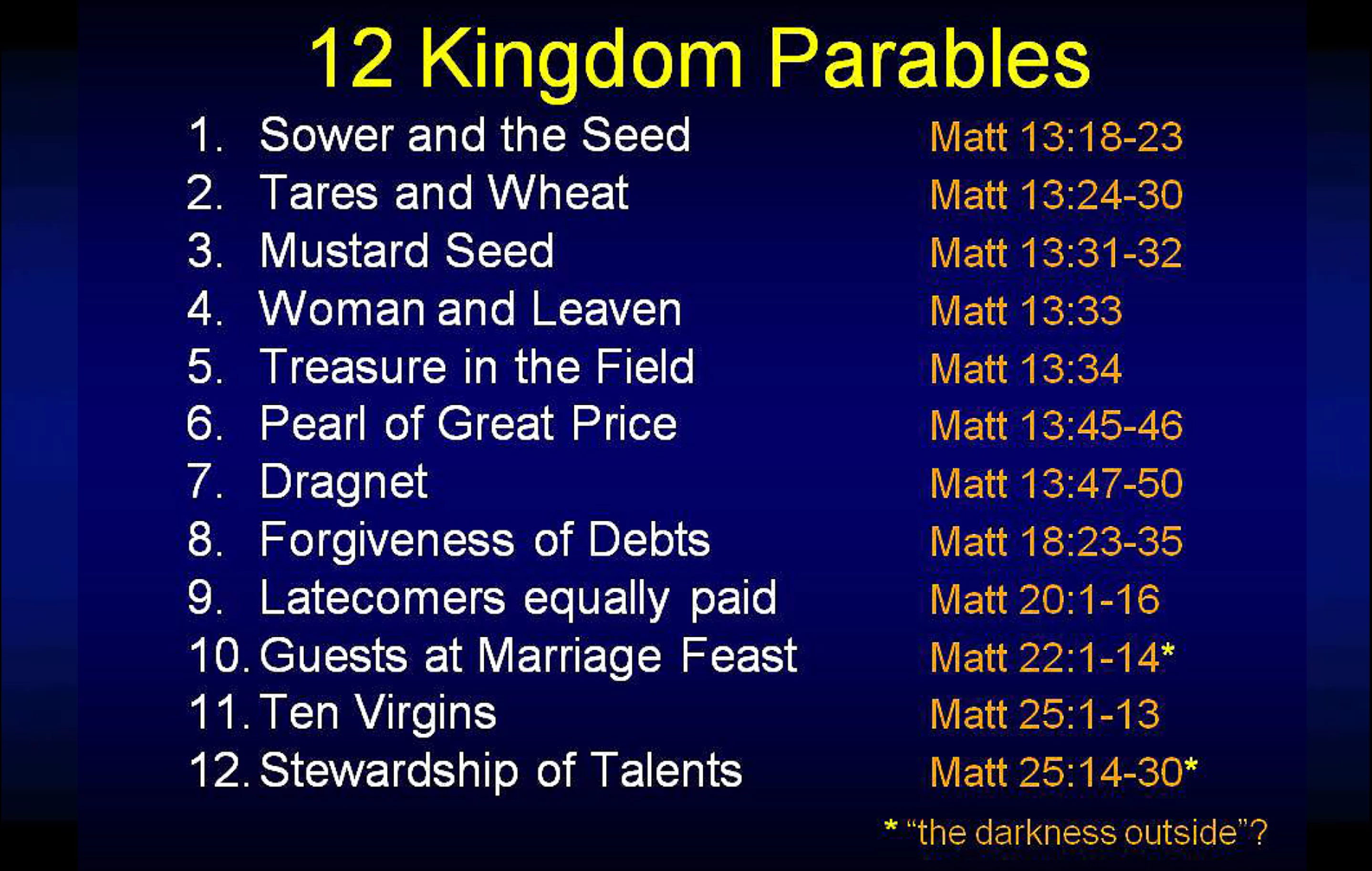
- Kingdom of Heaven is the entire God’s domain
- Kingdom from Heaven is earthly Kingdom

- 12 Tribes
- 12 Apostles (ruling over the 12 Tribes) Matt 19:28, Luke 22:30
- 12 Kingdom of Heaven Parables
- 12 Kingdom Mysteries (see notes on Mark s05)
- 12,000 sealed from each of 12 Tribes (Rev 7)
- New Jerusalem (Rev 21):
– 12 gates
– 12 foundation stones
– 12,000 x 12,000 x 12,000 furlongs

- In Jesus’ day this beautiful body of fresh water, 13 miles long and 7.5 miles wide, was dotted with populous towns, such as Capernaum, Bethsaida, Chorazin, Magdala and Tiberias
- The lake abounds in fish, with fishing an important industry (especially in that culture) (Matt 4:18-22, Mark 1:16-20)
- The sunny climate, with health-giving sulphur springs near Tiberias, made it a mecca for the sick and a fruitful scene for Jesus’ healing ministry (Mark 1:32-34)
- The lake lies in a depressed cup 680 feet below sea level and enjoys a healthful semitropical climate
- The Israeli Defense Force is the only air force that must have special altimeters to fly up the Jordan Valley: below sea level. (On our annual Bible study tours to Israel, as we come over the hills of Nazareth and approach the Sea of Galilee, the road signs highlight when we are going below sea level — we always tell our bus passengers to roll up their windows!)
- The lake was often subject to sudden and violent storms as the cold air from snowy Lebanon collided with the warmer air above the lake
- The valley on the NW side, near Magdala, formed by the two prominent mountains: “The Horns of Hattin” which create a Venturi effect that can cause a surprising squall on this relatively small body of water (as we shall note in this chapter)
- Used MS Clipchamp to edit out a video for Viktor: Chuck’s naval experience (cigar-shaped cloud)

Mark 4:35-36 Jesus Stills the Sea / Calms a Storm
- So far they used the ship as a pulpit, but now they will use it to sail across the lake to the other side

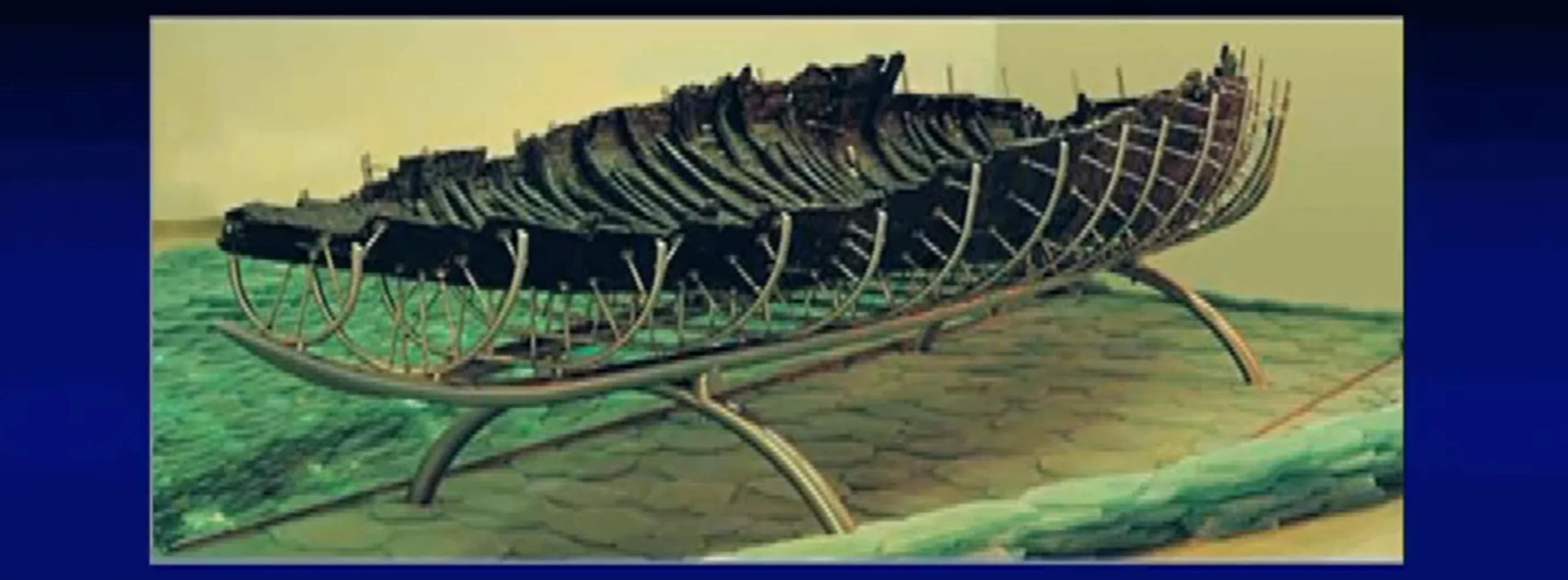
- In 1986 a Roman-era fishing boat was discovered in the mud during a drought when the lake was at a record low
- It was 26 ft long and 7 ft wide, of Lebanese cedar and oak. It was radiocarbon dated 85 B.C. - 15 A.D., and thus appears typical of the Gospel period
- After careful chemical treatments, it has been placed on display in a specially built facility, Yigal Allon Museum, next to Kibbutz Nof Ginosar, since 1995
Mark 4:37-38
- Did Jesus know the storm was coming? — Of course He did
- Can He be trusted in the storms of life?
- These guys were not “landlubbers” (persons unfamiliar with the sea or sailing) unfamiliar with these waters: these were professional fishermen well acquainted with seamanship and the storms characteristic of this area, yet this storm obviously terrified them
- Some scholars (Barnhouse, et al.) believe that this was a supernaturally induced storm (in anticipation of the events of the next chapter?)
- Just as Satan raised the storms that destroyed Job’s property and children, he may have been trying to destroy Christ before He could go to the Cross (or perhaps before He could get to Gadara — I don’t think this was the case as Satan cannot see the future. Cross, he could figure out from the Scripture, but not Gadara)
Mark 4:39

- “Rebuked” — The Greek verb φιμόω (phimoo) comes from the phimos, for muzzle: “Be muzzled!”
[There was even more “muzzling” to come on the approaching shore! (at Gadara)]
- The term implies it happened suddenly
Mark 4:40-41
- “What manner of man is this, that even the wind and the sea obey him?” — Indeed!
- Jesus completed the lesson and then gave His disciples an unexpected examination!
- They had listened to the Word of God, and that Word should have increased their faith
— “So then faith cometh by hearing, and hearing by the word of God.” (Rom 10:17)
- Alas, they failed the test! It is not unusual for terrible storms to come suddenly on the Sea of Galilee, although this one may have been satanic in origin
— The word “rebuked” in v. 39 is the same word Jesus used when dealing with the demons (Mark 1:25)
— Perhaps the enemy was trying to keep Jesus from arriving at Gadara, where He would deliver two demoniacs from Satan’s power (again, I don’t think this was the case as Satan cannot see the future. Cross, he could figure out from the Scripture, but not Gadara)
- “With Christ in the vessel, you can smile at the storm” — if your faith is in Him and Him alone
- They’re getting the message…
“He was crucified on a cross of wood, yet He made the hill on which it stood!”
- The storms of life can come suddenly; but none take Him by surprise
- There is no life where sorrow does not come. However, earth has no sorrow that heaven cannot heal
- These storms can come for several reasons. Our review in Romans listed 10:

- To glorify God (Dan 3:16-18, Dan 3:24-25 the burning fiery furnace)
- Discipline for known sin (Heb 12:5-11, James 4:17, Rom 14:23, 1 John 1:9)
- To prevent us from falling into sin (1 Pet 4:1-2)
- To keep us from Pride. Paul kept from pride by his “thorn in the flesh” (2 Cor 12:7-10) His eyes? (Gal 4:15, Gal 6:11)
- To build faith (1 Pet 1:6-7)
- To cause growth (Rom 5:3-5 tribulation → perseverance → proven character → hope)
- To teach obedience and discipline (Acts 9:15-16, Phil 4:11-13 …for I have learned, in whatsoever state I am, therewith to be content)
- To equip us to comfort others (2 Cor 1:3-4)
- To prove the reality of Christ in us (2 Cor 4:7-11) You don’t know what kind of a pilot you are until emergency land
“It’s the storm that measures the sailor, not the fair weather!”
- For testimony to the angels (Job 1:8, Eph 3:8-11, 1 Pet 1:12) Angels learn God’s will by watching us
[Source: Hal Lindsey, Combat Faith; 3, 4 & 6: Faith in the Night Seasons…]
→ James 1:2-4 (may also use Jas instead of James)
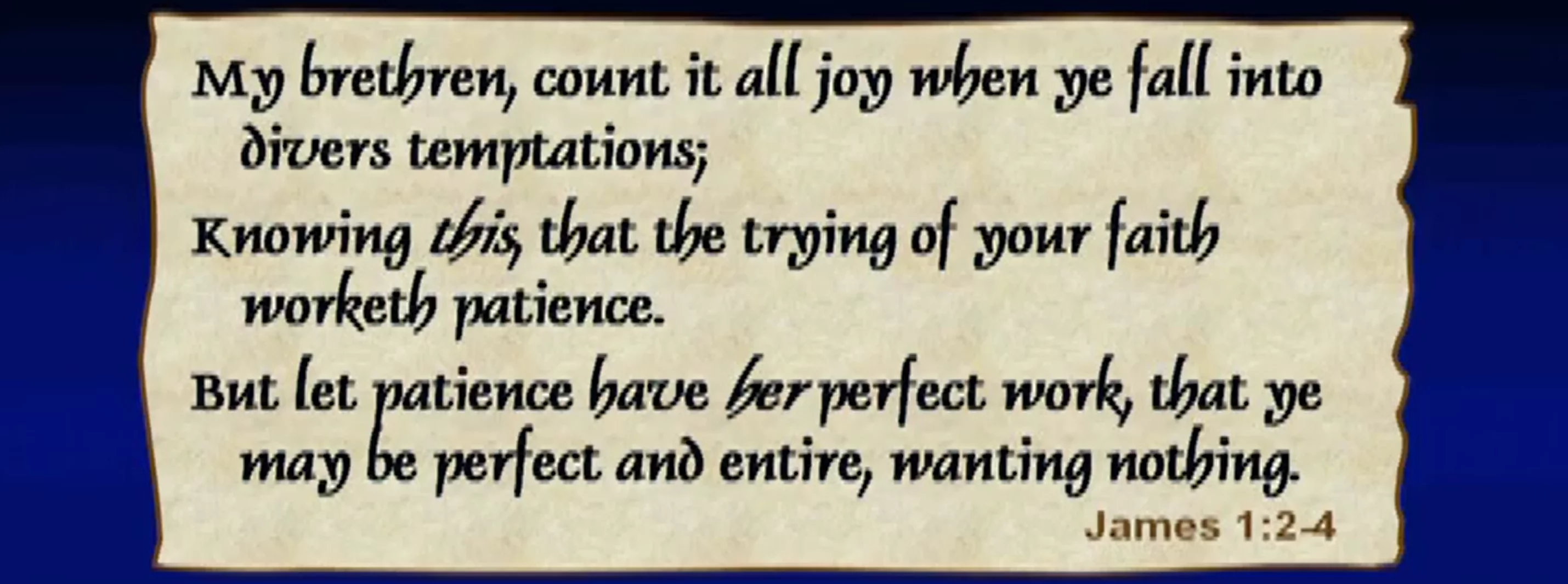
- “…count it all joy…” — a phrase that should always remind us of James 1
- Storms in our lives:
— We can cause the storm ourselves: Jonah did
— The Lord can send one to discipline us (or to train us to help others in their storms…)
— And, of course, they can be produced by Satan, as here in Mark 4
- We should note that the presence of Jesus on the boat did not keep the storm from coming. Yet, fear and faith are mutually exclusive. Faith is taking Jesus at His Word
- What say ye of Christ?
— Do you really understand who He is? (does that result in Him being the primary priority in your life)
— Is there anything more important in your life (then the reality of Jesus Christ)?

- The Case of the Deviled Ham: (a herd of swine. 2,000 of them that are going to go off the cliff)
— Strange event. One of the most provocative in the Bible
— Why did Jesus grant them a permission to do that? They asked for it, and He did grant them
— A glimpse into the Dark Side…
— Do you believe in “demon possession”? Back then? Today?
- Study Mark Chapter 5
