s06 (Ch 6) The Consequences of Unbelief (studied 15-Oct-2025)
The Book of Mark with Dr. Chuck Missler

The subsections of Chapter 6 (per LSB) are:


- The Servant rejected (Servant is one of the titles for our Lord Jesus Christ)
- Opposition develops
- Will anyone trust God’s Servant?
— “Take heed, brethren, lest there be in any of you an evil heart of unbelief, in departing from the living God.” (Heb 3:12 The Peril of Unbelief) (or Peril of Doubting per J. Vernon McGee)
- God takes unbelief seriously. So should we

The Consequences of Unbelief:
► The Unbelief of His Acquaintances (Hometown Neighbors & Family) → Mark 6:1-13
► The Unbelief of His Enemies (Herod Antipas) → Mark 6:14-34
► The Unbelief of His Disciples (5k & Apostles) → Mark 6:35-56
Mark 6:1

- “…his own country” → Nazareth (His hometown where He was raised)
- Psalm 69 yields a glimpse into those unhappy boyhood years… Most people don’t realize that His boyhood days were not happy days

- There is a Psalm which has hints about the silent years of Christ’s childhood and young manhood, of which the Gospels tell us practically nothing
— Dr. Luke tells us about an incident in the life of our Lord when He was twelve years old, but we learn nothing else about Him until He is about thirty years old
- Psalm 69 fills in some of the details of those early years…
(Psalm 69 is the 2nd most quoted Psalm in the NT, but not for these reasons)

→ Ps 69:8
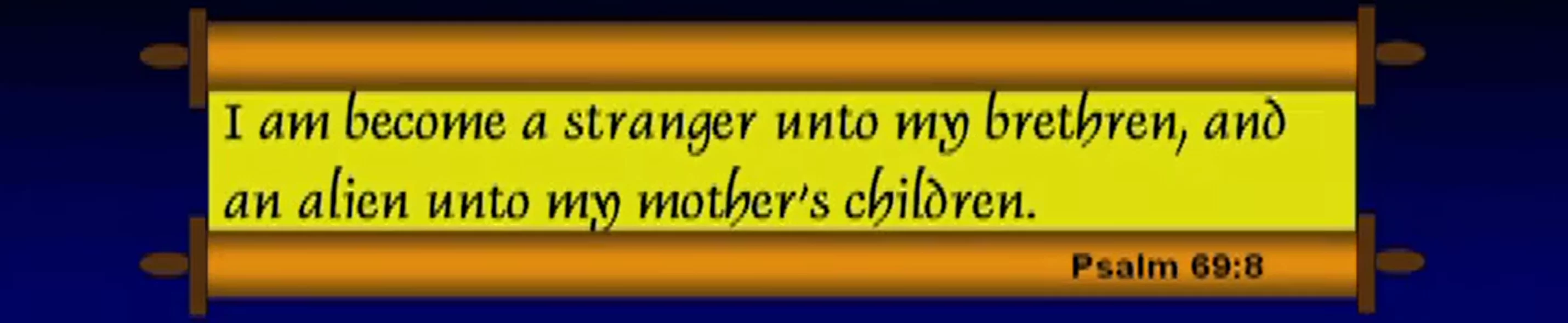
- What a strange expression to use. Then you realize the strange family He was in
- When kids come home from school, they don’t know who Jesus’ father is. Other children had Joseph as their father
- Jesus appeared to others as illegitimate child. That was a big issue in a small Jewish town where general consensus was that Mary had Jesus illegitimately
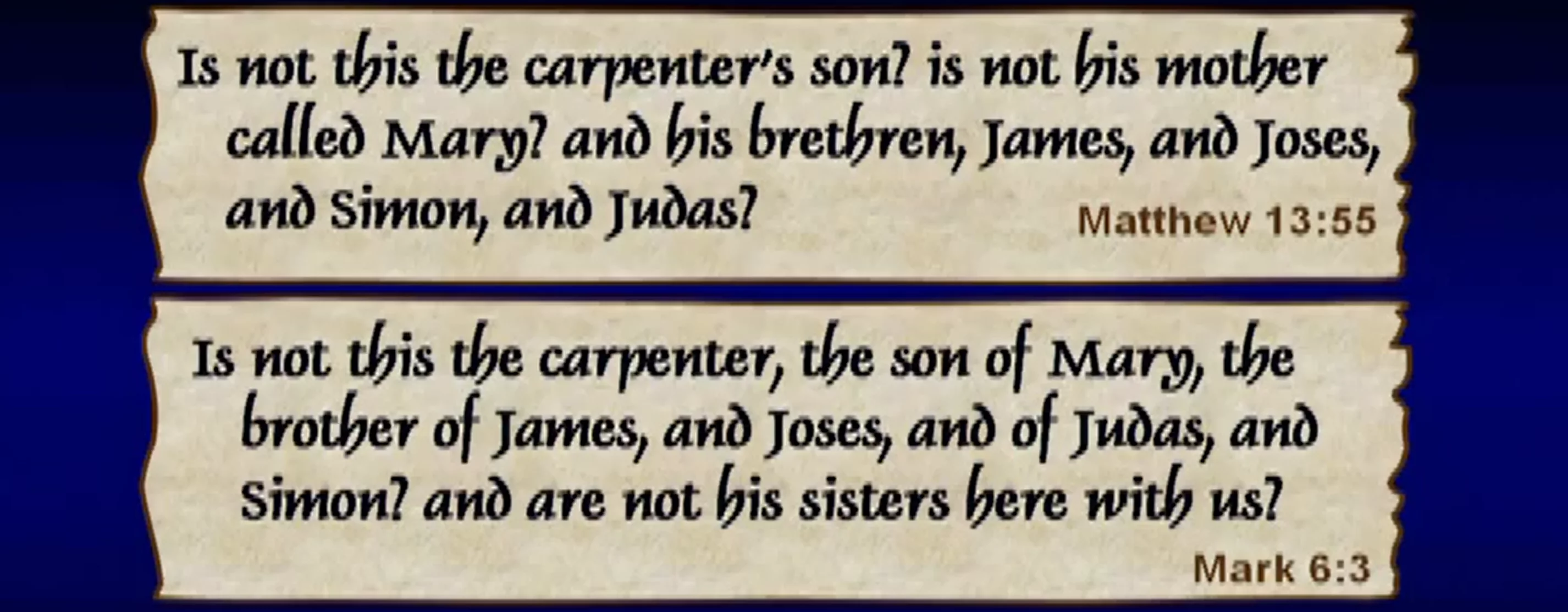
- Mary had other children, which confirms the record in the Gospels (Matt 13:55, Mark 6:3)
- “…my mother’s children”: He became an alien unto His mother’s children—not His father’s children because Joseph was not His father. They were half-brothers and half-sisters
- It may have been a very unhappy home. Imagine the tensions, the mood and what Mary had to put up with for 30 years (although Mary knew, there was no way to explain that to others)
- This verse tells a lot we would not know otherwise. Possibly her boys, James, Judas and Joses, said to her: “Mother, we heard somebody say that Jesus is not really our brother. They said that nobody knows who His father is”. It must have been interesting when they later discover who He really is!!
- This verse also teaches the virgin birth of Christ (which btw is tucked away in so many places throughout the Bible)
Quick Comparison between Matt 13:55 and Mark 6:3
→ Ps 69:9
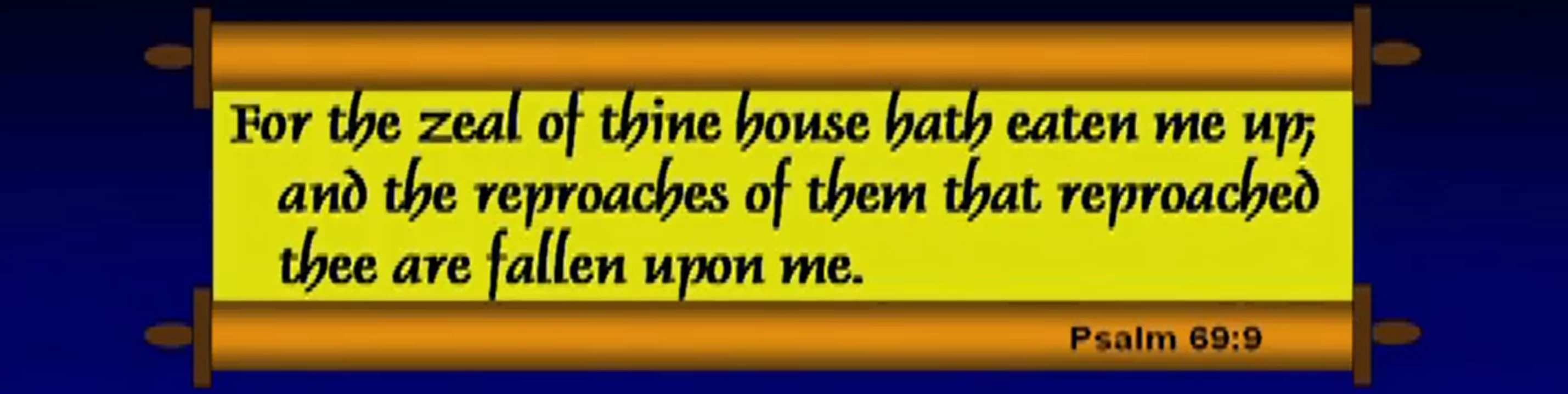
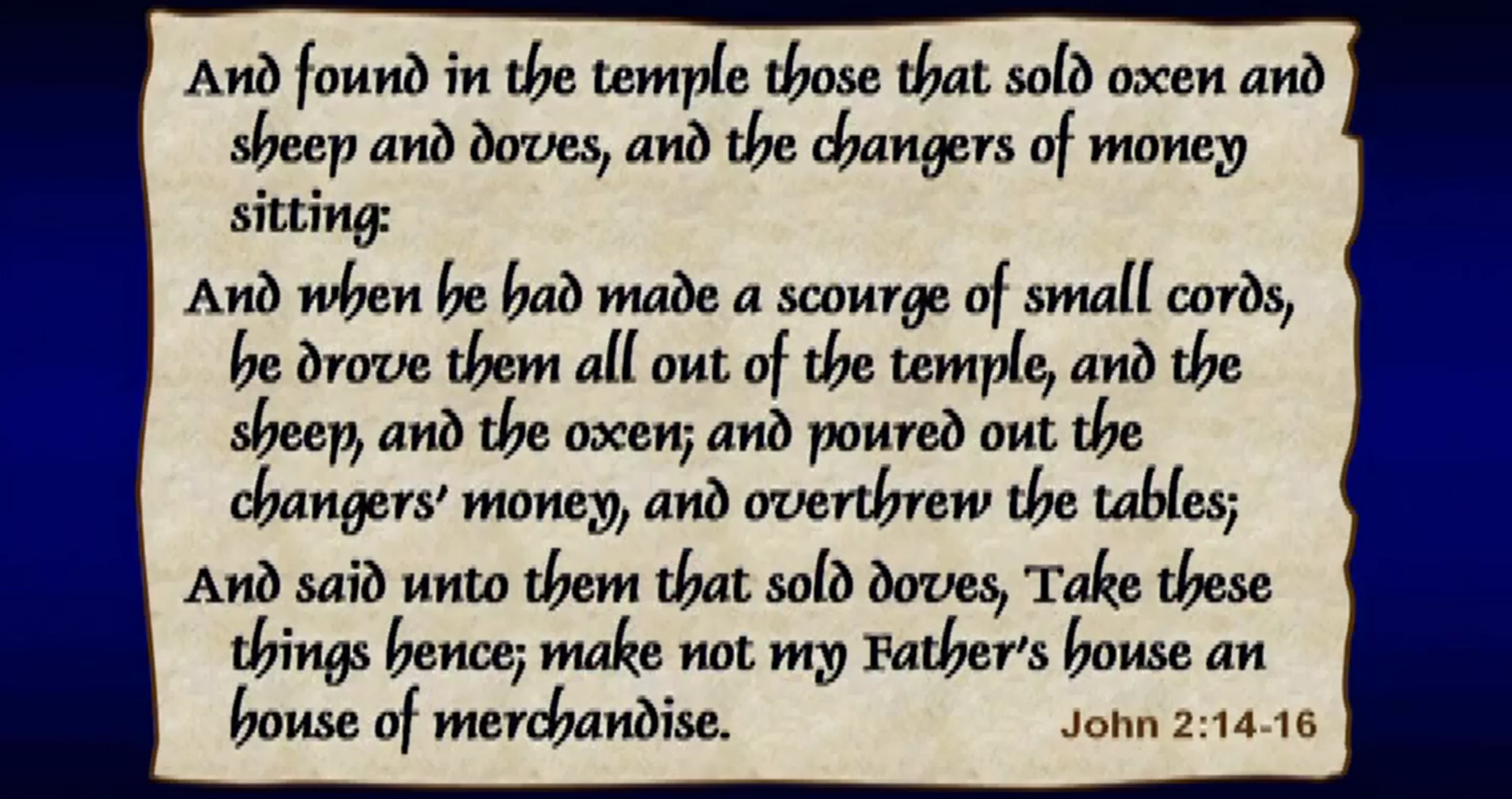
- This is a verse which our Lord also quoted—in reference to the temple
→ John 2:14-16
→ John 2:17

→ Ps 69:10-11
- When He was pious, they made fun of Him even doing that
- Apparently He was resented even for His devotion as a child
→ John 8:41

- “…They said to Him, “We were not born of sexual immorality; we have one Father: God.”” (John 8:41 NASB)
- The cloud of apparent illegitimacy hung over His life. Can you imagine that, growing up as an impressionable kid
Ps 69:12

- “… in the gate”: City Hall — the gate was where the town’s leadership met
- The drunkards at the local bar made up dirty little ditties about Him and His mother
- Why did He endure all of this?
- We often think of Christ suffering on the cross, and indeed He did. But we often overlook the 30 years of suffering
- He was raised in a town where He was called illegitimate in order that I might be a legitimate son of God. The Son of God bore that for me on the cross. He paid the penalty for my sins
- We have no idea what He endured for 30 years in order that we might have a clear title as a legitimate son of God

Mark 6:2
- At this point, there’s enough awareness that they are impressed
- These were people who (thought they) knew Him well. They were from His “home town”. They had been neighbors for 30 years!
- On a previous occasion He was here, they tried to throw Him off a cliff! (Luke 4:16-30)
— “and they got up and drove Him out of the city, and led Him to the brow of the hill on which their city had been built, in order to throw Him down the cliff.” (Luke 4:29 NASB)
- Here’s a “second chance”, but very little learning seems to have taken place
- (“Learning” is often defined as the modification of behavior)
- Have they changed? Not a lot. Perhaps not at all (see the next verse)
Mark 6:3
- “…carpenter”: τέκτων (tektōn) actually means a builder. We think of a carpenter as a wood-smith kind a guy
It can mean a craftsman, a worker. (It can also mean a planner and an architect)
— We really don’t know what the specific skill it was. It is commonly thought that he was a simple carpenter, replacing Joseph who apparently had died
— Every Jew, even the rabbis, learned a manual trade; Paul was a tentmaker. The context of the remark implies a humble village carpenter
- “…son of Mary” is actually an insult: in that culture you identified a man by his father
- Jesus belonged to family of at least seven children: four brothers and two sisters
— The Roman Catholic position (as many others of its views) is contradiction to the Scriptures. Jesus was Mary’s firstborn (Matt 1:25 “And knew her not till she had brought forth her firstborn son: and he called his name JESUS.”),
— But Mary actually did become the wife of Joseph and had other children (Scripture says in several places)
— [Roman Catholic position is to look to the church as their ultimate authority. We cling to the Word of God in its original form as without error — infallible and inerrant]
- “…offended at Him”: Lit., “they stumbled over Him”
- They couldn’t quite swallow that this Guy they had as a neighbor for 30 years is actually who He is
— He, indeed, was a “stone of stumbling” to those of unbelief (Isa 8:14, Rom 9:32-33, 1 Pet 2:8)
— The Greek word, σκανδαλίζω (skandalizo), is the word from which we get “scandalize”
Mark 6:4

- He reminded them of what He had told them at that first visit!
— “And He said, “Truly I say to you, no prophet is welcome in his hometown.” (Luke 4:24 NASB)
— “For Jesus himself testified, that a prophet hath no honour in his own country.” (John 4:44)
— “Familiarity breeds contempt” —Publius, the Syrian, 2 BC
- [Our own land is “familiar” with Jesus; we, too, have become a “gospel hardened” people…]
We hear about Jesus so much, we take Him for granted. We sort of dismiss it. It loses its impact.
If we really appreciate who He is, it should strike awe and reverence every time we hear that word, rather than a street term used as an expletive (swear word)
- [Sent to TS Mark 6:2-4]
Mark 6:5

- What is limiting God (in your life)? God is omnipotent, but He always works according to the laws of His own being and the laws of His attributes. (He won’t force Himself upon you. But invite Him and see what happens)
- Christ had all power, but He would not force His blessings on those who did not wish to receive them
- He would never violate our sovereignty either
- “Behold, I stand at the door, and knock: if any man hear my voice, and open the door, I will come in to him, and will sup with him, and he with me.” (To the Church in Laodicea, Rev 3:20) The latchkey is on your side of the door
Mark 6:6

- “…marvelled”: Only twice does the Scripture say that He “marvelled”: (He was amazed)
— Here, He marvelled at the unbelief of the Jews
— The other case was concerning the faith of the (Gentile) centurion (Matt 8:10, Luke 7:9) He was impressed
- Faith is more than mere belief. “…the devils also believe, and tremble.” (Jas 2:19)
- Faith is belief plus a total commitment (or total reliance —”I believe this chair will hold my weight. I will not have faith in it until I am sitting on it and relying on it”, a clumsy example)
- Salvation is more than an insurance policy against the flames of hell
— Salvation is a new creation: new life, new love, a new direction of the will
- Jesus’ heart was broken as He saw the desperate plight of the people (Matt 9:35-38)
Mark 6:7 The Twelve Sent Out

- “…sent”: ἀποστέλλω (apostello), to order one to a place appointed, from which we get Apostle, or Sent One
- “…by two and two”: In pairs: “Two are better than one…” (Eccl 4:9)
— A review of the lists of disciples reveals that they are always given in pairs. Also, the law always required at least two witnesses (Deut 17:6, Deut 19:15, 2 Cor 13:1)
Mark 6:8

- That seems like a poor planning
- Every day God seems to ask each of us the same question: Do you trust Me?…
- “Take therefore no thought for the morrow: for the morrow shall take thought for the things of itself. Sufficient unto the day is the evil thereof.” (Matt 6:34)
- Doesn’t mean one should not plan. But who you rely upon is Him. Not on your bank account, not on your career
- God delights in people trusting Him. Not relying on their own savvy
Mark 6:9-10
- They were not to “pick and choose”. They were to be profitable servants, not pampered guests
- There was to be no ground for the suspicion that they were seeking personal comfort or special recognition
Mark 6:11
Mark 6:12-13
- “…anointed with oil”: Cf. James 5:14
— “Is any sick among you? let him call for the elders of the church; and let them pray over him, anointing him with oil in the name of the Lord:” (Jas 5:14)
- Oil is a type for the Holy Spirit

- Herod Antipas was a son of Herod the Great by his Samaritan wife Malthace
- When Herod the Great died, the Romans divided his territory among his three sons:
— Antipas was made tetrarch of Perea (east of Jordan) and Galilee, and reigned during the whole period of our Lord’s life on earth (Luke 23:7)
- He was a frivolous and vain prince, and was chargeable with many infamous crimes
— “And He was giving orders to them, saying, “Watch out! Beware of the leaven of the Pharisees and the leaven of Herod.”” (Mark 8:15 NASB)
— “But when Herod the tetrarch was reprimanded by him because of Herodias, his brother’s wife, and because of all the wicked things which Herod had done,” (Luke 3:19 NASB)
— “Just at that time some Pharisees approached, saying to Him, “Go away, leave here, for Herod wants to kill You.” 32 And He said to them, “Go and tell that fox, ‘Behold, I cast out demons and perform cures today and tomorrow, and the third day I reach My goal.’” (Luke 13:31-32 NASB)
- He had married the daughter of King Aretas IV and then had divorced her so he could marry Herodias the wife of his half brother Herod Philip. It was a wicked alliance (cf. Ahab and Jezebel, 1 Kgs 18-21) (alluded to by Christ, idiomatically at least, in His letter to the Church of Thyatira, Rev 2:18-29)
- Jesus called him “that fox” (Luke 13:32). Study of labels of Jewish animals: clean ones are used in Messianic allusions, unclean ones are used in epithets. Animal idioms are quite pervasive in the Scripture
Mark 6:14 The Death of John the Baptist
- That’s his presumption. He’s got a guilty conscience
- When Herod heard of Jesus, he thought that was resurrection of John the Baptist (who by now had been killed)
- His conscience was bothering him
— Mark will give us a flashback to fill in the background details (vv. 17-29)
Mark 6:15

- Here, they are guessing the identity of Jesus
- The mystery of the identity of John the Baptist is also highlighted in John 1:19-28
Mark 6:16-17
- John the Baptist was calling to public’s attention the fact that that was illicit relationship
- “…in prison”: Probably Machaerus Prison, on the cliffs overlooking the Dead Sea
Mark 6:18-19
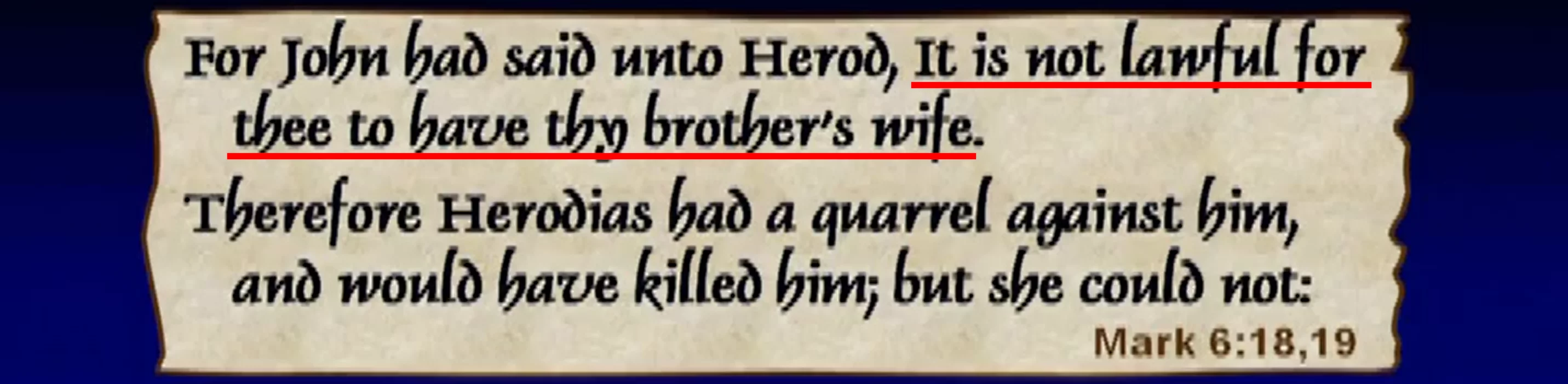
- Contrary to the Law of Moses (Lev 18:16, Lev 20:21)
- “Hell hath no fury like a woman scorned.” —William Congreve, Jezebel II
(AI: a woman who has been rejected by a man can be ferociously angry and vindictive)
Mark 6:20

- Amazing: This monarch, Herod Antipas, feared his prisoner. He privately listened to him preach
Mark 6:21-22
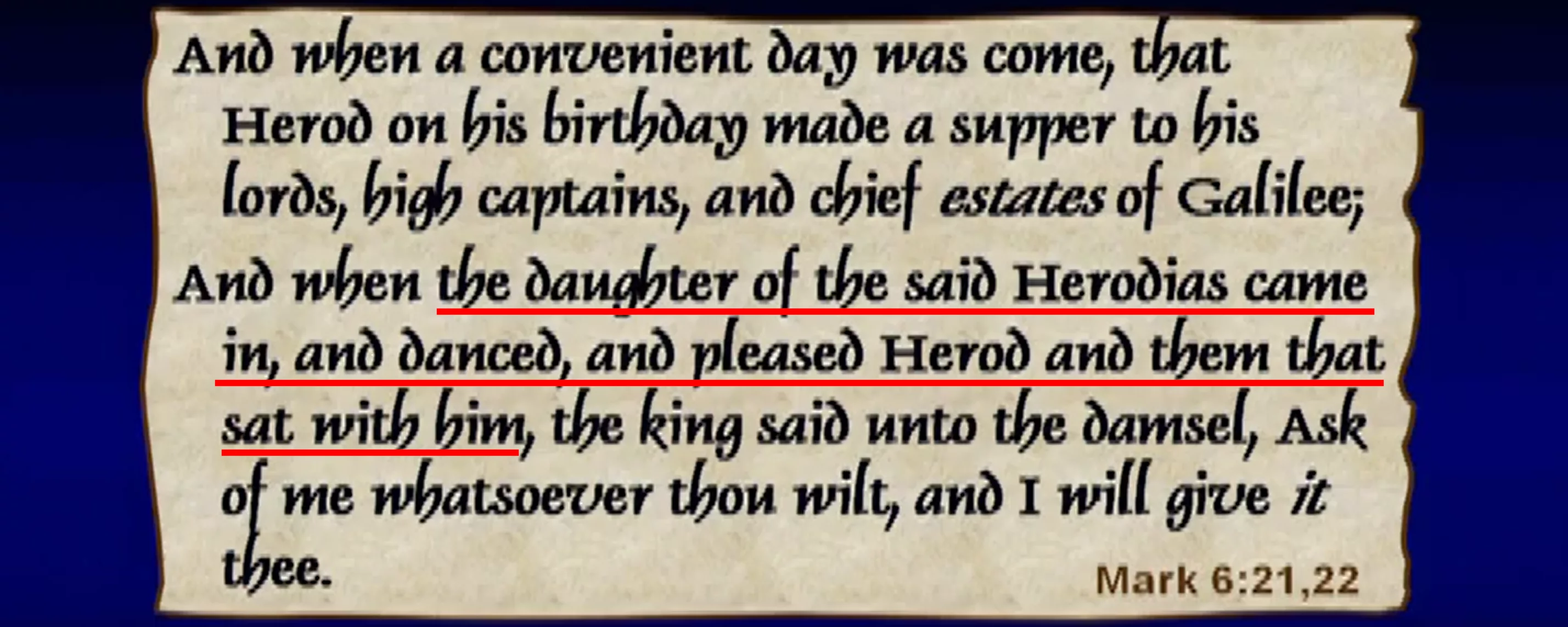
- The Jews would not have permitted a woman to dance before a group of men
- Even most Gentile mothers would have forbidden their daughters to do what Salome did
Mark 6:23

- Most scholars believe that was figure of speech, Herod didn’t mean it literally. Nevertheless, he is making very grand public gesture to reward (whore) her for this pleasing dance that she did (timestamp: min 27 😂)
Mark 6:24-25
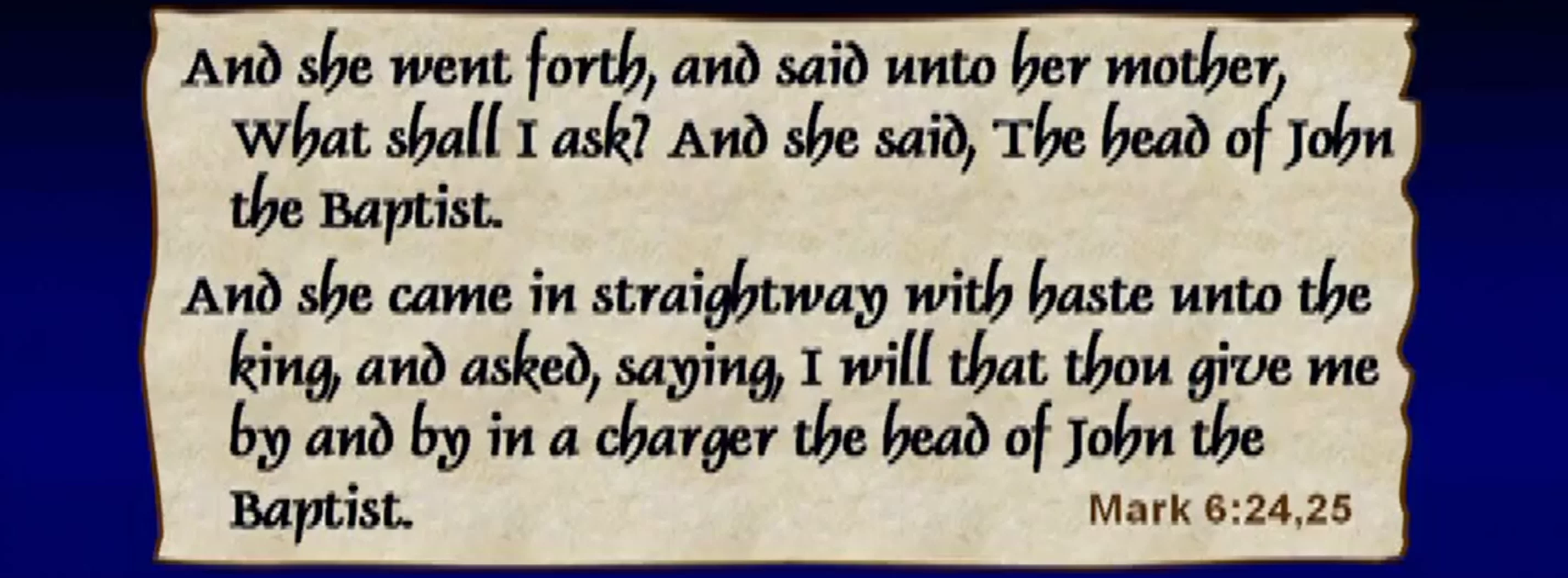
- “…by and by”: at once
- “…in a charger: a large silver plate
- That’s going to shake up the king — he didn’t really want to do that, for a lot of reasons, he feared John. He also probably feared the public since even though John was in the prison, he had quite a following
- That is quite a compliment to John! His head was considered to be worth more than half the kingdom!?
Mark 6:26-27
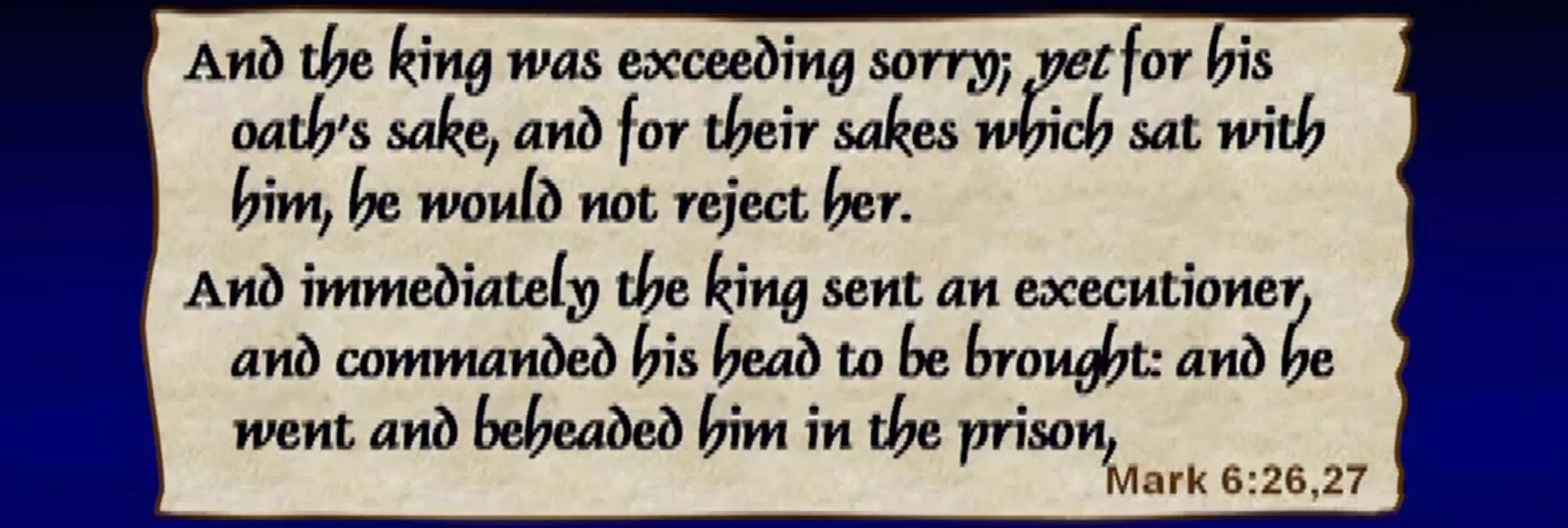
- “…the king was exceeding sorry”: he was trapped in a sense
- “…yet for his oath’s sake”: how often we have to eat our words
Mark 6:28

- Famous event in the history obviously
Mark 6:29

- …and John’s disciples went and told (reported to) Jesus (Matt 14:12)
- Don’t feel sorry for John: he got an instant trip to glory. He is well taken care of
- [America, too, has lost its conscience, the voice of its moral conscience, because the preachers of this land have ceased to denounce sin]
- Herod got a chance to see Jesus just before His crucifixion (Luke 23:7-11)
- But Jesus didn’t even give him a word: Herod’s conscience was long dead and buried
- Antipas’ nephew, Herod Agrippa denounced his uncle to the Roman emperor and Antipas was deposed and sent into exile (Acts 12:19) (need a better reference)
- Death of Herod was recorded in the Gospel: “And immediately an angel of the Lord struck him because he did not give God the glory, and he was eaten by worms and died.” (Acts 12:23 NASB)
- “For what shall it profit a man, if he shall gain the whole world, and lose his own soul?” (Mark 8:36)
Mark 6:30
- Jesus’ apostles (not John’s disciples) probably in regards to them being sent out (Mark 6:7-13)
— “When the apostles returned, they gave an account to Him of all that they had done. Taking them with Him, He withdrew by Himself to a city called Bethsaida.” (Luke 9:10 NASB)
Mark 6:31-33 (Jesus Feeds Five Thousand, starting with verse 33)
- Couldn’t rid of the crowds. Couldn’t find privacy
- [Haven’t we all experienced this kind of schedule?]
Mark 6:34 (Five Thousand Fed, started with verse 33)
Mark 6:35-36
- They are out in the boondocks here (informal North American English: rough or isolated country)
- Someone has defined “a committee”:
— A group of people who individually can do nothing, and collectively decide that nothing can be done
- They did a study of an optimum size of a committee and turns out to be 7/10 of a member
Mark 6:37
- The “ye” is emphatic. The amount required to purchase that much bread equates to about a year’s wages
- “…pennyworth” (denarii NASB): the Roman penny is seven-pence halfpenny. It was the daily pay of a Roman soldier in the time of Christ. In the reign of Edward III, an English penny was a laborer’s daily wage
Mark 6:38-40
- It was Andrew who discovered a lad who apparently had brought his lunch (John 6:8-9)
- “…green grass”? Only Mark includes this scenic detail (Cf. Ps 23:2) Remez: we infer the time of year
Mark 6:41-44
- It was Jewish practice to number the crowds by the number of men present. It can be presumed that there was another 5,000 women → ~10 thousand people (+ some children). Quite a group to cater to
- “Besides women and children” (Matt 14:21)
— Assuming at least an equal number of women and children—having used one of their lunches!—the total was twice what is commonly taught: 5,000 + 5,000 = 10,000?
- And a left-over basket for each disciple?
— [12 is also the “kingdom” number…] The Kingdom of Heaven Twelves (see Mark note s04)
- “Can God furnish a table in the wilderness?” (Psalm 78:19)
- “I will satisfy her poor with bread.” (Psalm 132:15) (additional ref included but not on slide: Isaiah 40:15)
- John tells us that this miracle occasioned Jesus’ sermon on the “bread of life” (John 6:26-40 Words to the People / I Am the Bread of Life)
— Probably a fulfillment of a Messianic prophecy by Solomon in Prov 30:1-4. The words of Agur. Agur was a collector representing Solomon. Also mentions untranslated Ithiel (God has arrived) and Ucal (to be consumed) → “God arrives to be consumed?” — that is what Jesus emphasizes in John 6 as a response to this miracle of feeding
- Amazed at the miracle of the feeding, they still failed to get the spiritual message
- Ultimately: “As a result of this many of His disciples withdrew and were not walking with Him anymore. 67 So Jesus said to the twelve, “You do not want to go away also, do you?”” (John 6:66-67 NASB)
Mark 6:45-46 Jesus Walks on the Sea / on the Water
- In the previous storm, He was with them. This time He was on the mountain praying for them. He was teaching them to live by faith
- [This is us, today. He is in glory, interceding for us: “Therefore He is able also to save forever those who draw near to God through Him, since He always lives to make intercession for them.” (Heb 7:25 NASB)]
Mark 6:47-48
- “…toiling”: same as “vexed” in 2 Pet 2:8 (talking about Lot in Sodom and Gomorrah: “vexed his righteous soul from day to day with their unlawful deeds”) → tortured, implies real mental distress and anxiety. These professionals were concerned that they might be swamped
- “…fourth watch”: 3 - 6 am
Mark 6:49-51
- “…walking upon the sea”: Mark (Peter’s amanuensis) omits the episode of Peter attempting to join Jesus (Matt 14:28-32)
- (This is another instance where the Gnostics seem to have been correct (they claimed that Jesus didn’t come into the flesh, but was some kind of Spirit — when He walked, He didn’t leave footprints): He didn’t leave footprints!)
Mark 6:52

- Not only that the Apostles had this experience on the stormy sea (Jesus walking on the water, calming the storm again), but they just come from a place where there were 10,000 people fed miraculously — and they didn’t really understand the spiritual implications of that. Obviously amazed, but not sure what to do with it
- This is most disturbing that they didn’t integrate what it meant. But aren’t we also guilty of the same thing?
- Even a disciple of Jesus Christ can develop a hard heart if he fails to respond to the spiritual lessons that must be learned in the course of life and ministry
- If we really understand who He is, none of these narratives are surprising
Mark 6:53-55 Many Healed at Gennesaret
- Gennesaret is the proper name of the Sea of Galilee (the shape of the harp) (It’s not a sea, but a lake)
- Land of Gennesaret — a fertile plain on the NW shore of the Sea of Galilee
- Every place He goes, the crowds form, seeking healing, understandably
Mark 6:56
- Again, the borders of the garments were a target (hem implies the rank of the person)
- When people say, “Have faith!” — that is an empty suggestion unless it is faith in Him!
- It’s not about having faith, but having faith in Him. You will become like that what you put your faith in

- You go to the doctor for surgery and put your faith in that doctor. He performs his service and you recover. Are you well because you had faith in the doctor? — No. It wasn’t your faith that saved you: the doctor did
- What saves you is the object of your faith
- You are saved not by your faith, but by the One in whom you trust. It is Jesus who saves us

