s07 (Ch 7) The Hazard of Traditions (studied 18-Oct-2025)
The Book of Mark with Dr. Chuck Missler
The subsections of Chapter 7 (per LSB/NASB) are:

All of us have traditions. And those traditions have utility, they are useful in many ways. And yet they also represent a hazard. They become ossified, crystalized and sometimes we get bound by them. This is really a guard against that.
Mark 7:1 God’s Commandments, Man’s Traditions

- “…came from Jerusalem”: Came from headquarters, a hit-squad of some kind coming down
Mark 7:2

- This had nothing to do with personal hygiene, nor was this commanded by the Law (rather just a ritual)
- These professionals were the theological “hit-men”. They were upset every time that Jesus undermined their authority over the people and their traditions
- Jesus was encroaching on their turf. They were the custodians of “proper” practice
- [We find similarities in our own life today. Many churches regard practices of other churches being wrong]
Mark 7:3

- “Tradition is a fence around the law” (Torah being the Law)
— The Mishnah, a compilation of Jewish oral traditions made at the end of the 2nd century AD (ultimately gets codified (written down) in Talmud in 3rd century. Oral traditions many times took precedence over the Torah itself)
- The Jews viewed tradition as protecting God’s Holy Word and assisted His people in keeping it. This probably began with good intentions, but ultimately produced some famous absurdities
— In the effort to protect the Sabbath from being broken by inadvertent labor, the devout were given an amazing list of prohibitions, so called “fences”:
► One could not look into a mirror, lest a gray hair might be plucked
► One couldn’t wear false teeth, lest they fall out and picking them up would be working
► The rabbis debated about a man with a wooden leg: if his home caught fire, could he retrieve it on the Sabbath?
► If someone spit on the Sabbath he had to take care of where it landed: if it landed in the dirt and was scuffed with his sandal it would be cultivating the soil and thus performing work
- If you are in an Israeli hotel on Shabbat, you will encounter the “Sabbath elevators”: every floor is pre-selected to avoid having to push a button (because that is “work”). Usually there are two elevators: one stopping on odd numbered floors, the other on even
- The Pharisees’ commitment to ritual purity made them extremely pious and self-righteous. As it happens, those who keep these rules start feeling very unique and they start showing disdain for those who don’t
Mark 7:4

- The biggest concern of the Mishnah (186 pages) was “cleanliness” including ritual washing (not so much for the sake of hygiene, but just to fulfil the ritual)
- Originating from the Biblical command that all priests must wash their hands:
— “Aaron and his sons shall wash their hands and their feet from it;” (Exo 30:19 NASB)
— “Then you shall bring Aaron and his sons to the doorway of the tent of meeting and wash them with water.” (Exo 40:12 NASB)
- But then all pious Jews (who were not priests) began to do it about 200 BC
— Hygiene was not the reason, rather just a side effect
- A rabbi who once omitted washing his hands before eating bread was excommunicated
- It is reported that another rabbi who suffered imprisonment under the Romans nearly died because he used his ration of drinking water to ritually wash up
- Ultimately, the concept of true inner purity had been trivialized to a system of external washings
- These washings not only indicated a wrong attitude toward people, they also conveyed a wrong idea of the nature of sin and personal holiness
Mark 7:5

- They were quite alarmed by this. Quite concerned and quite critical
Mark 7:6

- Often, the best defense is a well-directed offence
- Jesus quotes Isa 29:13:
“Wherefore the Lord said, Forasmuch as this people draw near me with their mouth, and with their lips do honour me, but have removed their heart far from me, and their fear toward me is taught by the precept of men:”
“…by the precept of men” — in other words, in contrast to the precepts of God
Mark 7:7-8
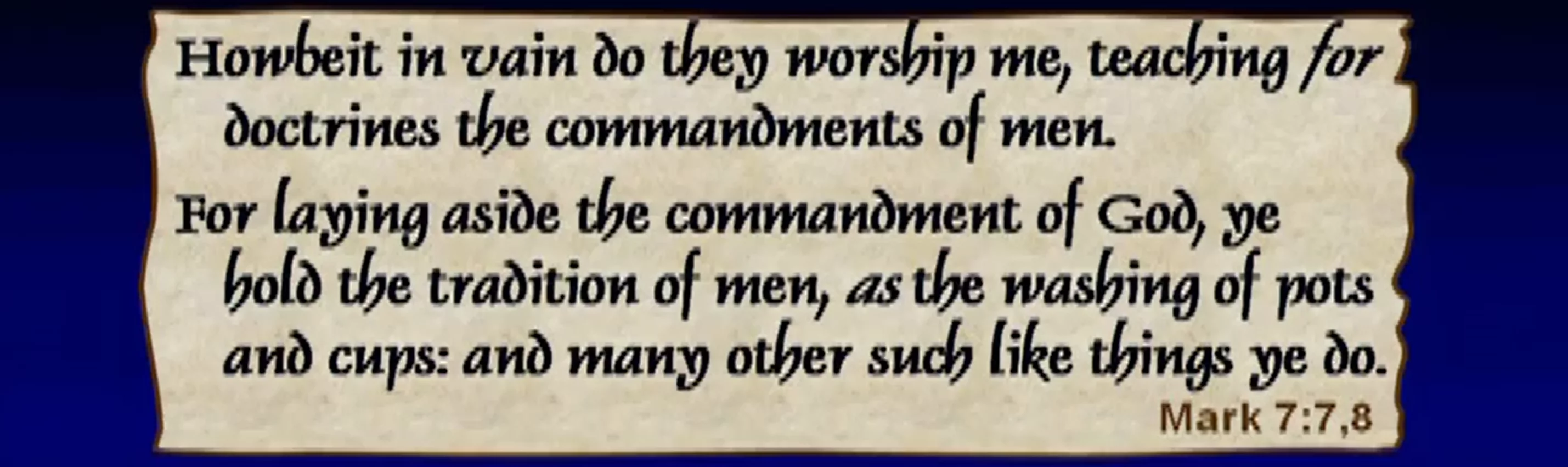
- That’s Jesus’ criticism of them
Mark 7:9

- They stated: “He who expounds the Scriptures in opposition to the tradition has no share in the world to come”
— An example is Rabbi Eleazer (1-2 century AD) who emphasized the paramount importance of oral and traditional law in rabbinic Judaism, asserting that established traditions are as crucial as the written scriptures—ignoring the fact that Scriptures should be taking precedence over oral traditions
- It is a greater offense to teach anything contrary to the voice of the Rabbis than to contradict the Scripture itself
— The Mishna: that is shocking stuff that is in Mishna—these traditions have eclipsed and taken precedence over the actual Word of God. That is also one of the tragedies in Judaism today
Mark 7:10-11
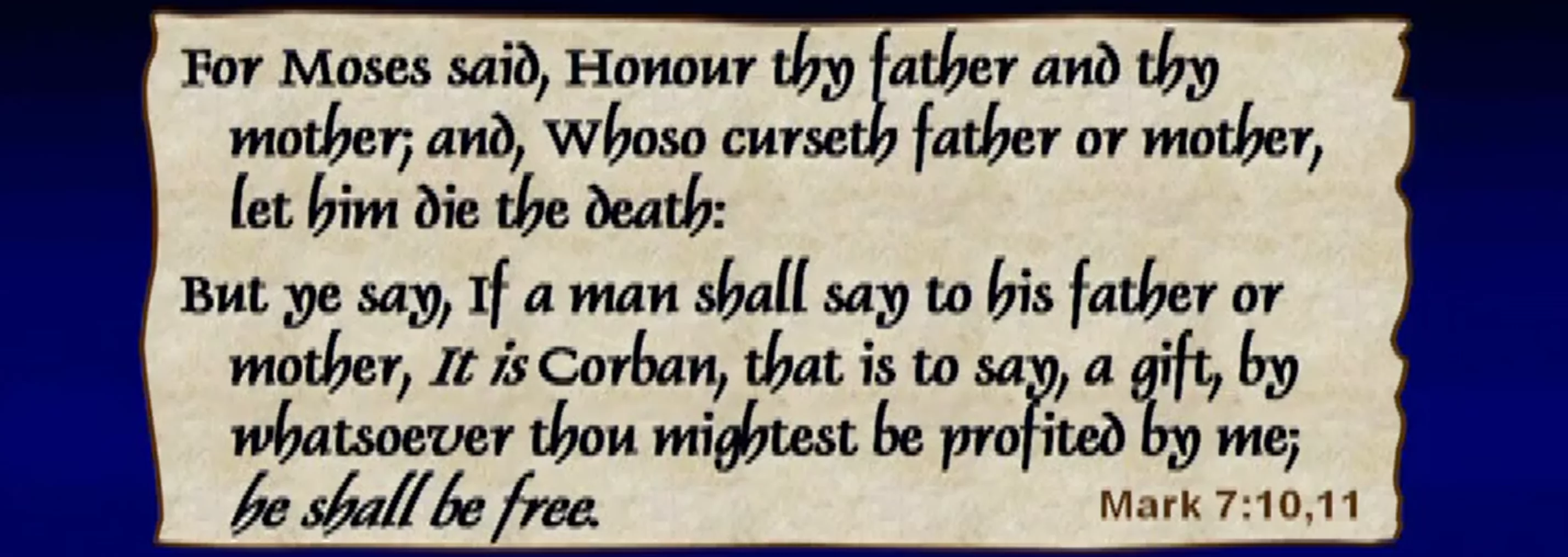
- Jesus is referring to an unusual practice in which they would set aside certain goods as “dedicated to God” (Corban) instead of using those goods to take care of their parents. They used Corban as an excuse to escape from their obligations to their mother and father, because Corban exempts them from using those goods
- Now Jesus refers to the Law:
— “Honor your father and your mother, that your days may be prolonged in the land which the LORD your God gives you.” (Exo 20:12 NASB)
— “He who curses his father or his mother shall surely be put to death.” (Exo 21:17 NASB)
— “If there is anyone who curses his father or his mother, he shall surely be put to death; he has cursed his father or his mother, his bloodguiltiness is upon him.” (Lev 20:9 NASB)
- They side-stepped the Commandment by simply declaring that their possessions were “Corban” (“given to God”), and thus dedicated for spiritual purposes (Num 30 The Law of Vows)
— “If a man makes a vow to the LORD, or takes an oath to bind himself with a binding obligation, he shall not violate his word; he shall do according to all that proceeds out of his mouth.” (Num 30:2 NASB)
- The reality of the matter was that God never saw their “Corban” and they used the goods for themselves
Mark 7:12-13
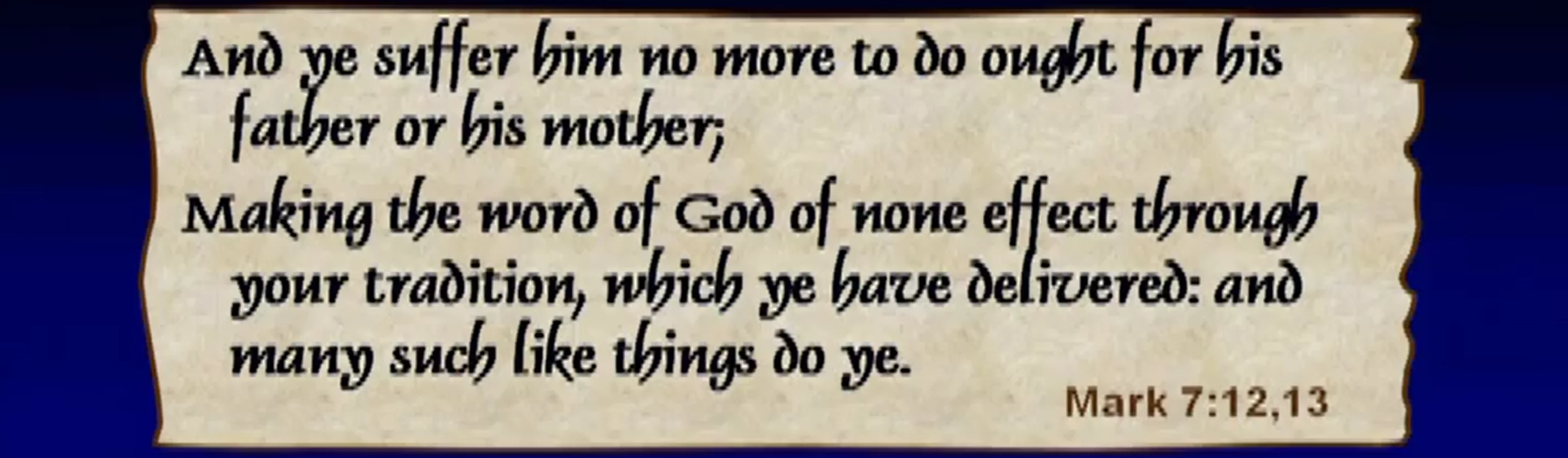
- Jesus is chiding them because they use their traditions to eclipse or supersede what the Law calls for
- They were committed to their traditions over and above to their commitment to the Law of God
- Those who try to justify themselves by the Law end up modifying it in order to escape its authority
- Note the tragic sequence:
◘ Teaching their doctrines as God’s Word (v. 7)
◘ Laying aside God’s Word (v. 8)
◘ Rejecting God’s Word (v. 9)
◘ Robbing God’s Word of its power (v. 13)
- [In the same way, those who handle God’s Word without submitting to it are in the constant process of conforming it to their own self-complacency]
Mark 7:14-16 The Heart of Man
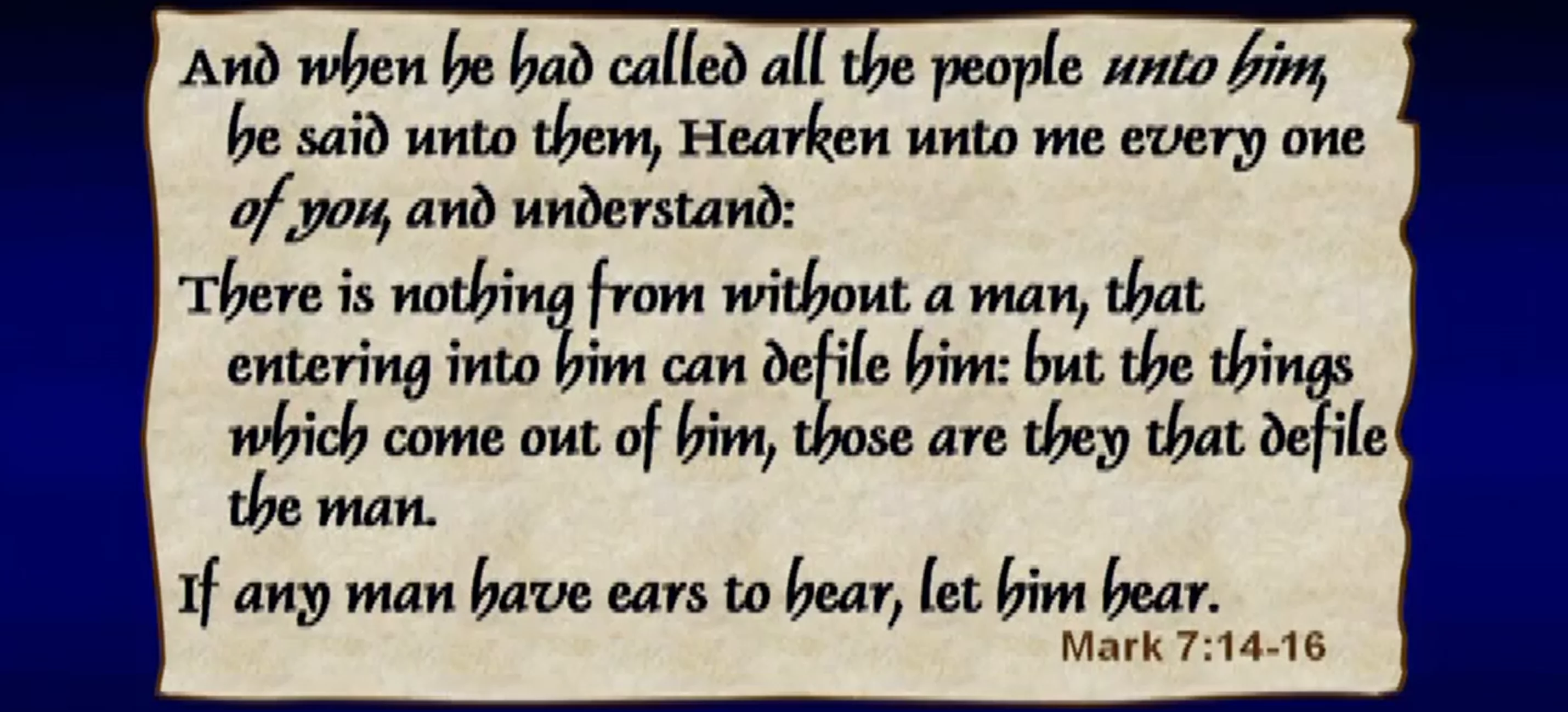
- Hygiene is worrying about eating something that is not pure. That is okay, but that is not in view here
- (Yes, physically you can contaminate yourself with bad food, but not spiritually)
- Jesus is talking about spiritual defilement, which is not about what you eat, but what comes out of you
— “there is nothing outside the man which can defile him if it goes into him; but the things which proceed out of the man are what defile the man.” (Mark 1:15 NASB)
- Jesus had the Pharisees reeling and He made his closing remarks as public as possible!
- This is declaring null and void the entire Mosaic system of “clean and unclean” foods!
(Noah took 2 of unclean animals and 7 of clean ones. How did he know which ones are clean and unclean?)
Mark 7:17

- The disciples still just did not “get it”. It wasn’t “a parable” at all. It was straightforward exposition
Mark 7:18-19
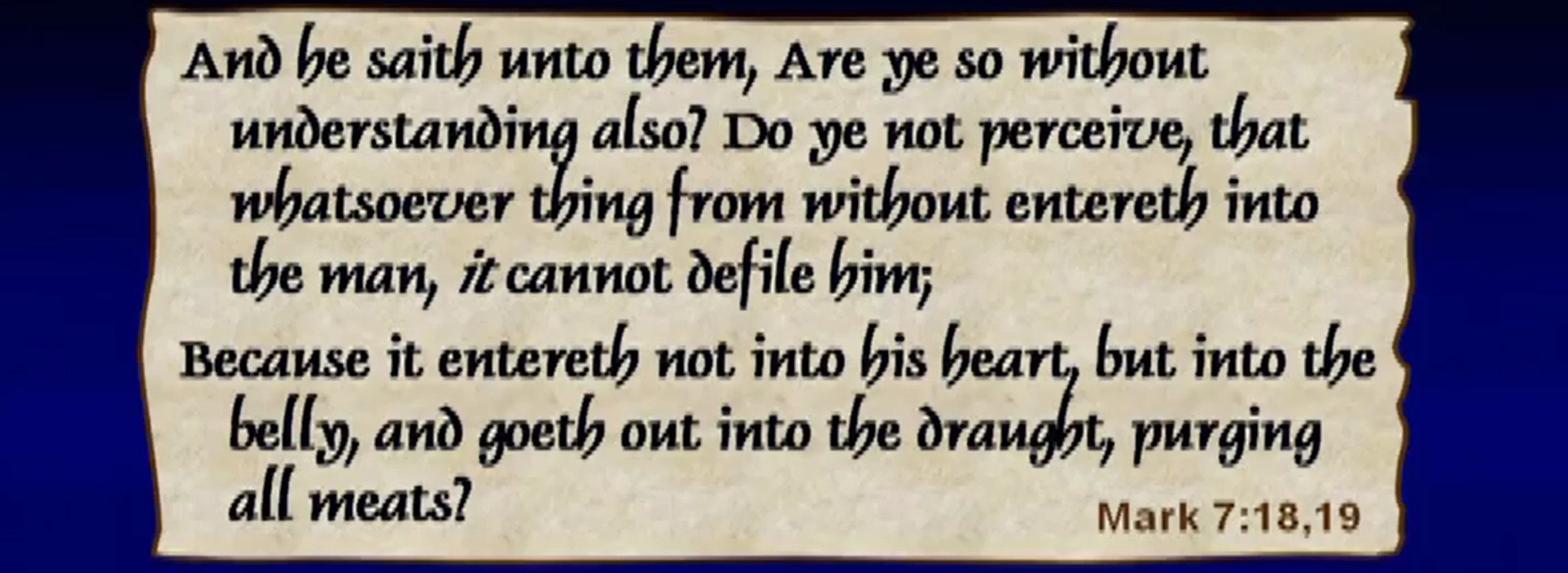
- Jesus had declared all foods are “clean”
- That comes as a shock to a Jew
- (Jews should not abandon their traditions, but they need to recognize them as what they are — as traditions only)
Mark 7:20-23
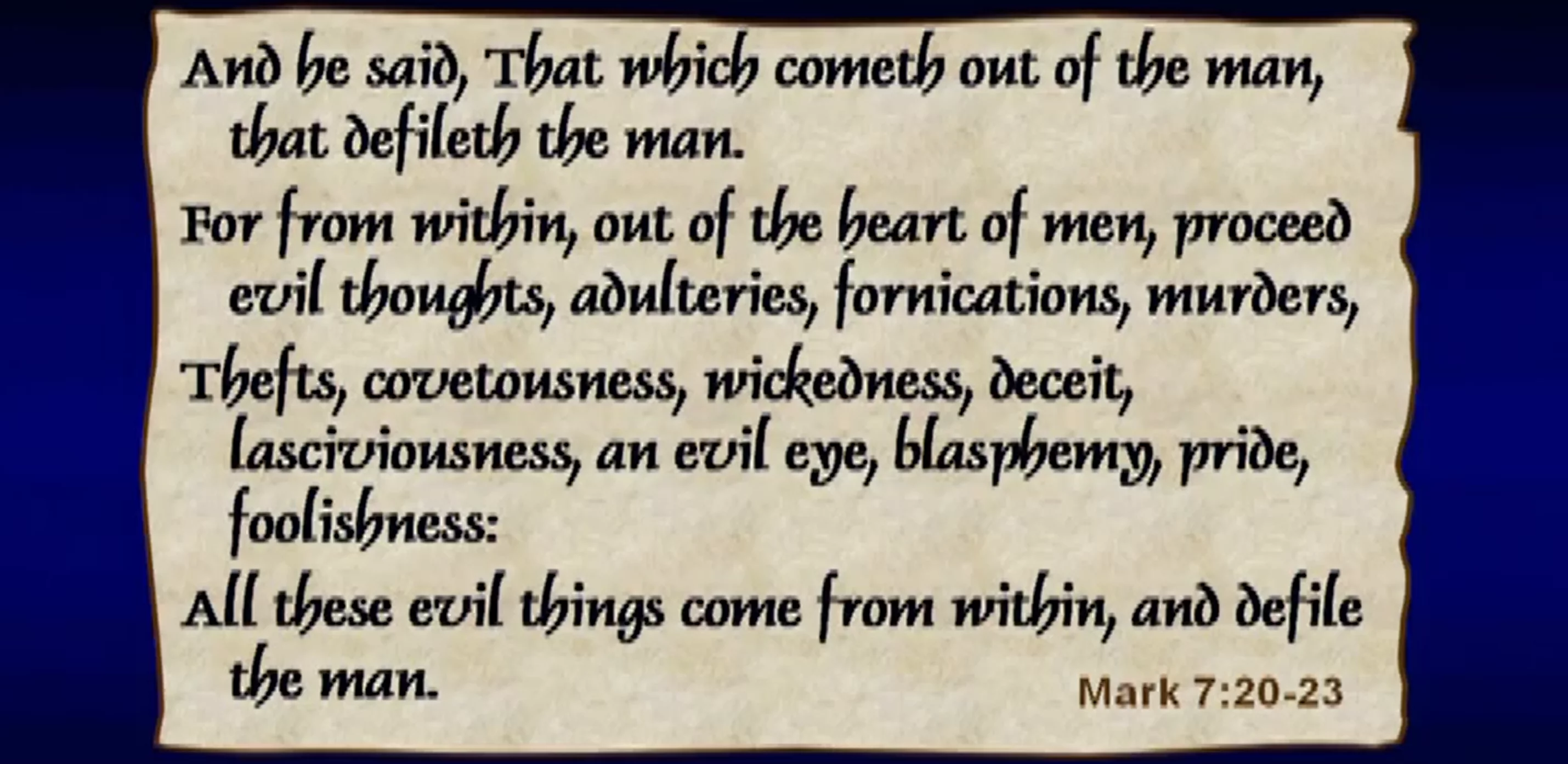
- Some regard this declaration as the most revolutionary passage in the New Testament
(to the Jewish mind, certainly)
- Most of us fail to appreciate its impact since we are unfamiliar with the bondage from the fastidious legalism which had taken over the Jewish culture. (fastidious = extremely or excessively careful and detailed with demanding attitude)
- [Peter had this very issue re-emphasized to him on a rooftop in Joppa “kill and eat!” — Acts 10:10-16]
(and Peter still didn’t integrate it fully — Paul had to call him out for his hypocrisy in Gal 2:11-13)
- Some traditions can be helpful to us as reminders of our heritage, but we must constantly beware lest traditions take the place of truth (that has correlation to American patriotism. Godly country was twisted into a democracy, which is recognized as an unstable form of government. That’s why founding fathers worked hard to avoid democracy, and gave us a republic. Here, traditions have failed us since we haven’t embraced the right ones)
- Holiness has always been a matter of the heart, a right relationship with God by faith (not keeping rules)
- Ceremonial purity was a matter of external obedience to a law as evidence of that faith
— “6 Behold, You desire truth in the innermost being, And in the hidden part You will make me know wisdom.”
— “10 Create in me a clean heart, O God, And renew a steadfast spirit within me.”
— “16 For You do not delight in sacrifice, otherwise I would give it; You are not pleased with burnt offering. 17 The sacrifices of God are a broken spirit; A broken and a contrite heart, O God, You will not despise.” (Ps 51:6, 10, 16-17 NASB)
- Ceremonial purity is not supposed to replace the faith
- Moses made it clear that God wanted love and obedience to come from the heart, and not be merely outward obedience to rules (“love the LORD your God with all your heart and with all your soul” Deut 6:4-5, Deut 10:12, Deut 30:6, Deut 30:20)
[Deuteronomy is basically 3 sermons by Moses at the end of his life]
- There is a big difference between true dedication and simply conformance to some kind of system of rules

Man’s traditions:
❌ Outward forms (which is a form of bondage) Eg kosher laws for a Jew are a form of bondage (Rabbinical con-job)
❌ Trifling rules
❌ Outward piety
❌ Neglect, which replaces the Word
vs. God’s Truth:
✔️ Inward faith and liberty (liberty we have in Christ is a precious thing to really understand)
✔️ Fundamental principles (and they don’t change)
✔️ True inward holiness (that’s what He is after)
✔️ Exalts the Word of God

- “Evil thoughts”: διαλογισμοί οι κακοί (dialogismoi oi kakoi) — evil reasoning within oneself
- “Sexual immorality”: πορνεία (porneia) — illicit sexual intercourse: adultery, fornication, homosexuality, lesbianism, intercourse with animals etc.; sexual intercourse with close relatives (incest) etc.
- “Adulteries”: μοιχεία (moicheia) — voluntary sexual intercourse outside of marriage (between a married person and a person who is not their spouse)
- “Murders”: φόνος (phonos) — murders, slaughters
- “Thefts”: κλοπή (klope) — kleptomania
- “Covetousness”: πλεονεξία (pleonexia) — greed, appetite for what belongs to others
("Madison Avenue" is a metonym for the advertising and marketing industry. It refers to the way advertising preys on and encourages a desire for material possessions, fostering a sense of inadequacy or lack that can be "cured" by purchasing something, which in turn drives consumerism. Ads are designed to make people want things they don't have or need, which is a form of coveting or an insatiable desire for worldly gain. They contribute to a culture where people define their worth by what they own)
Covetousness is a form of idol-worship. That’s why tithing is antidote for covetousness
- “Wickedness”: πονηρία (poneria) — depravity, malice, evil desires
- “Deceit”: δόλος (dolos) — craft, guile, deceit
- “Lasciviousness”: ἀσέλγεια (aselgeia) — unbridled lust, excess, licentiousness, lasciviousness, wantonness, outrageousness, shamelessness, insolence. We are not only to avoid lasciviousness (these things), we are also to avoid those who seek pleasure in it (in those things)
[it is disturbing to realize how Hollywood has allowed these things to become commonplace (a usual or ordinary thing). It is bad enough for them to exist. It is quite another thing for them to be celebrated. Astonishing number of magazines thrive on just keeping track of who is sleeping with whom in the entertainment industry]
- “An evil eye”: ὀφθαλμός πονηρός (opthalmos poneros) — an evil eye that watches another’s possessions (a form of an extreme covetousness)
- “Blasphemy”: βλασφημία (blasphemia) — slander, detraction, speech injurious to another’s good name; thus, also, impious and reproachful speech injurious to divine majesty (we normally associate this term for slandering God) The degree of gossip and slander within the Christian body is astonishing
- “Pride”: ὑπερηφανία (huperephania) — pride, haughtiness, arrogance
- “Foolishness”: ἀφροσύνη (aphrosune) — foolishness, folly, senselessness; thoughtlessness, recklessness

- God declares to Jeremiah: “The heart is deceitful above all things, and desperately [incurably] wicked: who can know it?” (Jer 17:9)
Nowhere in the Bible does God cure the heart. Doesn’t repair it. It’s always used the expression of “replacing it with a new one”. That’s why it’s called “a new birth”. You are reborn, a new creation in Christ. Just because we don’t see it physically, it must be a figure of speech — No, it is a very real dynamic and it will show up in changes of a person
- [There is no power in the world that can make the heart good]

➡️ Rom 3:10-11 (Ps 14:1-3 = Ps 53:1-3)
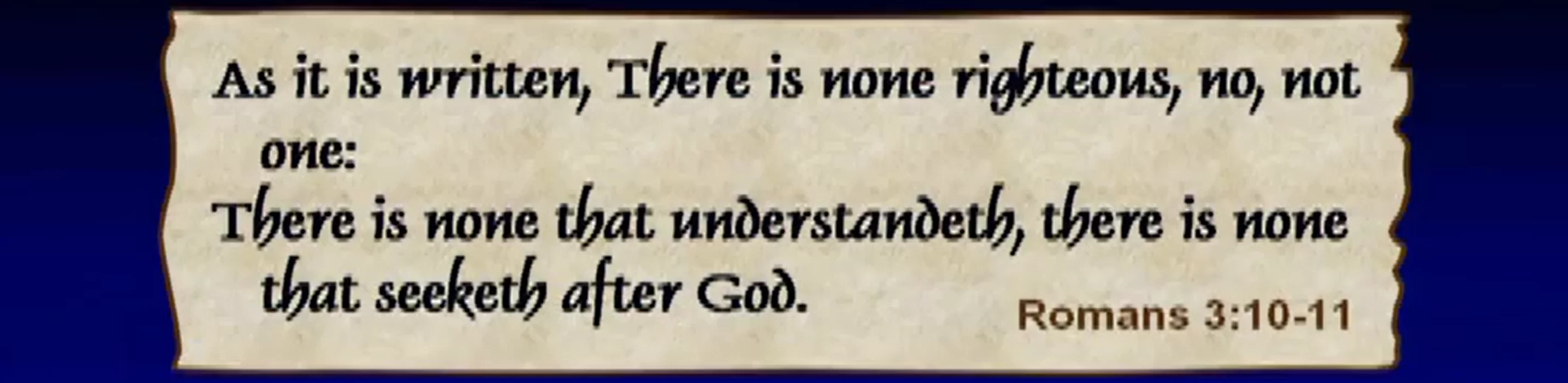
- God took the initiative to reach out to you
- All of us are willfully ignorant! — We chose to be. We were not stupid or uninformed or we didn’t know
— Rom 1:18-32 nailed this thoroughly
- If “none seeks,” then all that “seek” do so upon God’s initiative => Election! (Cf. Luke 4:25-29, John 6:43-47)
➡️ Rom 3:12

- Paul is hammering this here to make his point, to make the foundation for the following chapters in Romans
- People deliberately turned their backs on the truth — they dishonored God instead of glorifying Him
— What use are they? (like “overripe fruit”?)
— They do not follow after that which is good
- Man does not evolve upwards (that is another part of the fallacy of what we are thought in our culture):
— Man devolves downward!
(Take a look at the ethics of the politicians of the first few decades of America and the ethics of politicians today)
➡️ Rom 3:13-14
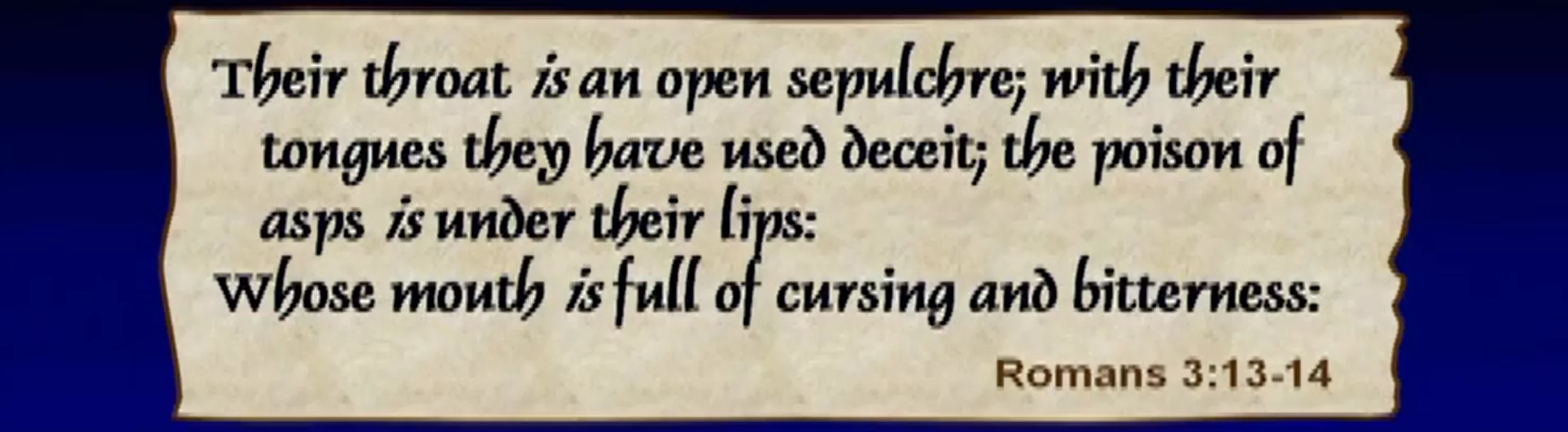
- “…an open sepulchre”: probably the most detestable thing that the Jewish writer could conceive of (symbolizes that a person's throat is like an open grave with a foul stench from which only lies and malice come) Psalm 5:9
- “…the poison of asps”: Egyptian cobra (Cf. Ps 140:3)
- Man’s tongue is a window into his heart (Mark 7:18-23, Matt 12:34-37, Rom 10:9-10)
➡️ Rom 3:15-18
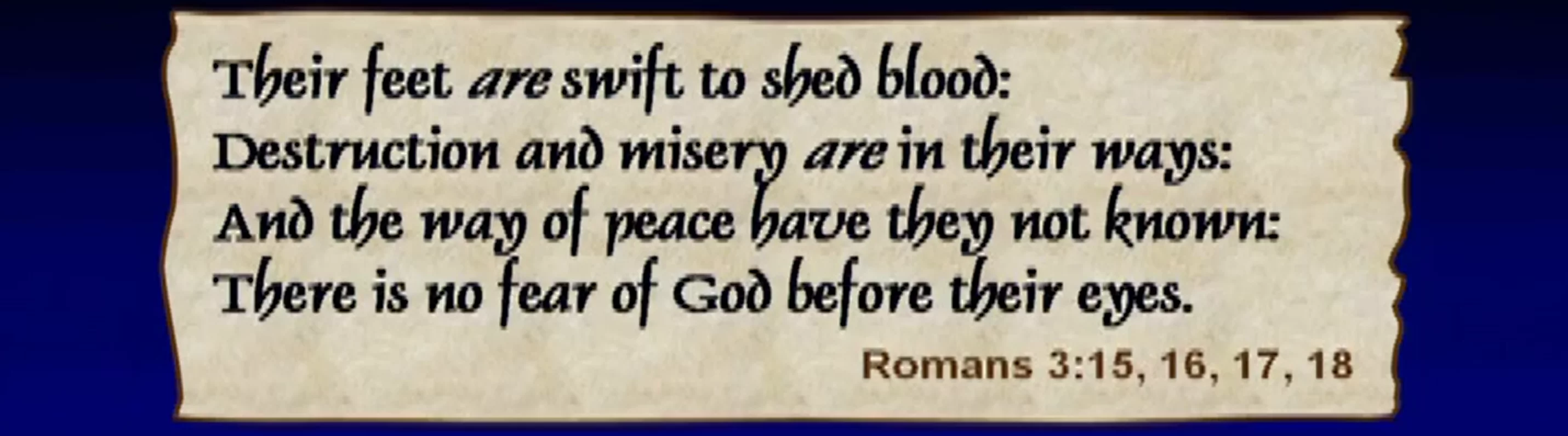
- (v. 15) Quoting Isa 59:7 (Cf. Eph 6:15)
- Anatomical order: from the inside outward… throat, tongue… lips… feet…
- (v. 16) Man has no fulfillment except in glorifying God
- (v. 17) There is no peace when separated from God (Eph 6:15)
- (v. 18) Quoting Psalm 36:1
- Similar to the days of Noah: “…The end of all flesh has become before me;” (Gen 6:13) (Cf. Gen 6:12-13, Deut 5:29)
- Fear of God: from your devotional life…
- “For all have sinned, and come short of the glory of God;” (Rom 3:23)
- Paul says of himself—as we also must:
“O wretched man that I am! who shall deliver me from the body of this death?” (Rom 7:24)
Jesus Christ has. That is incredible drama of it all. Christ has repaired this deficiency on our part
Mark 7:24 A Gentile Woman’s Faith

- A change of scene — He left Israel (Galilee and Judea) and went to Gentile country (sort of like a vacation spot away from the crowds, way up north on the coast)
- The only recorded occasion outside Israel: a summer cottage for privacy, on the Mediterranean coast, about 40mi from Capernaum

- There are only a few in Scripture commended for their faith: and always Gentile
- Here is one whose name is unknown
Mark 7:25-26

- The verb tense indicates that she kept on begging (not a once off, but a continuous process)
- Nationality was against her — Gentile, not Jewish. “Unclean” by Jewish standards. Despised by the religious establishment
- Furthermore, she was a woman — her gender was against her — no standing in that society
- Satan was against her — demons had taken control of her daughter
- Disciples were against her — tried to send her away (Matt 15:23)
- She had a deck stacked against her every which way you can imagine
- What does Jesus say to her? He sort of puts her to the test
Mark 7:27

- “…the dogs”: κυνάριον (kunarion) — little pet household dogs, not street scavengers
- [Jesus hinted at hope, and she grabbed it!]
- He is implying: As bad as it looks, there may be some leftovers
Mark 7:28

- You and I reading this might miss the tone of it, He didn’t of course
- She used Jesus’ own words and used them as the basis for her plea! A bright persistence of faith
- This woman was willing to spend untiring energy in the pursuit of spiritual things
- [Do you persistently and passionately pray for anything?] Do we get serious about praying or we sort of toss up a request now and then and then wonder why our Lord may not seem to respond as we thought He would
- She was intense, committed and persistent
- She depended entirely upon Christ’s goodness and not her own: it was all grace
- She didn’t say she deserve this
- “The sacrifices of God are a broken spirit: a broken and a contrite heart, O God, thou wilt not despise.” Psalm 51:17
- “But without faith it is impossible to please him: for he that cometh to God must believe that he is, and that he is a rewarder of them that diligently seek him.” Hebrews 11:6
- Just knowing God exists is not enough. That’s just a preamble. The demons also know He exists, they tremble
- Know that He is a rewarder, an intelligent person, He has decisions, responses, preferences. Understand those
- “...that diligently seek him” — not just casually, but diligently
Mark 7:29-30
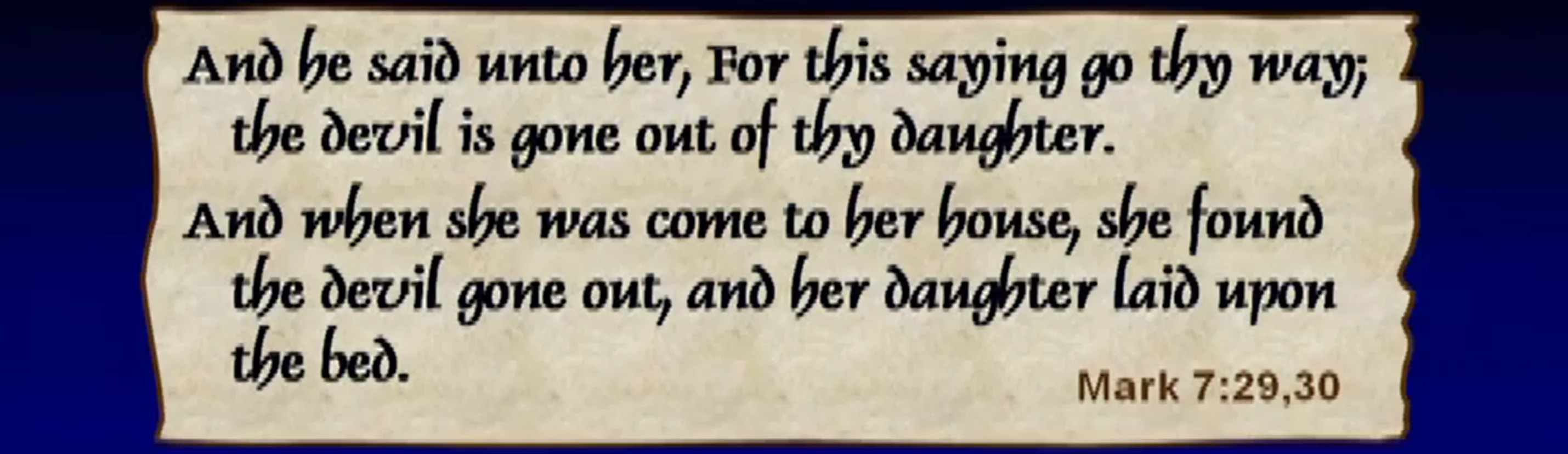
- Praise His Holly Name!
- “Blessed are they which do hunger and thirst after righteousness: for they shall be filled.” (Matt 5:6)
Mark 7:31 The Deaf Hear, the Mute Speak

- Decapolis are 10 Greek cities east of the Jordan. Non-Jewish environment
Mark 7:32

- (Some authorities indicate that deafness is more debilitating and traumatic than blindness! The social stigma and isolation is more severe)
Mark 7:33-35
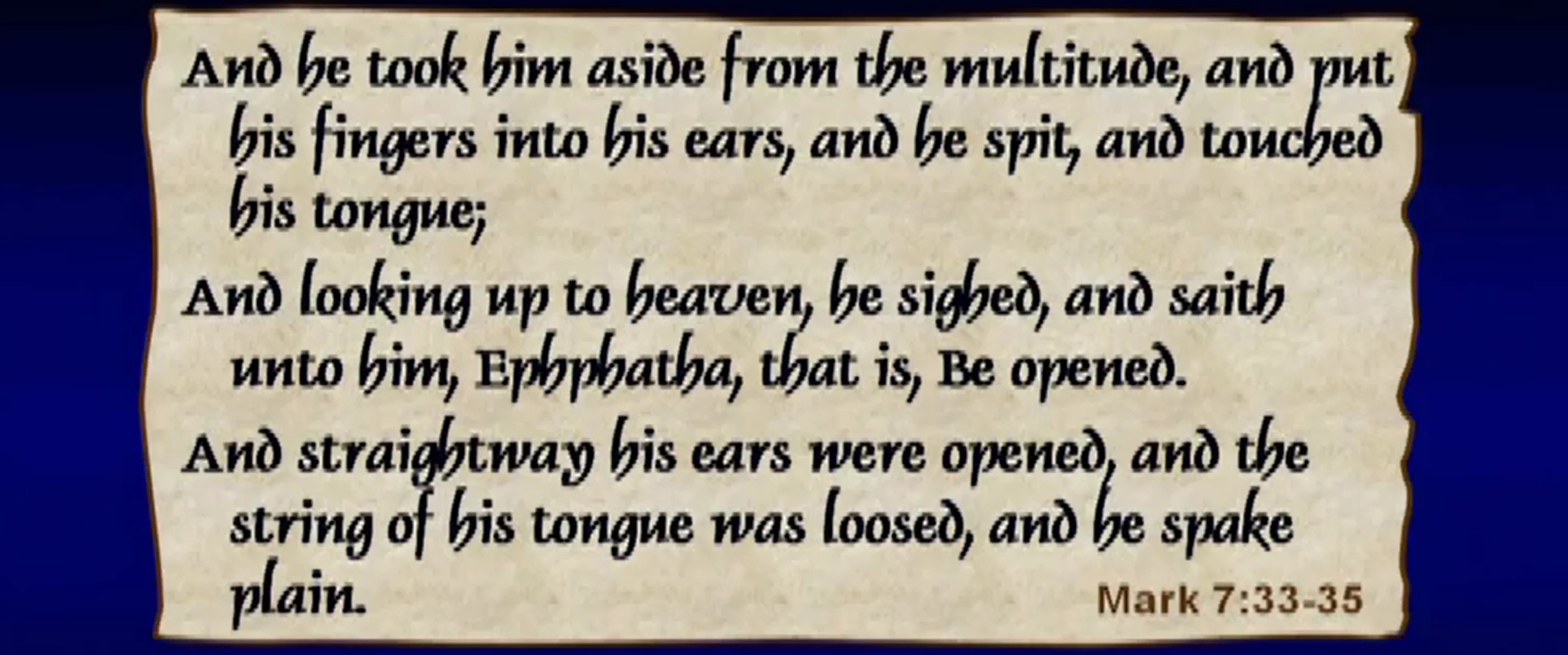
- “Ephphatha” is Aramaic phrase, but Mark interprets it — implies he is writing to Gentiles
- “…and he spake plain”: verb tense suggests he kept on speaking
- Why are these details recorded?
— Jesus’ procedure seems to be a form of communication with him; a form of sign language
— It also gives us an example to follow: His look; His sigh; His touch; and His Word
— His was a “hands-on” ministry: it was personal; it was compassionate; it was directed to a specific need
- [Our prayerlessness is probably among our most serious sins…]
Mark 7:36-37
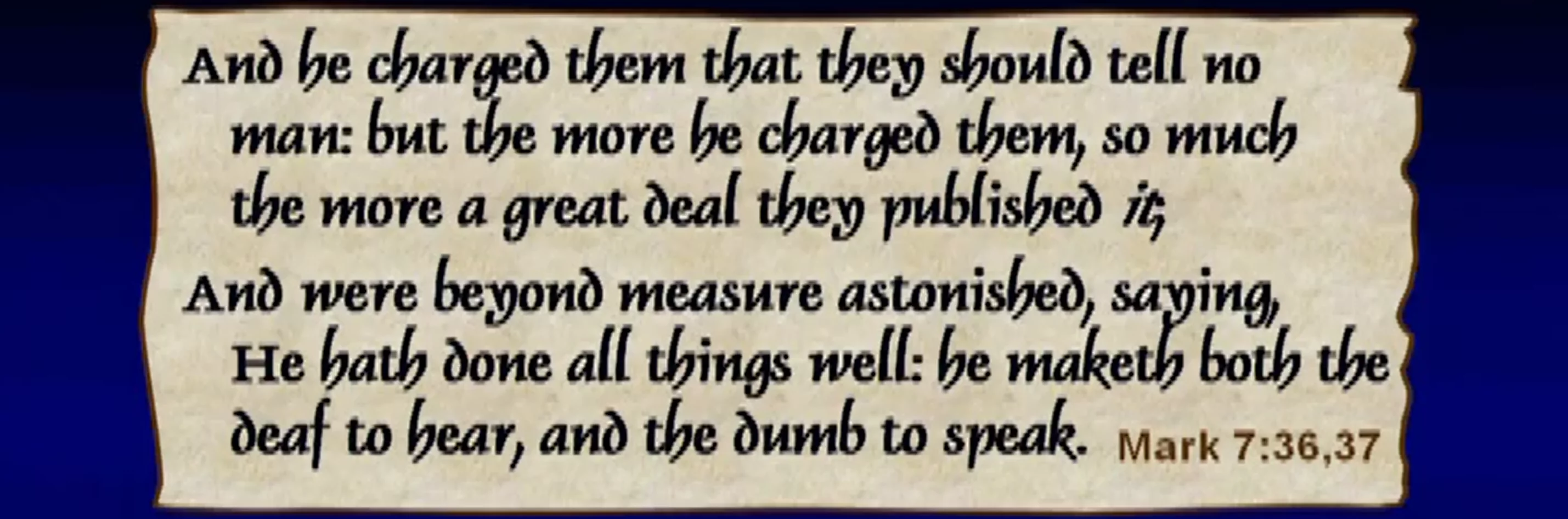
- [We get it backwards: He charged us to tell everyone; and we treat it as a secret…]
- John the Baptist sent his disciples to check on Jesus as if he had his doubts (Luke 7:22). We don’t know if he was using that just to challenge and train his disciples. So Jesus told them to report to John that the blind see, the deaf hear, the lame walk…

