s08 (Ch 8) 4k, Peter, Take Up Your Cross (studied 21-Oct-2025)
The Book of Mark with Dr. Chuck Missler
The subsections of Chapter 8 (per LSB) are:


- 4,000 is counting men only. How many people were really there? Multiply by 2 or 2.5 to estimate (Matt 15:38)
- Parallel passage Matt 15:32-39
- Not to be confused with the feeding of the “5,000” in Chapter 6 (which was probably 10,000):
— The 5,000 were with Jesus only one day → here, three days
— Other details also varied: what they started with, what they had left over, etc.
— Jesus’ declaration in v.19 is conclusive: Feeding 5k → 12 baskets full of broken pieces were left over
- Also, they were distinctively different groups of people (often missed by commentators):
— The 5,000 were exclusively Jews
— The 4,000 were fed in the Decapolis, a Gentile area (yes, there may have been some Jews)
Mark 8:1-3 Jesus Feeds Four Thousand
- Jesus was always touched by the need of the multitude… Especially seen in the Gospel of Luke
- For three days they flocked about Him, absorbed in His teachings
Mark 8:4-5
- “…Seven”: This time there were more loaves for fewer people but it was still true, “What are these among so many?”
Mark 8:6-8
- “…seven baskets”: In Chapter 6, after feeding the “5,000”, there were 12 hand-baskets left over
— Term used there: κόφινος (kophinos) a basket, such as were carried while traveling on foot
- Here, there were 7 hampers-full, large baskets such as were often used for carrying commercial goods
— Term used here: σπυρίς (spuris) a plaited reed basket, a wicker hamper
— These were large enough to hold a person: Paul escaped from Damascus in one of these (Acts 9:25)

Much of this was intended to be instructional for the disciples themselves. Jesus wanted them to understand the following:
- That He was the Bread of Life (John 6:48-51)
— He deliberately identified Himself with the manna, “the bread from heaven” (Exo 16:4)
— Bethlehem (House of Bread), His place of birth, echoes this very emphasis
— He also underscored this at the Last Supper: “Take, eat: this is my body, which is broken for you: this do in remembrance of me.” (1 Cor 11:24)
— Messianic prophecy by Solomon. If translated properly, it says: “God arrives to be consumed” (Cf. Prov 30:1-4)
- He wanted his disciples to understand that He was not only the Bread of Life for the Jews, but also for the Gentiles: “Man shall not live by bread alone.” (Matt 4:4)
- The supply from God always meets and exceeds the demand
— Whatever the Lord has given us, there is far more for Him to give us still. You can’t run dry
— Our souls are “elastic”
Mark 8:9

- “Beside women and children” (Matt 15:38) — Probably as many as twice that number!
Mark 8:10

- “…Dalmanutha”: A place on the west of the Sea of Galilee; in the parallel passage it is called “into the borders of Magdala” (Cf. Matt 15:39)
— Probably the Greek name of one of the many Migdols (i.e., watch-towers) on the western side of the lake
— It has been identified in the ruins of a village about a mile from Magdala, in the little open valley of Ain-el-Barideh, “the cold fountain”, the mouth of a glen a mile south of Magdala, near the beach; called el-Mejdel, possibly the “Migdal-el” of Josh 19:38
Mark 8:11-12 The Demand for a Sign (MEV)
- Now the bloodhounds of hate are on His trail again…
- They are always looking for a sign and that seems to upset the Lord
- The grammatical construction here indicates that Christ was angry. Why did they ask for a sign?
— He is upset because it was the evidence of the state of their hearts
— It springs from foundation of doubt
Mark 8:13-14
Mark 8:15 The Yeast of the Pharisees and of Herod (MEV)

- Disciples here are confused. They think that He is commenting on the fact that they didn’t bring enough bread
- “…leaven of the Pharisees”: hypocrisy and self-righteousness
- “…leaven of Herod”: (leaven of the Herodians) political chicanery; worldliness
- They are both adverse, but adverse in different aspects
- Jesus says — don’t get caught up with either one of these groups, with what they are into
- In the Scriptures, leaven represents wrong or evil teaching. It never means the gospel
— One of the fallacious things that is being taught today is that leaven represents the gospel in the parable of the woman who hid leaven in three measures of meal (Matt 13:33)

- The meal symbolizes the gospel, and the leaven, which represents wrong teaching, was hidden in it
— This is the process of making something taste good to the natural man
- Actually, what is liberalism?
— It all came into existence by the pulpit trying to please the unsaved church members. And today we have a lot of men trying to please the congregation, even when they are unsaved: that is putting leaven in—mixing wrong teaching with the truth of the gospel
Mark 8:16-18
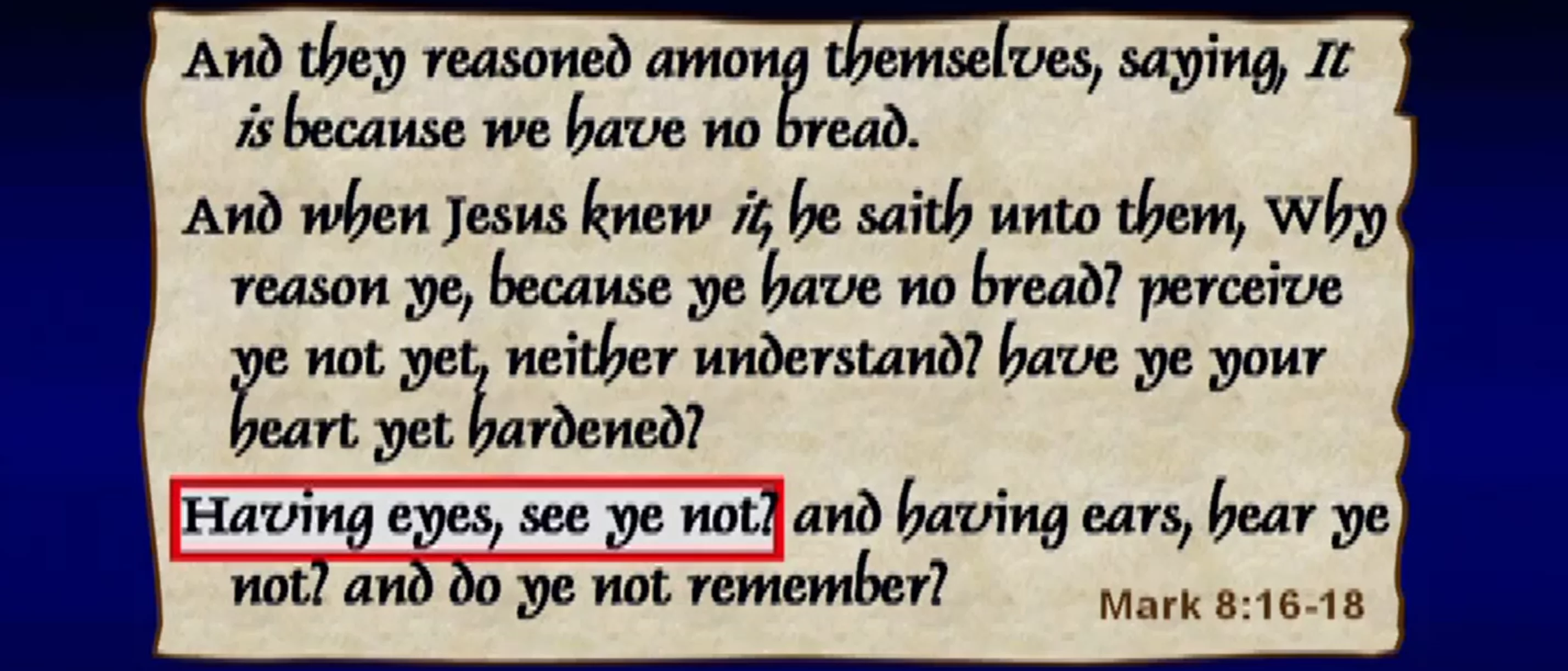
- They just got thru feeding huge crowds, miraculously — clearly, Jesus is not concerned about the fact that among the 12, they got only one loaf of bread
- There are people who have been studying the Bible for years and who are like that…
Mark 8:19-21
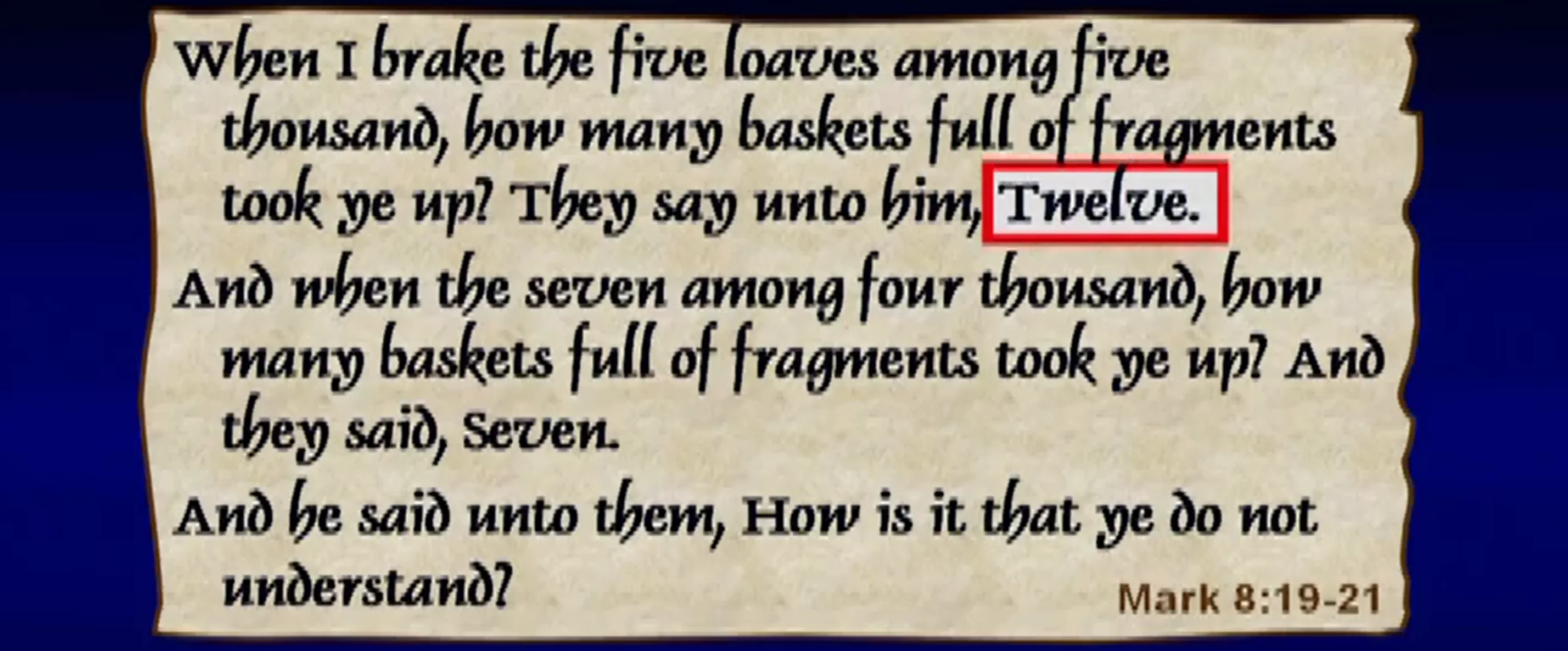
- “…twelve”: Symbolic of the Kingdom?

- Even though it was very recent past for them, disciples haven’t really appropriated the two feeding experiences
- We, too, need to dwell on the evidences of the past, that we know that those events really happened:
— Israel’s crossing of the Red Sea
— The fall of Jericho
— The sun standing still for Joshua
— Elijah at Mt. Carmel
— The raising of Lazarus
— Peter’s deliverance from jail
— And, above all, the empty tomb…
Mark 8:22-23 The Healing of a Blind Man at Bethsaida (MEV)
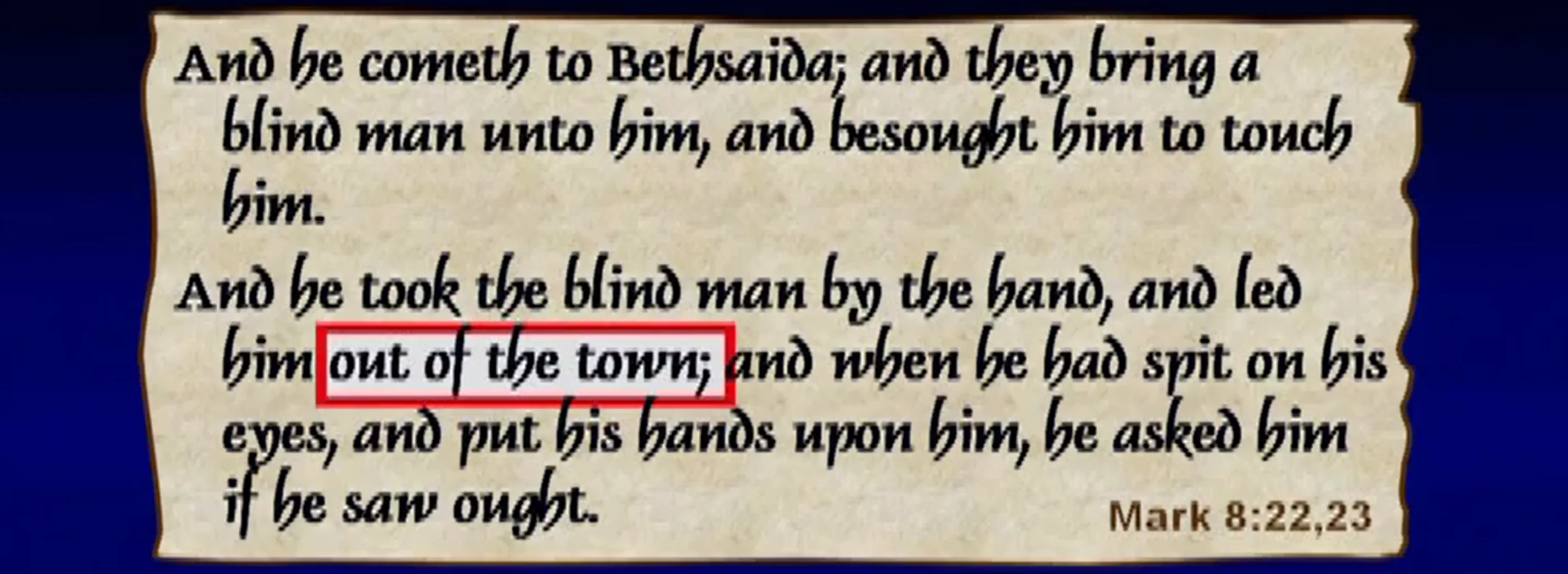
- This is an interesting incident from several points of view
- “…they”: his friends did the begging, not the blind man. He apparently was acquiescing to their enthusiasm; willing, but wary (feeling or showing caution about possible dangers or problems). His friends seem to have the driving force
- “…out of the town”: you notice that He led the blind man out of town. Had Bethsaida, where many of His mighty works had been performed, become like Nazareth where He could no longer perform mighty works?
— We will actually find that suggested in a few verses from here
Mark 8:24

- “…I see men as trees, walking.” — We’ll come back to this

- Blindness
— We are all first spiritually blind. Like the blind man we can say: (John 9:25 - me added)
“Once I was blind, but now I can see”. But you’ll notice that He gained only partial sight, and only Mark tells us this
- Partial sight
— Is this not our condition today?
— “For now we see through a glass darkly; but then face to face…” (1 Cor 13:12)
— Socrates, in his day, made the statement that he was the wisest of the Athenians. That shocked many of his friends because he was known to be humble (sounded like an audacious statement):
“Well there are a great many of the Athenians who think they know, and I know I do not know. And since I know that I do not know, I am the wisest of the Athenians”
- Perfect sight
— The third stage is perfect vision. We’ll get our 20/20 spiritual vision when we come into His presence, and that’s when we’ll really be able to see
— “Beloved, now we are children of God, and it has not appeared as yet what we will be. We know that when He appears, we will be like Him, because we will see Him just as He is.” (1 John 3:2)
— When our Lord had finished, He had healed this man perfectly
— Koinonia Institute logo (coin)

- There is a strange element to this healing here. It seems that He has to do it twice. He does it once and the guy can only see partially. That might be a Remez (a hint of something deeper, a lesson there that we are to learn)
- 1) Jesus’ staged healing was premeditated: the man was beginning to understand; his expectations were being transcended…
- 2) But there’s another aspect to this: “Do you see anything?”— “…I see men as trees, walking.”
Key to idiomatic uses of “trees”?
— As Kings: Cf. Dan 4 (Nebuchadnezzar’s Dream of a Great Tree), Ezek 31 et al
— Reigning over: Cf. Jotham’s Parable in the OT Judg 9

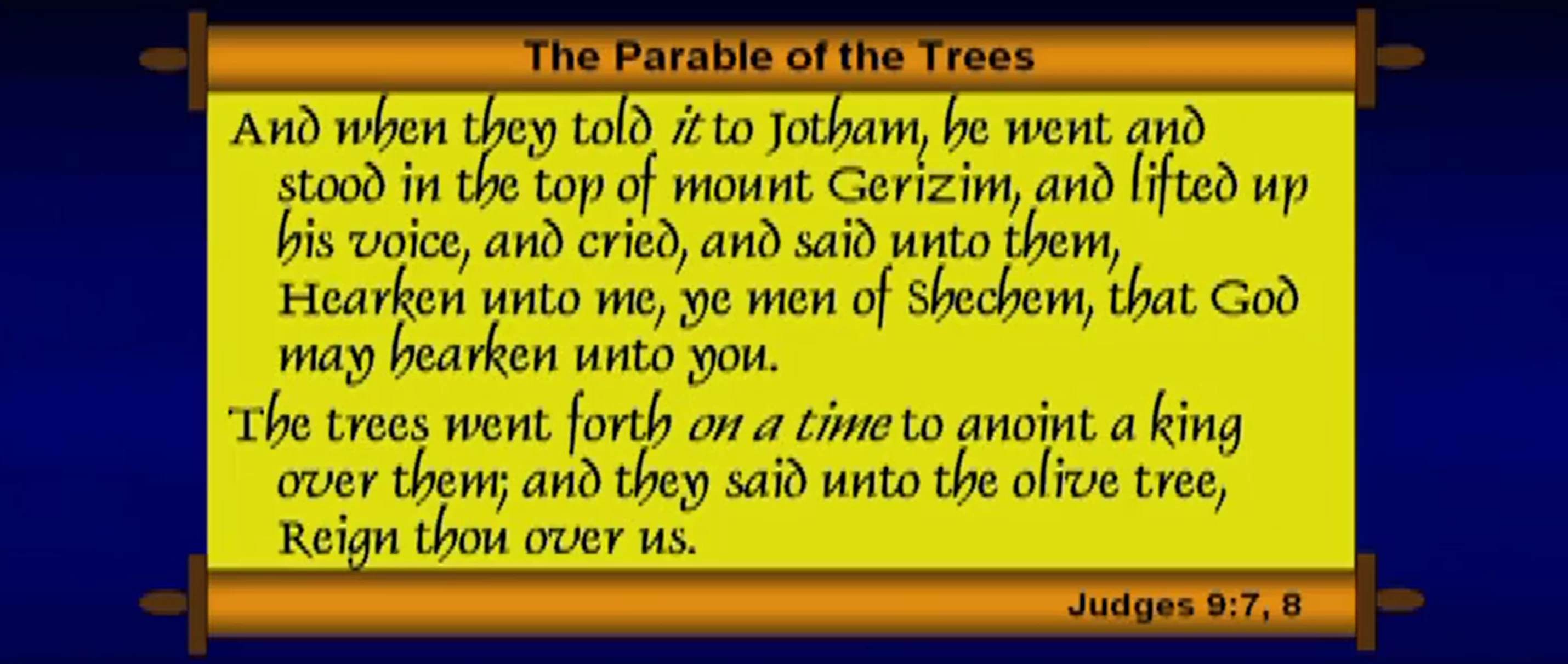
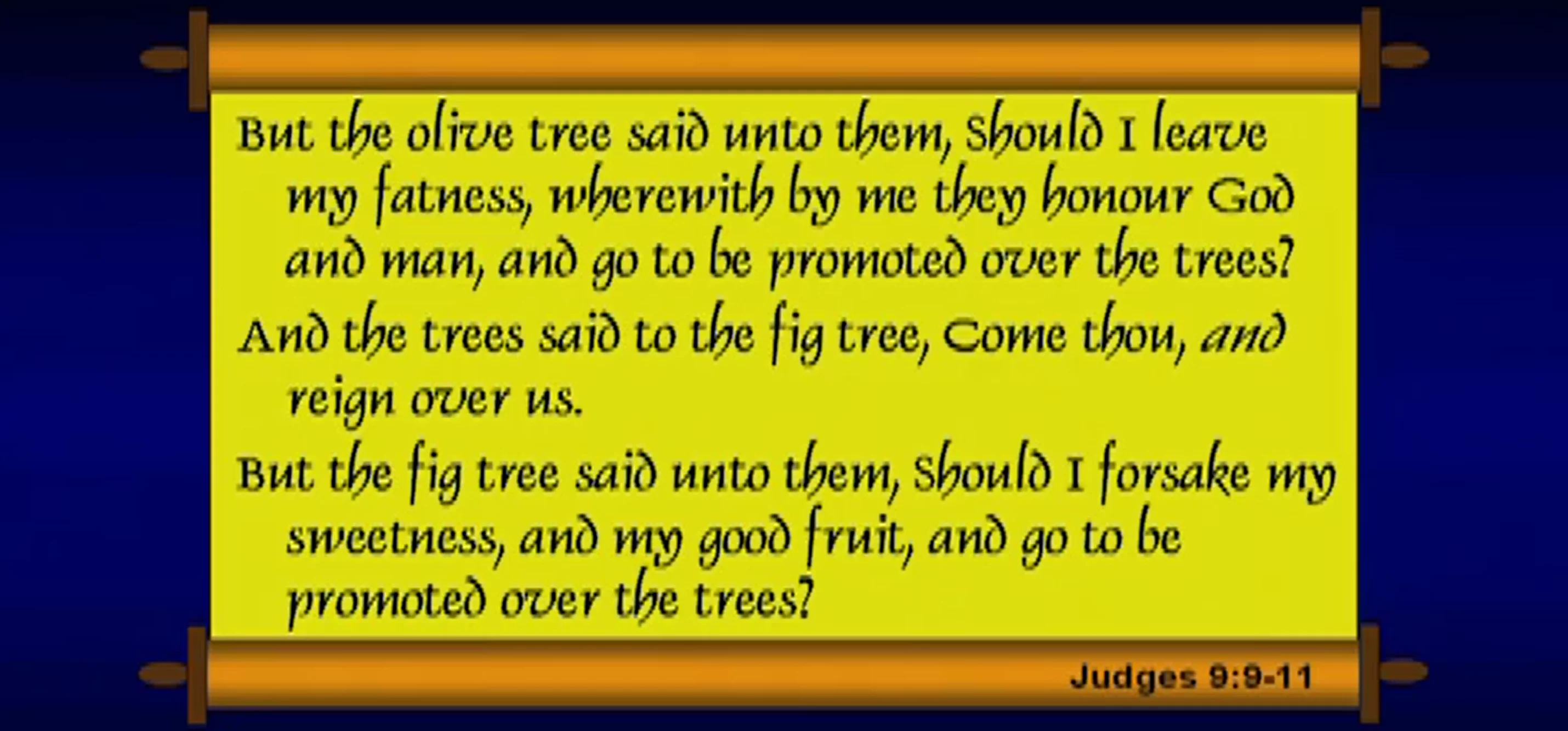
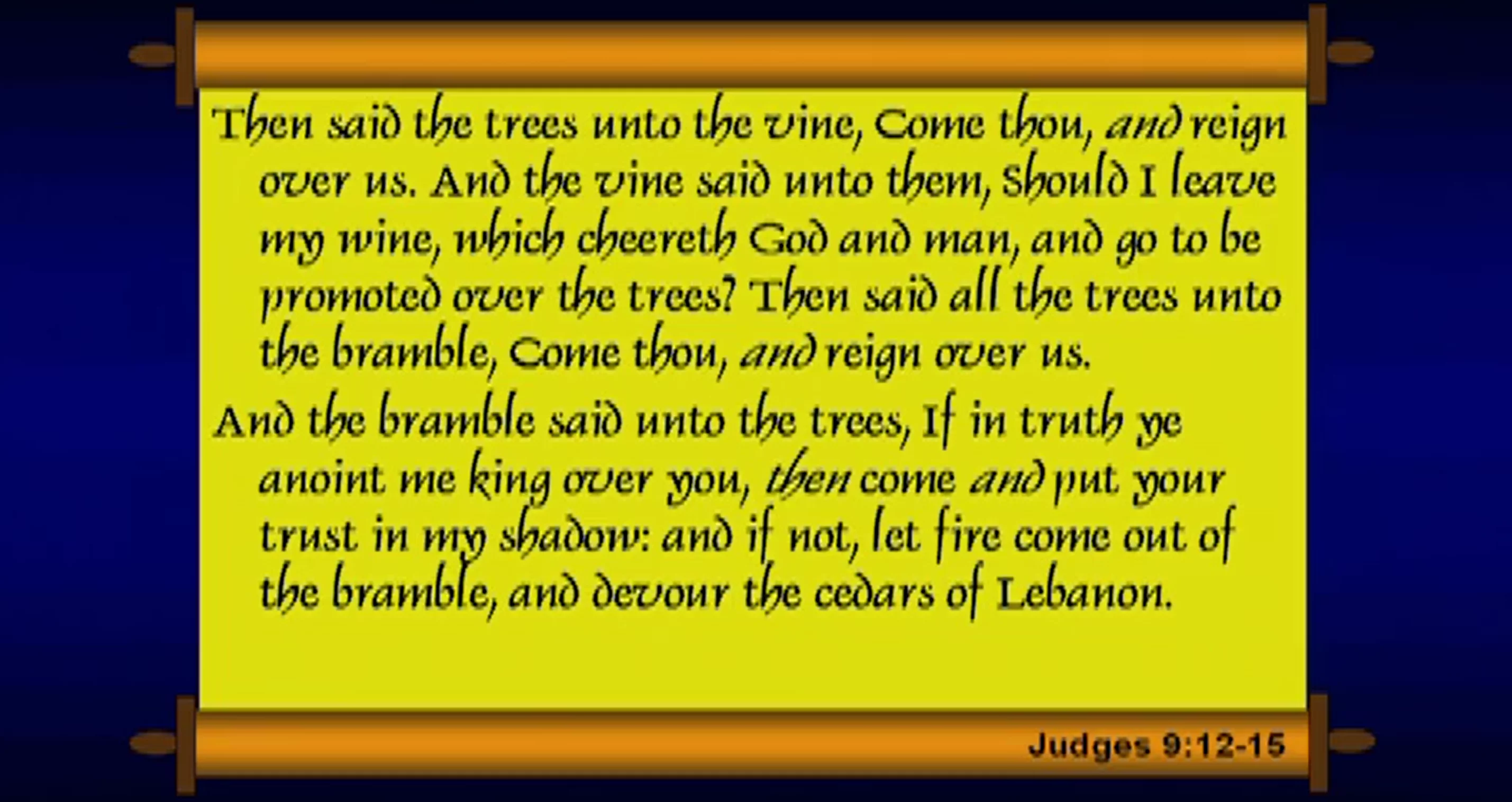
Jotham’s Parable of the Trees (Judg 9:7-15)
🟤 Judg 9:7-8
🟤 Judg 9:9-11
🟤 Judg 9:12-15
- What’s going on here?
- [to a Jew, “the cedars of Lebanon” are symbolic of the Temple]
- First of all, let’s talk a little bit about “Politics”:
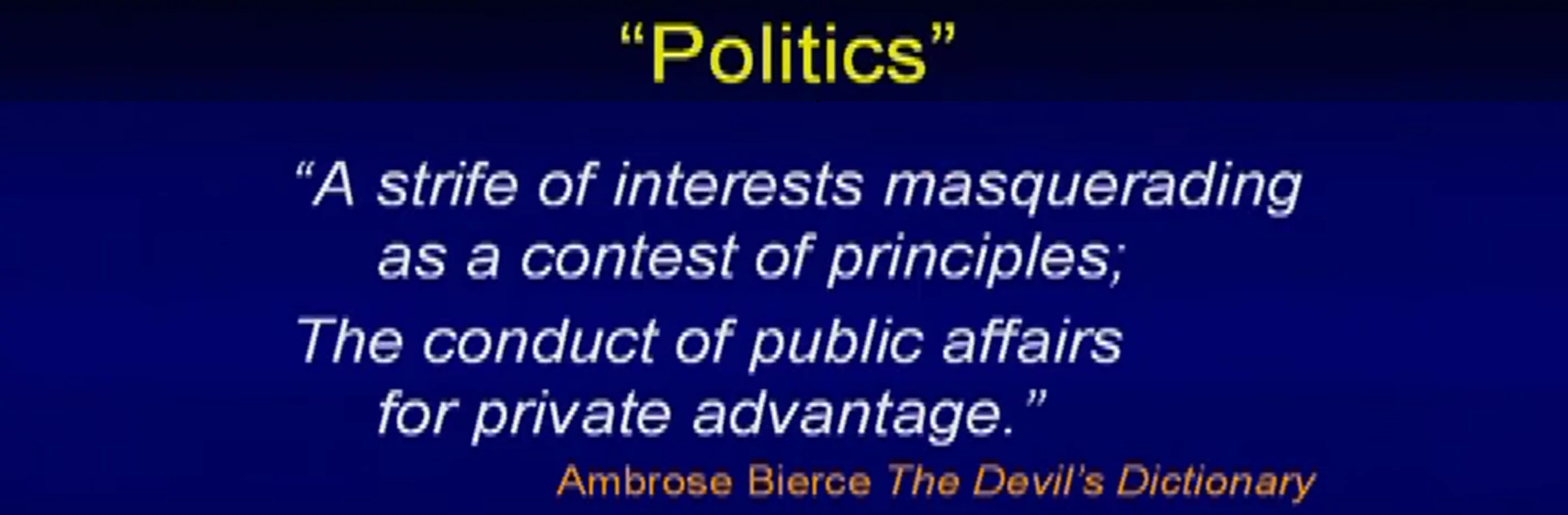
“A strife of interests masquerading as a contest of principles; The conduct of public affairs for private advantage.”
— Ambrose Bierce The Devil’s Dictionary

- Olive Tree – Valuable oil → Genealogy (Lineage)
- Fig Tree – Sweet Fruit → Political (didn’t bear fruit and that’s why it was cursed, Mark 11:14)
- Vine – Wine → Spiritual
- Bramble – No fruit (only good as fuel for the fire) → Satan’s Empire
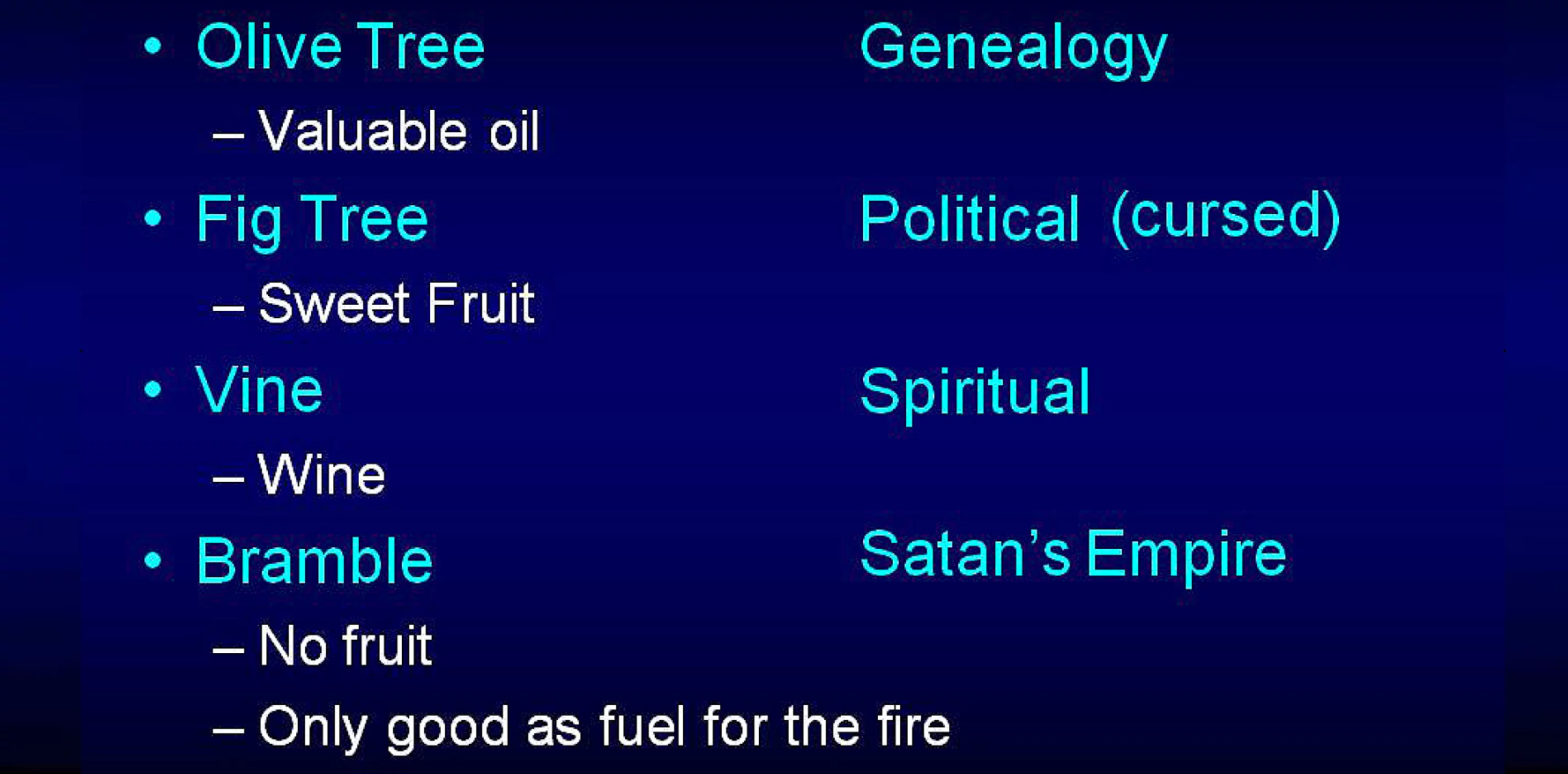
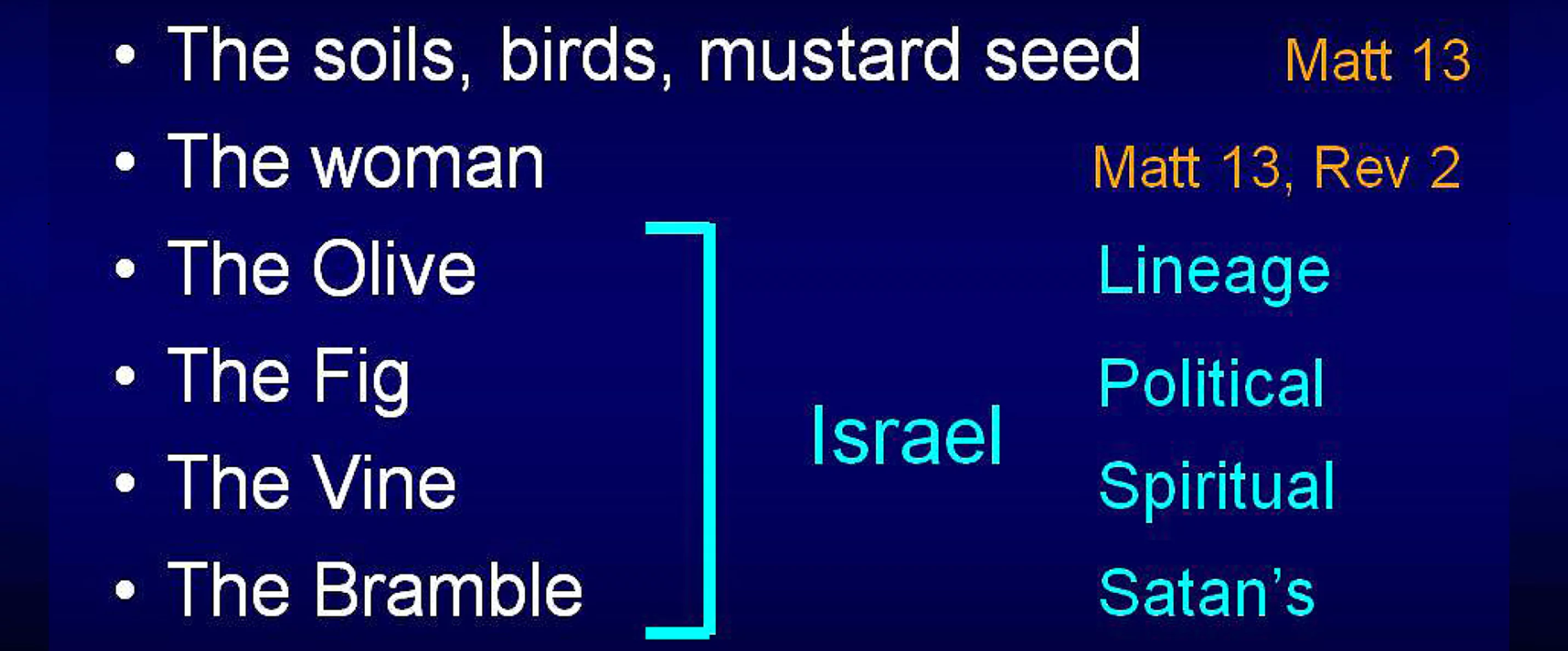
- All of these are used of Israel in different places of the Bible
The Rabbis treat Jotham’s parable as an index of these different idioms of Israel. Each four: Olive tree, Fig tree, Vine and Bramble, are (consistently) used in the Scripture of Israel, but each with a particular complexion (aspect)

Mark 8:25-26
- “…Neither go into the town, nor tell it to any in the town”: This place of Bethsaida had already had judgment pronounced upon it
— “Woe to you, Chorazin! Woe to you, Bethsaida! For if the miracles had occurred in Tyre and Sidon which occurred in you, they would have repented long ago in sackcloth and ashes.” (Matt 11:21 NASB)

- The guy saw “clearly from afar”, with 20/20 vision (his sight improved as he gained faith)
- Jesus matched the improvement of his sight with the growth of his faith
- The Lord’s miracles were more than simply remarkable events: they were parables of spiritual reality
- The progressive healing of the blind man reveals to us that sometimes God heals or saves in stages
— “For as the heavens are higher than the earth, so are my ways higher than your ways, and my thoughts than your thoughts.” (Isa 55:9)
— “Thy way is in the sea, and thy path in the great waters, and thy footsteps are not known.” (Ps 77:19)

- Different methods which our Lord used in opening eyes of the blind:
— Here at Bethsaida when He healed the blind man, he touched his eyes. So this man had an experience
— When Jesus healed blind Bartimaeus, He didn’t touch him at all but just told him from a distance, and faith alone opened his eyes (Mark 10:46–52, Luke 18:35–43)
— But the man who had been born blind was told to go and wash in the pool of Siloam, an entirely different method (John 9)
- What is the point here? The point is, you don’t put God in a box. There isn’t a formula, other than sovereignty of God. That sovereignty is nowhere more frustrating than in the area of healing:
— There is supernatural healing that takes place. It’s all over the landscape
— It seems to elude predictability
- There is a risk in our responding to His truth—it refers to the response to faith:
— “For whosoever hath, to him shall be given, and he shall have more abundance: but whosoever hath not, from him shall be taken away even that he hath.” (Matt 13:12, Matt 25:29, Luke 19:26)

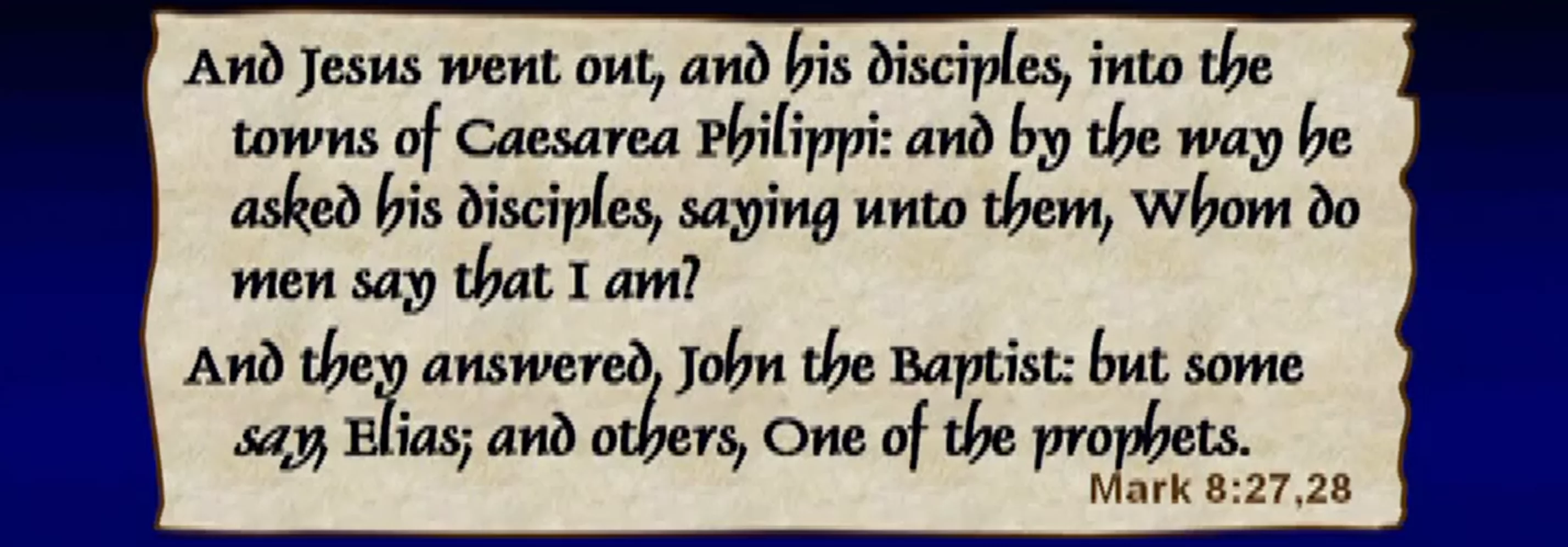
Mark 8:27-28 Peter Confesses Jesus Is the Christ
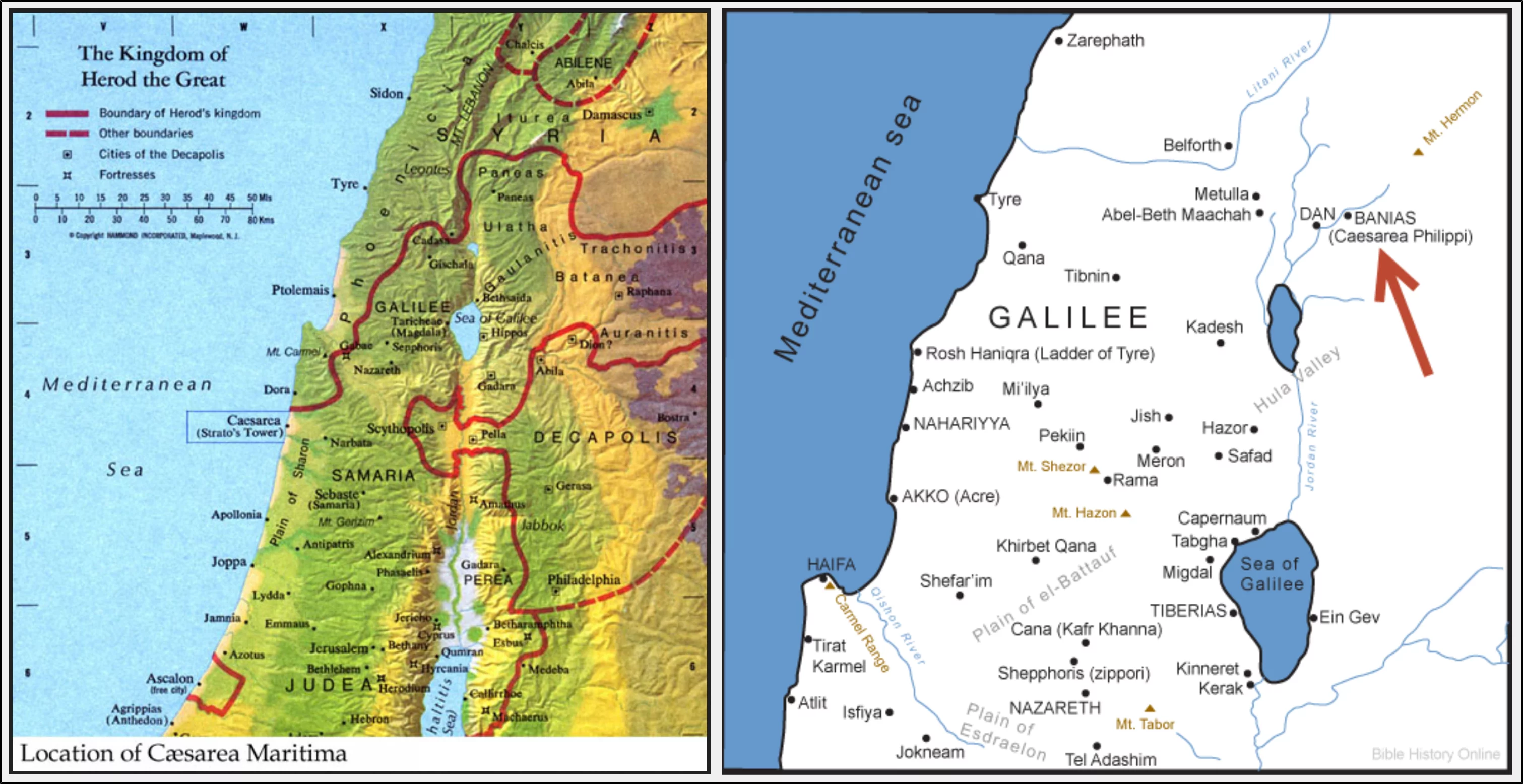
- Caesarea Philippi is way up north (Golan)
- Don’t confuse it with Caesarea on Mediterranean (Herod’s Caesarea Marittima)
- The ones they were expecting (John 1:19-21):
— John the Baptist or the one that was predicted in Isa 40:3 (A Voice in the Wilderness)
— Elijah (Mal 4:5)
— The Prophet (Deut 18:15)
Mark 8:29

- “…the Christ”: Christ is not a name. Jesus is His name
- Christ is a title—in the Hebrew, it was the Messiah, which means the “Anointed One”
— (The term “Christ” does not appear in the International Standard Version (ISV): they use “Messiah”)
— This title gathers up all the rich meaning of the Old Testament. It is a fragment with fullness
(Micah 5:2, Isa 7:14, Ps 2:2, Ps 45:6-7, Mal 3:1)
- It is not enough to be familiar with other men’s views of Christ, be they right or wrong. Our Lord’s question was intended to emphasize the responsibility of individuals to know Him for themselves
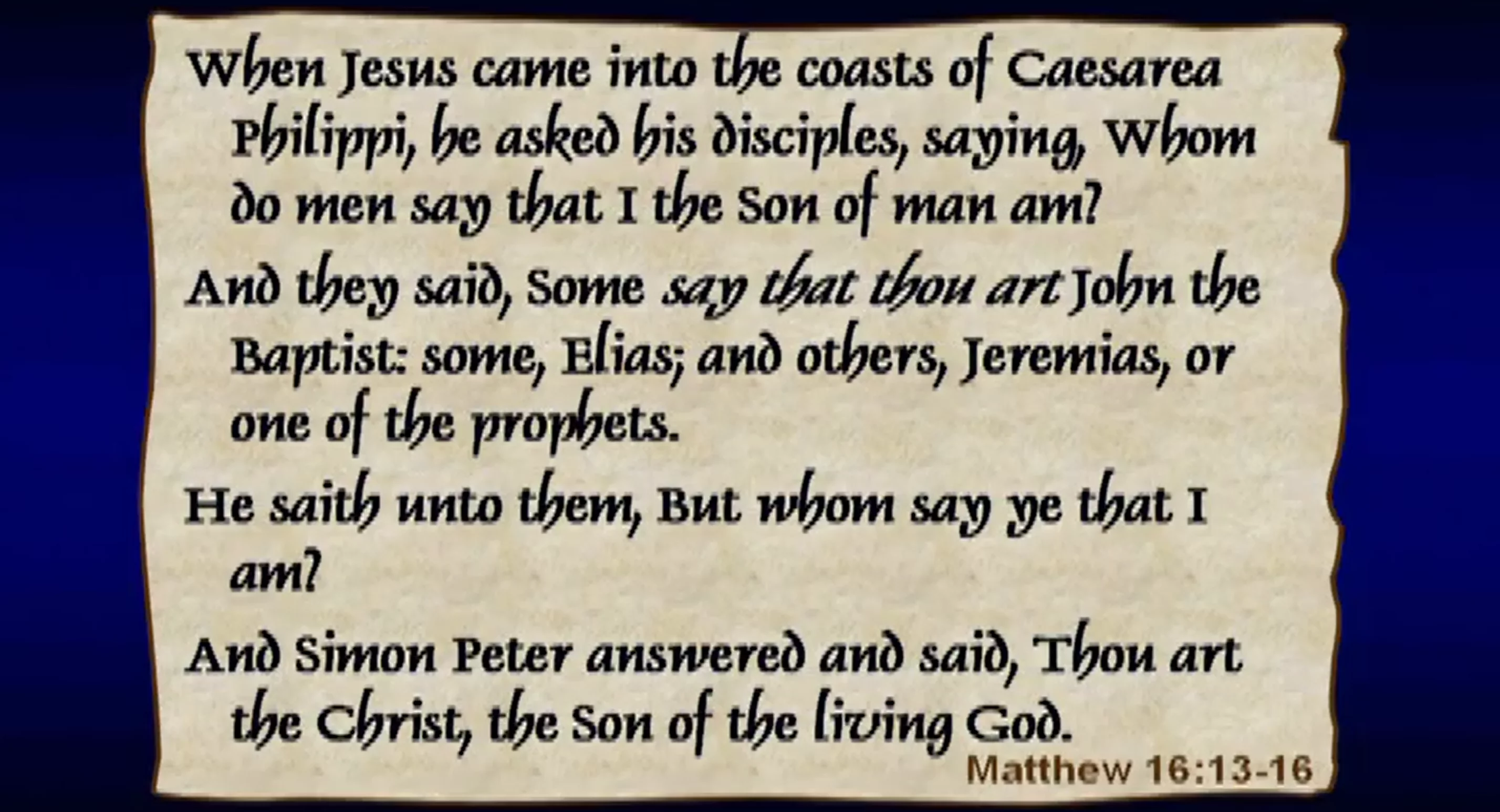
- Peter’s fuller confession is given in the Gospel of Matthew:
🔴 Matt 16:13-16 (Peter’s Confession of Christ)
🔴 Matt 16:17-18
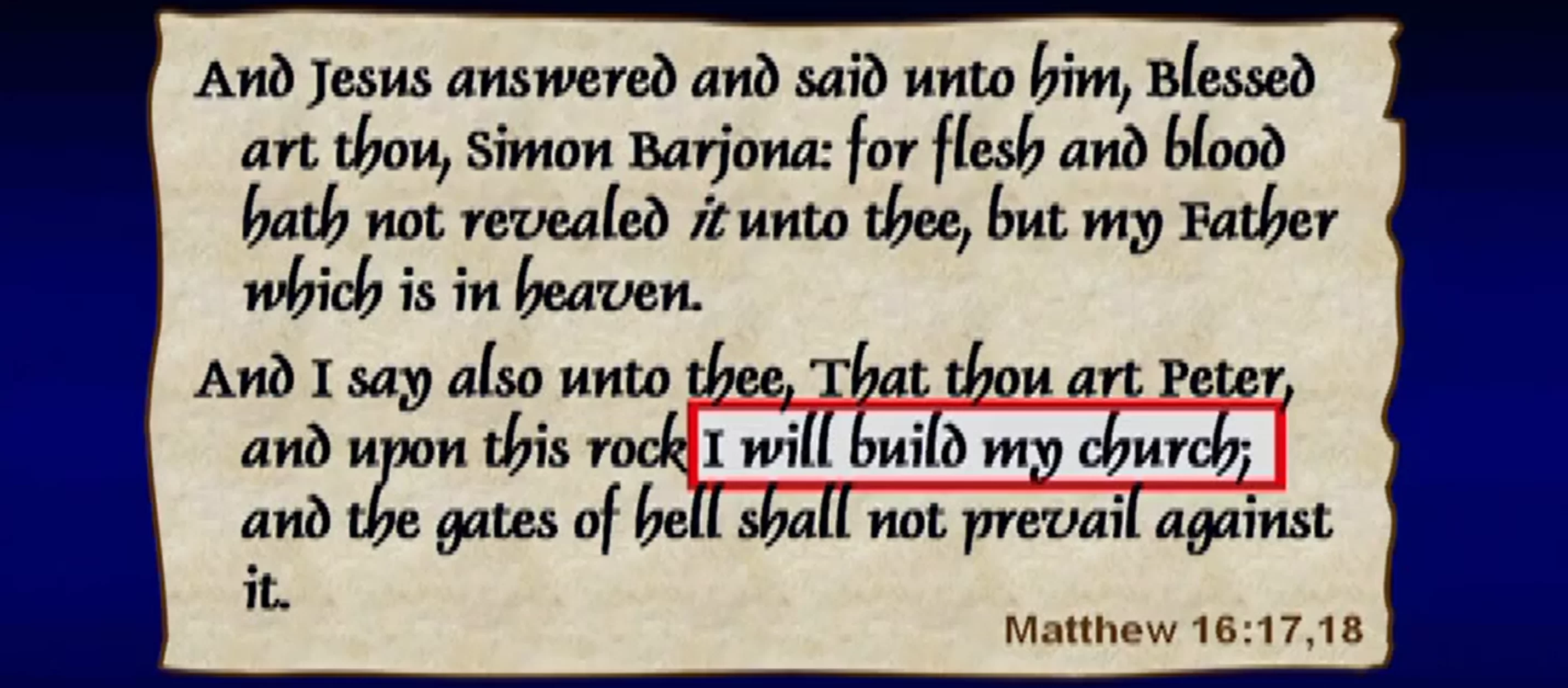
- “…upon this rock I will build my church”:
⛏️ Petros — (smaller) — part of a rock, that which is hewn out of a rock, a stone
⛏️ Petra — (larger) — the rock out of which a stone is hewn (Matt 7:24-25)
- This is a pun between Peter (the stone) and Petra (the rock)
- Who is the Rock? (1 Cor 3:11, Eph 2:20, 1 Cor 10:4, 1 Pet 2:4-7)
- Peter was not infallible; Paul had to dress him down (Gal 2:11-16)
- The idea of Peter being the first pope is not Biblical
— See the briefing package, The Kingdom of Blood, for an in-depth study
🔴 Matt 16:19-20
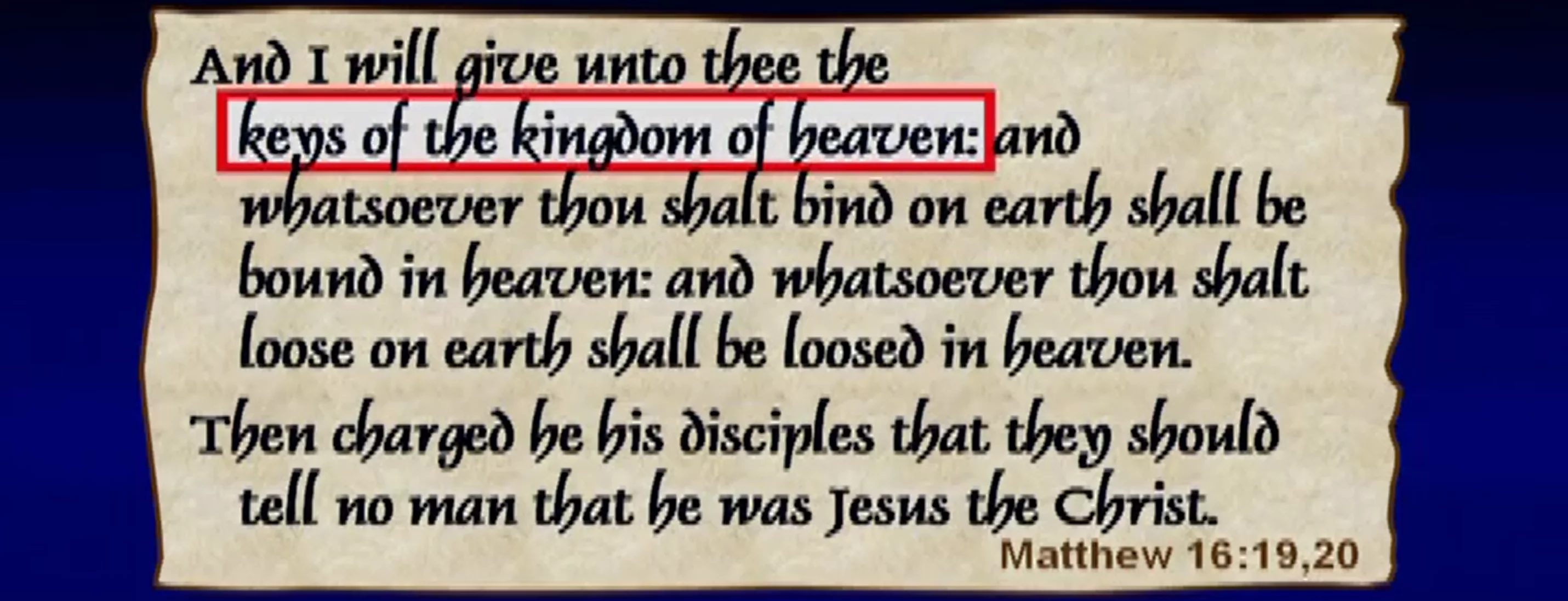
- “…keys of the kingdom of heaven”: Defined (Isa 22:22; Cf. Isa 9:6, Ps 2:7) — keys to the tabernacle of David
- Were these given only to Peter? No, given to all disciples (Matt 18:18)
- It is apostolic authority. Not unique to Peter alone
- Keys of David mentioned in the letter to the Church of Philadelphia (Rev 3:7)
Mark 8:30

- “And he charged them”: This is a strong rebuke: the verb, ἐπιτιμάω (epitimao), is the same one Jesus used in rebuking the demons (Mark 1:25)
- They were to wait until the gospel story was complete (Cf. next verse Mk 8.31)

- Mark includes certain interesting details, but he also omits to make certain mentions that other Gospels do
- This Gospel of Mark makes no mention of (fingerprint of his humility):
— The Lord’s commendation of Peter (it’s Peter’s Gospel, he is being humble)
— His prophetic words concerning the building of His Church upon the rock of His deity; nor
— His giving of the keys of the kingdom of heaven
(which Peter used on Pentecost and in Cornelius’ house to admit Gentiles as well as Jews in its present aspect)
— Peter humbly made no mention of his affirmation to Mark
Mark 8:31 Jesus Foretells His Death and Resurrection (MEV)
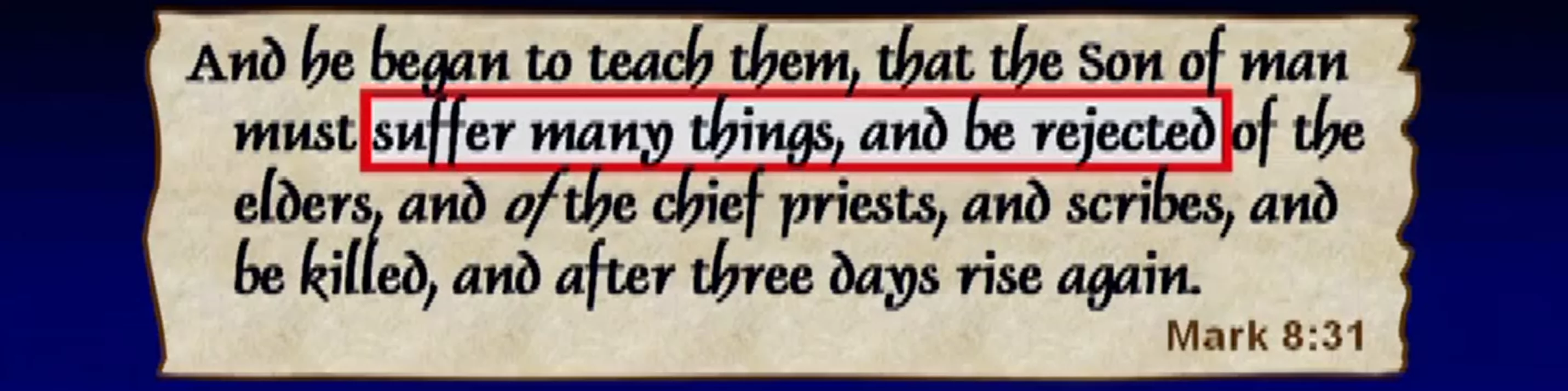
- “…suffer many things, and be rejected”: Jesus did not reveal His Person apart from His work of redemption. Salvation depends on who He is and what He did
- The final phase of their training begins here. It was at Caesarea Philippi that He first revealed His cross to them
(Yet only a few women seemed to anticipate that final week)
Mark 8:32-33
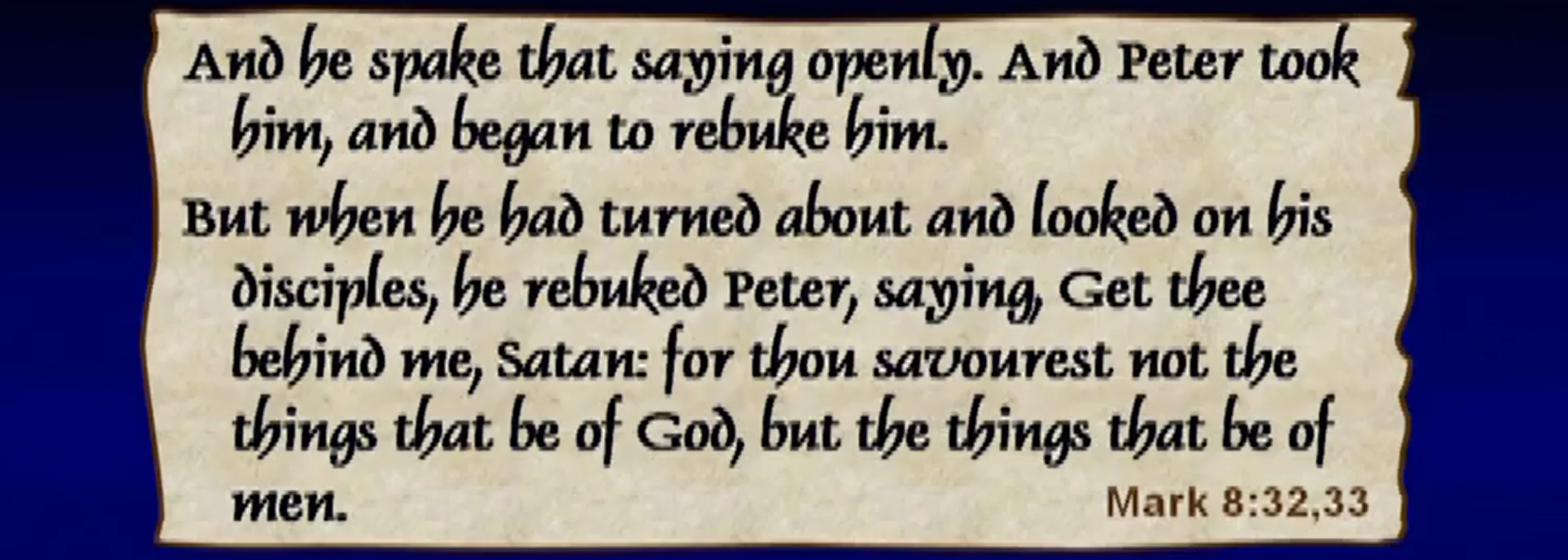
- These were the harshest words Jesus ever spoke to a devoted, well meaning heart
- Peter had become the unwitting (not on purpose, unintentional) carrier of demonic doctrine, paralleling Satan’s proposition during the temptations following Jesus’ baptism (Matt 4:8-10)
- Peter had good intentions, but that is not enough (zeal without knowledge — very dangerous)
- Only moments before, Peter confessed Jesus as the Christ, the Son of the living God; now he ventures, with an air of protective superiority, to rebuke Him!?
- The disciples knew He was the Messiah early. When Andrew first introduced Jesus to his brother Simon, he used this very identity (John 1:41)
- Peter apparently was a victim of the “Two Messiah” view of the OT:
— 1) The Messiah ben Joseph: the Suffering Servant and
— 2) The Messiah ben David: the Ruling King
- The fixation on the Ruling King view, and his political aspirations, is what ultimately disenchants Judas

- The sacrificial death of Christ was essential to make atonement for sin and the very mission that He was in the world to accomplish: appeasement, satisfaction, substitution, redemption, pacification and reconciliation (all wrapped up in this. That was His mission)
- Crucifixion is not a tragedy. It was an achievement that was planned before the foundation of the world
- The Hebrew word translated by these various terms is rendered by a Greek word meaning “propitiation”: ἱλαστήριον (hilasterion), relating to an appeasing or expiating, having placating or expiating force, expiatory; a means of appeasing or expiating, a propitiation
- The Hebrew term, כַּפֹּ֫רֶת(kapporeth), “mercy-seat”, refers to the place of atonement: the golden plate of propitiation on which the High Priest sprinkled the seat seven times on the Day of Atonement, symbolically reconciling YHWH with His chosen people
- The slab of gold on top of the ark of the covenant measured 2.5 by 1.5 cubits (about 120cm x 70cm)
- On it, and part of it, were the two golden cherubim facing each other whose outstretched wings came together above and constituted the throne of God (artists do not render this properly; two of the wings come together to form back of the seat and two the side to make the seat)
- God, in the OT, is repeatedly viewed as He who “dwelleth between the cherubim”. The “mercy seat” in the Holy of Holies was sprinkled with the blood of the expiatory victim on Yom Kippur, the annual day of atonement, signifying that the life of the people, the loss of which they had merited by their sins, was offered to God in the blood as the life of the victim, and that God by this ceremony was appeased and their sins expiated
- All through His life Jesus had the cross before Him. He became Man that He could die as our Kinsman-Redeemer, גָּאֳלֵי(goel) (Lev 25:48; cf. Boaz in Ruth 4)
- [There are some scholars who believe that this seat will literally be the seat from which the Messiah will rule during the Millennium: Cf. the briefing pack, The Seat of Mercy]
— “Whom God hath set forth to be a propitiation through faith in his blood, to declare his righteousness for the remission of sins that are past, through the forbearance of God;” (Rom 3:25) The essence of the death of Christ
— “Herein is love, not that we loved God, but that he loved us, and sent his Son to be the propitiation for our sins.” (1 John 4:10)
— “And he is the propitiation for our sins: and not for ours only, but also for the sins of the whole world.” (1 John 2:2) This verse is refutation of the concept of limited atonement, popularized in the 5 points of Calvinism:

- [btw John Calvin was not Calvinist, because his students went further than he did. Calvin understood this, Calvinists don’t, typically, strangely enough—Calvinists don’t understand Calvin, just like hyper-dispensationalists don’t understand dispensationalism]
- The cross was the very purpose He came for
— “Even as the Son of man came not to be ministered unto, but to minister, and to give his life a ransom for many.” (Matt 20:28)
- This is the concept that is central to the doctrine of grace
— “For I delivered unto you first of all that which I also received, how that Christ died for our sins according to the scriptures;” (1 Cor 15:3)
— “Then said he, Lo, I come to do thy will, O God. …” (Heb 10:9)
— “Him, being delivered by the determinate counsel and foreknowledge of God, ye have taken, and by wicked hands have crucified and slain:” (Acts 2:23)

This whole thing is a model for living. You need to understand:
- What it meant, and
- What it requires
Because, this is a “So what?” question. What do I do with this?
Mark 8:34 Take Up Your Cross (LSB)
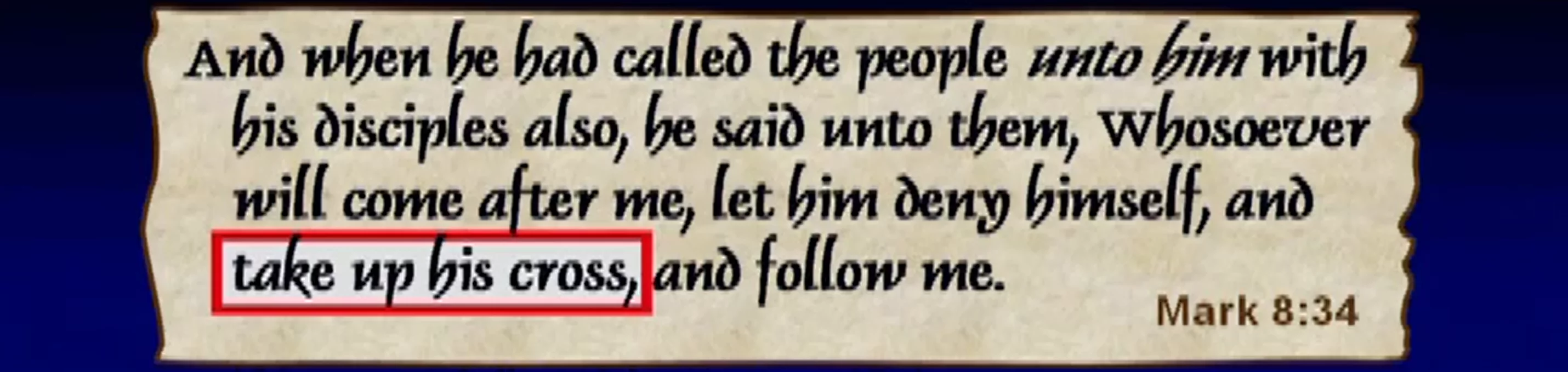
- Familiar words. Heavy words. We need to be serious about it
- “…take up his cross”: You have a cross to take up? Absolutely!
— We too must follow him to crucifixion
— We, too, march to death. Of ourselves
- Paul spoke of “dying daily”
— “I affirm, brethren, by the boasting in you which I have in Christ Jesus our Lord, I die daily.” (1 Cor 15:31 NASB)
— “I am crucified with Christ: nevertheless I live; yet not I, but Christ liveth in me: and the life which I now live in the flesh I live by the faith of the Son of God, who loved me, and gave himself for me.” (Gal 2:20)
- It’s that exchanged life. We trade. We live His life in us
- Practical books written on this theme: “The Way of Agape” accompanied with “Be Ye Transformed”
Mark 8:35-37
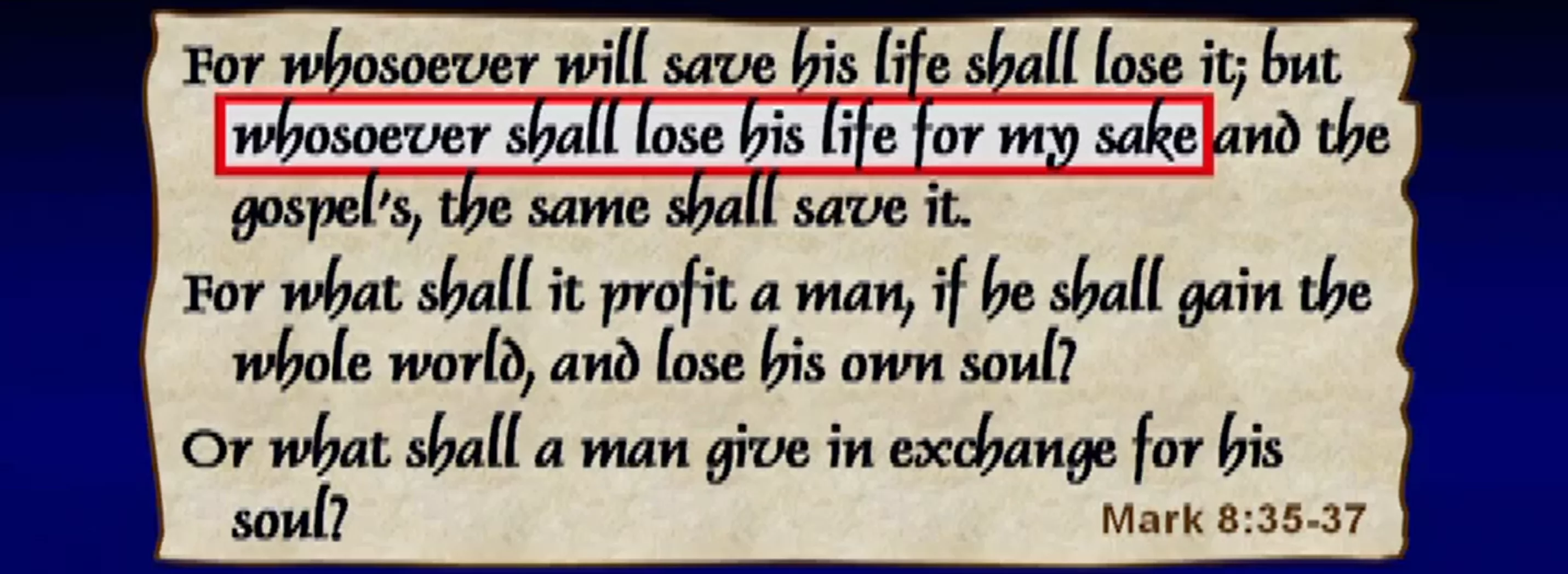
- “…whosoever will lose his life for my sake…”: The fundamental law of life—Losers are keepers
Mark 8:38