s10 (Ch 10) The Five Paradoxes (studied 27-Oct-2025)
The Book of Mark with Dr. Chuck Missler
The subsections of Chapter 10 (per LSB) are:


- There are many figures of speech and rhetorical devices in the Scriptures:
— symbols, types, parables, proverbs and paradoxes
— (Our book, Cosmic Codes: Hidden Messages From the Edge of Eternity, includes an appendix which catalogues over 200 different kinds of rhetorical devices, with examples and references)
- A paradox is a statement that ostensibly contradicts itself and yet embraces a valid truth or principle
— “Therefore I take pleasure in infirmities, in reproaches, in necessities, in persecutions, in distresses for Christ’s sake: for when I am weak, then am I strong.” (2 Cor 12:10)
— “by glory and dishonor, by evil report and good report; regarded as deceivers and yet true; 9 as unknown yet well-known, as dying yet behold, we live; as punished yet not put to death, 10 as sorrowful yet always rejoicing, as poor yet making many rich, as having nothing yet possessing all things.” (Cf. 2 Cor 6:8-10 NASB)

This chapter is structured around five succinct paradoxical declarations:
- Two Shall Be One → Marriage and Divorce
- Adults Shall Be as Children → Jesus Blesses Little Children
- The First Shall Be Last → The Rich Young Ruler
- Servants Shall Be Rulers → James and John’s Request for Status
- The Poor Become Rich → The Healing of Blind Bartimaeus

- In our cultural emphasis on “self-fulfillment”, “self-realization” and “self-actualization”—that is, the worship of self—this passage is painfully relevant
- More important than “self-fulfillment”, or even our own happiness, is obedience to God’s Word. God desires obedience more than actual worship
— “Samuel said,
“Has the LORD as much delight in burnt offerings and sacrifices
As in obeying the voice of the LORD?
Behold, to obey is better than sacrifice,
And to heed than the fat of rams.” (1 Sam 15:22 NASB)
- One of the things that is really missing, from our modern culture especially, is the Fear of God. There was a day we would designate a believer as God-fearing person. We don’t use that phrase anymore. We are so conditioned to burry or hide or sweep under the carpet the need to fear God. All thru the Bible the faithful trembled before Him
- Yes He loves us, and we want to embrace His love and His grace, that’s fantastic. But we shouldn’t overemphasize that to the degree of not fearing Him
— “There is a way which seemeth right unto a man, but the end thereof are the ways of death.” appears twice in the Book of Proverbs — Prov 14:12, Prov 16:25 Often, things that seem right to us are actually quite wrong
Mark 10:1 Teaching About Divorce
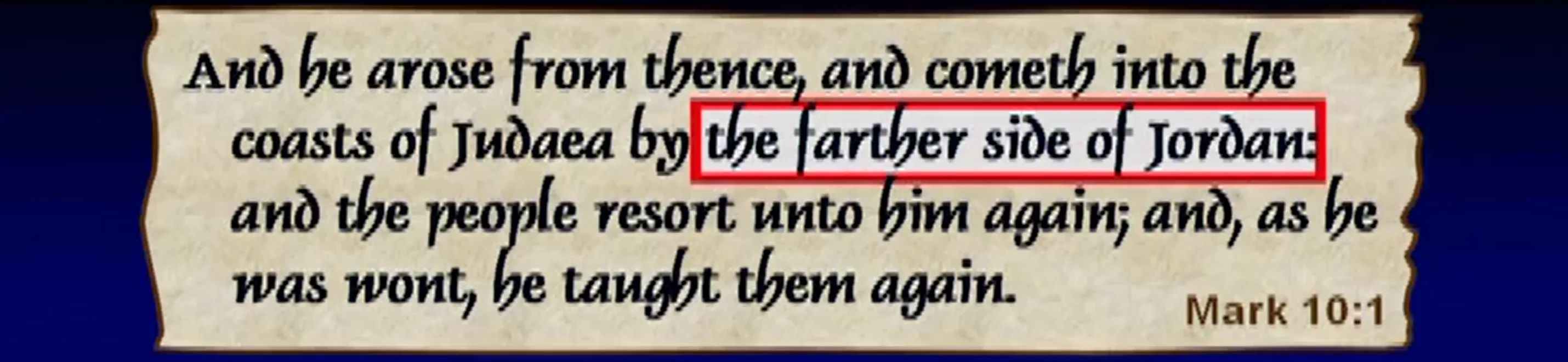
- “…the farther side of Jordan”: Perea, or present day Trans-Jordan. A region ruled by Herod Antipas, which may explain why the Pharisees tried to trap Him by raising the question about divorce
— John the Baptist had lost his head when he preached against Herod’s adulterous marriage (Mark 6:14-29)
- With one statement Mark summarizes about six months of Christ’s ministry (v. 1)
— His mention of Judea covers the later Judean period, recorded largely in John 7:10-10:39 and Luke 10:1-13:21
— The reference to the farther side of Jordan has to do with the Perean ministry, the greater part of which is reported in Luke 13:22-19:28
— The events of Mark 10:2-52 are in reality the closing events of this Perean period (Luke 18:15-19:28)
Mark 10:2

- Tempting Him is actually testing Him. They tried to trap Him
- “…and asked him”: “Kept asking Him”— it isn’t just a one shot thing, they were pestering this issue. The verb indicates that they had hoped to provoke something incriminating. This isn’t a sincere inquiry for truth
- There was more than simply politics involved: divorce was an extremely controversial topic among the Jews—as it remains among Christians today—and no matter what answer Jesus would give, it would be certain to displease somebody and even might yield an opportunity to arrest Him
- The two prevailing views on divorce depended upon how one would interpret the phrase some uncleanness in Deut 24:1-4 Heb: matter of nakedness
1) The followers of Rabbi Hillel were quite lenient and permitted a man to divorce his wife for any reason, even the burning of his food
2) The school of Rabbi Shimmai was much more strict and taught that the critical words some uncleanness referred only to premarital sin. If a newly married husband discovered that his wife was not a virgin, then he could put her away
Mark 10:3-4
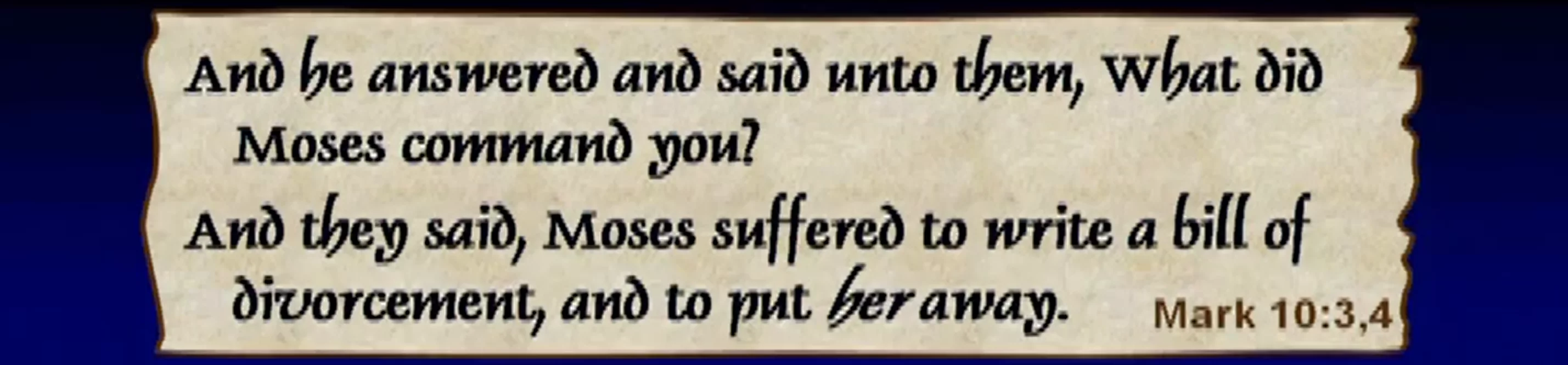
- As usual, Jesus ignored the current debates and focused attention on the Word of God (Deut 24:1-4)
- Two key facts are paramount:
— 1) It was the man that divorced the wife, not the wife who divorced the husband, for women in Israel did not have this right. (Roman women did have the right of divorce)
— 2) The official “bill of divorcement” was given to the wife to declare her status and to assure any prospective husband that she was indeed free to remarry. Apart from the giving of this document, the only other requirement was that the woman not return to her first husband if her second husband divorce her
- Among the Jews, the question was not, “May a divorced woman marry again?” because remarriage was permitted and even expected
- The big question was: “What are the legal grounds for a man to divorce his wife?”
— [The Torah did not give adultery as grounds for divorce: in ancient Israel, the adulterer and the adulteress were stoned to death (Deut 22:22, Lev 20:10, also see John 8:1-11)]
— Whatever Moses meant by “some uncleanness” in Deut 24:1, it could not have been adultery!
Mark 10:5

- Jesus explained that the divorce law was given because of the sinfulness of the human heart: the law protected the wife by restraining the husband from impulsively divorcing her and casting her off rather than treating her like a human being
- Without a bill of divorcement, a woman would be likely to become a social outcast and treated like a harlot. No man would want to marry her, and she would be left defenseless and destitute
- By giving this commandment to Israel, God was not putting His approval on divorce or even encouraging it
- Rather, He was seeking to restrain it and make it more difficult for men to dismiss their wives
- He put sufficient regulations around divorce so that the wives would not become victims of their husbands’ whims
- Husband would need to think twice before divorcing her:
— Either accept her as she is and not divorce her or
— Divorce her and know that he will never be able to be with her again (while she was free to remarry)
Mark 10:6

- Jesus takes them back far before Moses to the record of the original creation (Gen 1:27, Gen 2:21-25)
- God established marriage and He has the right to determine the rules
Mark 10:7

- According to Scripture, marriage is between a man and a woman (not two men or two women!)
Mark 10:8-9
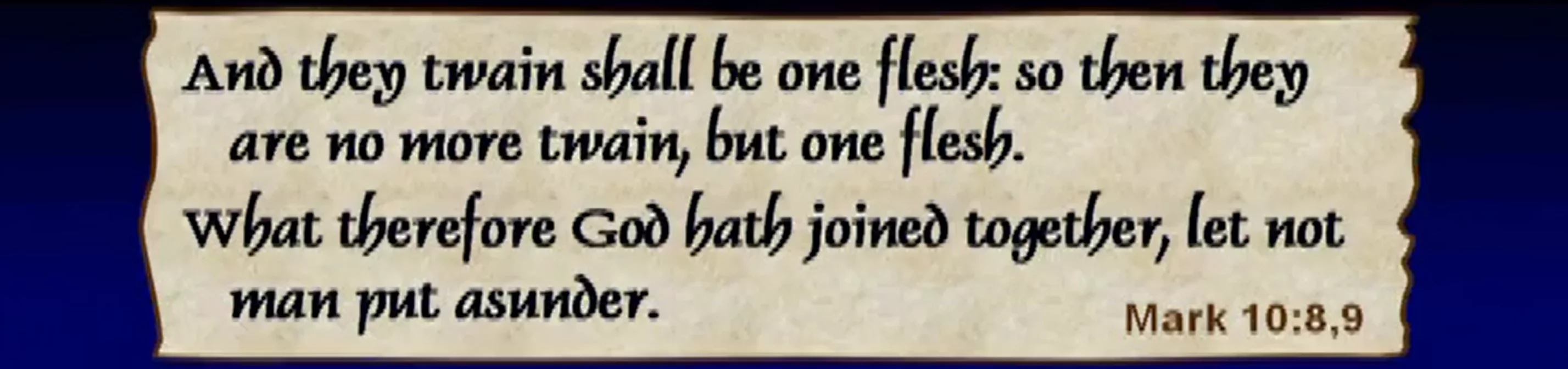
- The relationship is sacred, intimate and intended to be permanent
- [For a more complete rendering of Jesus’ teaching, see Matt 19:1-12]
— (Matthew had shorthand skills—they were required for his profession as a customs official)
- The union is a physical union: only a physical cause can break it:
— either death (Rom 7:1-3) or
— fornication (Matt 5:32, Matt 19:9)
- Mark didn’t include the “exception clause” found in Matthew, but neither did he say that death breaks the union. With the abandonment of execution for adultery, divorce was substituted for death; it was understood as adequate grounds
Mark 10:10-12
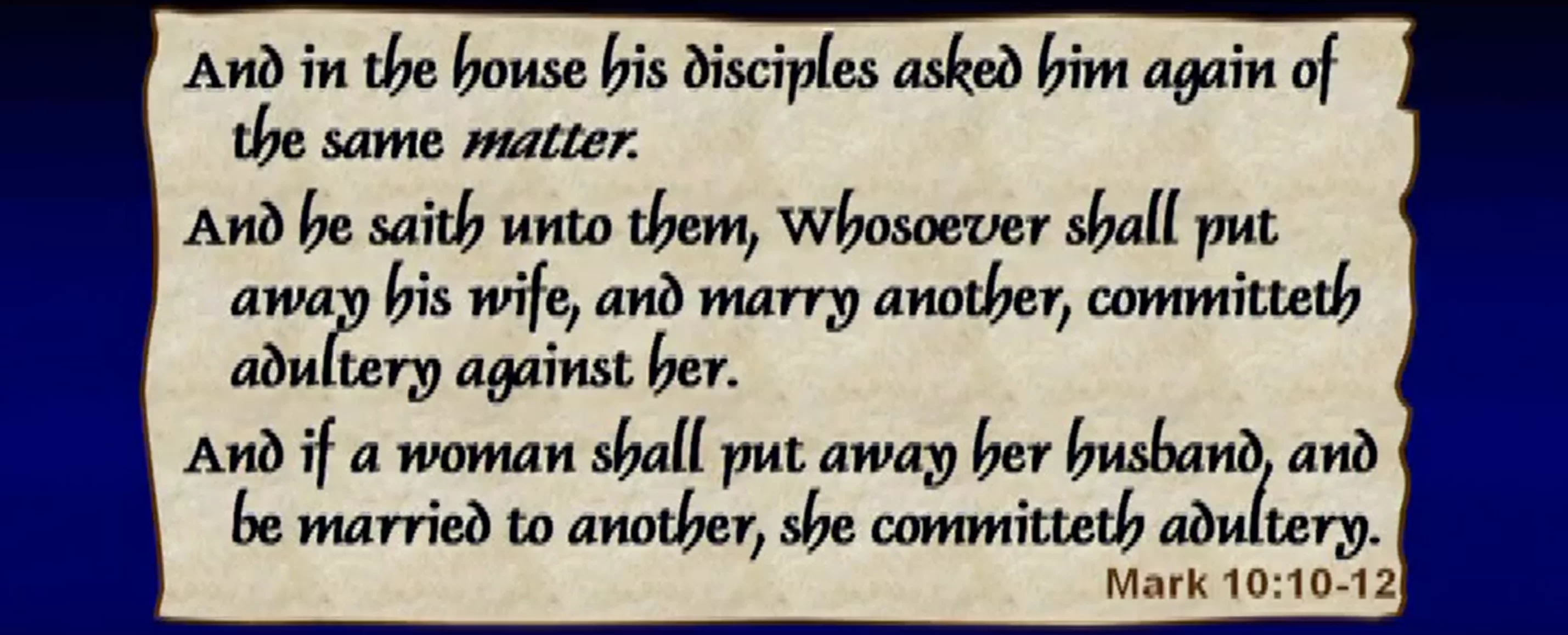
- The disciples were now convinced that marriage is a dangerous thing to get involved in
- To remarry after divorce, other than one granted on the grounds of fornication, would make the person guilty of committing adultery, and this is a serious thing
- Notice that Jesus included the women in His warning, greatly elevating their status in society and giving them equality of responsibility with men
— The rabbis would not have gone this far
- A divorce may be legal according to secular laws and yet not be right in the eyes of God. He established the institution of marriage and He makes the rules. He expects married people to remain committed to each other
- In Paul’s further amplification for unequally yoked couples, there appear to be three potential grounds for remarriage after divorce (1 Cor 7:8-16):
1️⃣ When one’s mate was guilty of sexual immorality and unwilling to repent
2️⃣ When a believer is deserted by an unbelieving spouse
3️⃣ When the marriage and divorce occurred before coming to Christ
- [The breakdown of the “sanctity of commitments” in our society—in business as well as in the family—is a core cancer of our present moral bankruptcy and is actively promoted by so-called “liberals”]
- Our government is now the purveyor of immorality
— Why are we surprised? Governments have always loved crises: they provide the rationale for increasing budgets and bureaucracies, and subjugating the population
— Most new dictators create external crises to consolidate their internal powers (standard practice throughout history)
— In our country, they long ago learned that social crises serve as well as military ones
— There is one insight that supplies a key missing link: immorality results in social crises
— Is it any surprise to learn that governments have an enormous incentive to promote immorality?!
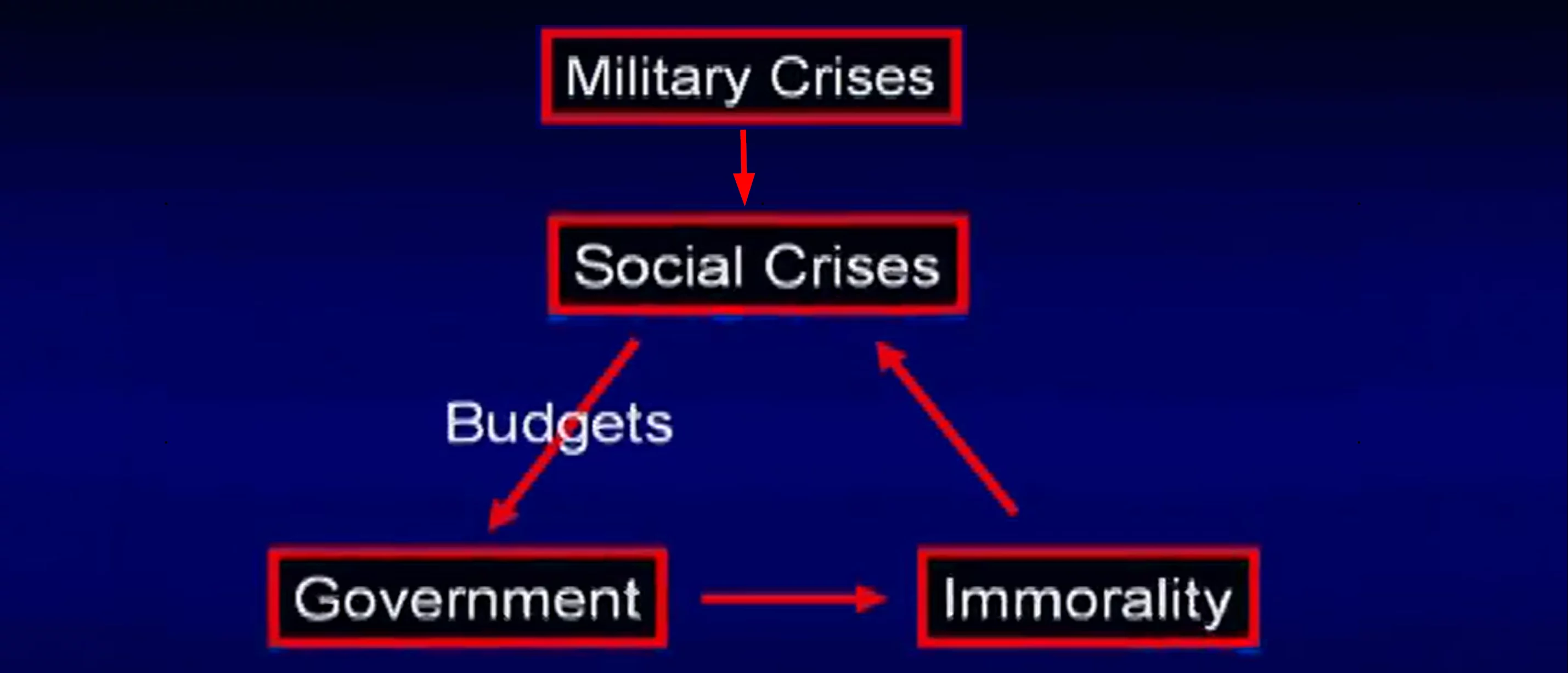
- Governments love military crises because they increase budgets and give them greater license to remove freedoms
- In America, they quickly discovered that social crises are just as effective as military ones (war on poverty, climate control…) — social crises can be fabricated
- The missing link is: What causes social crises? — Immorality does
- Then, why are we surprised that Governments have incentive to promote immorality (abortions, what have you)
- It’s no surprise that the parties that are for big Government are the same parties that promote immorality — same sex marriages, destroying the family
- [abortions were a capital crime in some of the ancient pagan cultures — population was a source of power]

Mark 10:13-14 Jesus Blesses Little Children
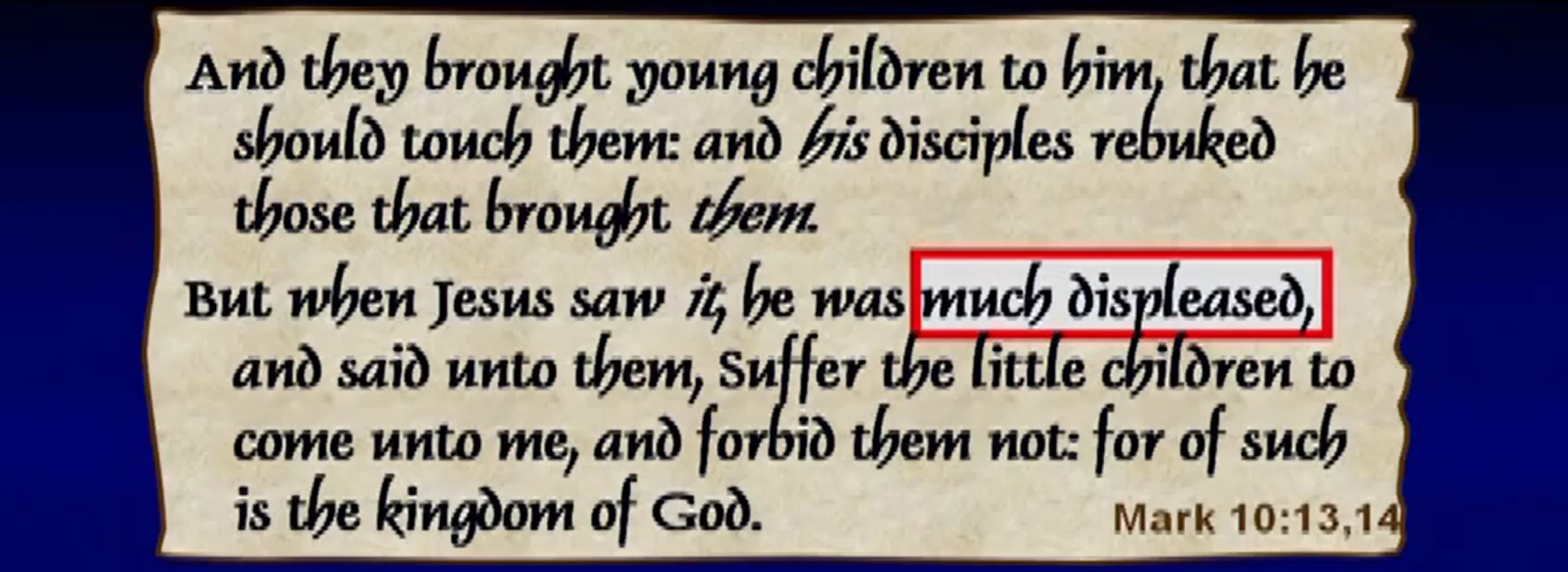
- “…much displeased” is understated. The Lord became indignant (showing anger or annoyance) and openly rebuked His disciples
- First marriage, then children: the sequence seems logical. It was customary for parents to bring children to the rabbis for a blessing
- The disciples may have been trying to protect His time and strength, but they were failing to attach sufficient importance to the children. This is surprising since He had already taught them to receive the children in His name and to be careful not to cause any of them to stumble, etc. (Mark 9:36-37)
- Children are a blessing, not a burden; a treasure not a liability (Cf. Ps 127, Ps 128)
- Did you realize that the commitment of “Guardian Angels” is Biblical?! (Matt 18:10)
Mark 10:15-16
- The children were better kingdom examples than were the adults. We tell the children to behave like adults, but Jesus tells the adults to model themselves after the children: How?
— Their humble dependence upon others
— Their acceptance of themselves and their position in life
— Children live by faith. A child enjoys much but can explain very little
— We enter God’s kingdom by faith, like little children: helpless, unable to save ourselves, totally dependent upon the mercy and grace of God
- [Note: there is no suggestion here that Jesus baptized these children] Infant baptism is one of the church’s heresies. Baptism is intended to be a public disclosure of a willful commitment and infant can’t do that
— He didn’t even baptize adults (John 4:1-2)
— If the disciples had been accustomed to baptizing infants, they would not have turned the people away

Mark 10:17
- Of all the people who ever came to the feet of Jesus, this man is the only one who went away worse than when he came! — (But we have some suspicions…)
- Calling Him “Good Master (Teacher)” was flattery; rabbis never let the word “good” be applied to them

- He certainly had some superficial views regarding spiritual things (also wildly rampant in our society)
- His presumption was that there was “something he could do” to earn eternal life:
— The underlying fallacy behind every false cult or religion
— Religion is man’s attempt to cover himself before God (by whatever: traditions, procedures, rituals…)
— What led to the Jesus movement of the early 70s, was the discovery by the young people that Jesus Christ was the most anti-religious person that ever walk the face of the earth
- Behind this “good works” view is a superficial (naïve) view of sin, man, the Bible, Jesus Christ and salvation
Mark 10:18-19
- Jesus was not denying that He was God: He was affirming it!
- Jesus points the young man to Moses: He wanted him to see himself as a sinner bowed before the holy God
- We can’t be saved by keeping the Law (Gal 2:16-21, Eph 2:8-10)
- The Law is simply a mirror that shows us how dirty we are, but the mirror can’t make us clean
- The Law shows us the need for a Savior, but the Law cannot save us
- It can only lead us to Christ (Gal 3:24)
- It can’t make us like Christ: only grace can do that
Mark 10:20

- He had a superficial view of the Law of God. He measured obedience only by the externals rather than the inward attitudes
- No one who understands the Law can honestly say they keep it, not really. That is underscored by the Lord’s amplification or exposition of that in Matt 5-7 (Sermon on the Mount)
- His problem was covetousness (which Jesus didn’t list)
Mark 10:21
- Ouch — that shattered his view that he was okay because he kept the Law presumably
- “…loved him”: Jesus “loved him” — This is a detail that Matthew and Luke failed to mention. How did Mark know that? Somebody suggested He must have looked into Jesus’ eyes. Maybe. But Chuck has suspicion:
— This appears to be suggestive evidence that this rich young “ruler” may have been Mark himself
Mark 10:22-23
- It is tough for rich ones to come to God: they feel sufficient, they don’t feel the need for God
- That also describes Western societies and their pseudo-prosperity (based on borrowing from others)
- “…grieved”: λυπέω (lupeó) yields the picture of storm clouds gathering…
Mark 10:24-25
- “…trust”: Trust is the operative word. Do not trust in your material possessions. Trust in Jesus
- [There’s nothing wrong with being rich: Example of a very senior executive who is very active Christian. He has very elaborate personal home — no mortgage against it and he doesn’t trust in his house]
- Money is a marvelous servant, but a terrible master. If you possess money, gratefully use it for God’s glory
- Don’t let money become an end in itself. Money is just a means to an end (money is usually not the objective for an entrepreneur; they are driven by the desire to have something happen, they see a need and want it filled)
- If money possesses you, beware! It is possible—perhaps too likely—that wealth can rob you of God’s richest blessing: eternal life
Mark 10:26-27
- “…astonished out of measure”: The disciples were shocked at these declarations about wealth because most Jews thought that the possession of great wealth was evidence of God’s special blessing
- Many people today still cling to this error (in spite of the message of Job, and the clear teachings in the NT)
- Great wealth might be a way God is testing you (instead of blessing you). Executives when they are at the peak fail this test — they begin to think the rules are not for them
Mark 10:28

- Peter’s response here indicates that there were a few problems in his own heart. “…What then will there be for us?” (Matt 19:27)
Mark 10:29-30
- Both now and then (not much comment — I guess Chuck cannot interpret this; need to check MacArthur)
- You never judge the tapestry until the artist is finished
- God does not judge us until the end of our days
Mark 10:31


Mark 10:32 Jesus Again Foretells His Death and Resurrection
- They left Perea, they are on their way to Jerusalem — this is all in anticipation of the big climax
- “…and Jesus went before them: and they were amazed…”: Walking alone was a surprising departure from his usual practice of companionship with his disciples. No doubt there was something about his strange aloofness that amazed them and made them afraid
- Something is going on here — it’s subtle, but we need to pick up on that
- The tenses used here indicate that this was a continuing situation that went on for some time. It wasn’t an incident, but a trend
Mark 10:33
- They couldn’t handle this. They didn’t take it at face value
- Their destination still was Jerusalem, and the final climactic week…
- The things that He told them are foreshadowed in the “Servant Passages” (Isa 42-53)
— “For the Lord GOD will help me; therefore shall I not be confounded: therefore have I set my face like a flint, and I know that I shall not be ashamed.” (Isa 50:7)
- He had previously told them what was going to happen (Mark 8:31, Mark 9:31)
- Now He told them where it’s going to happen
And that the Gentiles were going to be involved
Mark 10:34

- Remember: He did it all for you and me
- Specifically for you and me
- Chuck personally holds a view that Jesus paid for every one of his sins specifically
- That has a very disturbing flip side: next week when something occurs that I really mess up and I sin, Jesus paid for that too. Next week provides me an opportunity to try not to sin so I don’t contribute to His pain 2,000 years ago. My sin is forthcoming, the one He paid for back then. It scares me to realize that my conduct, going forward, has the capacity of adding pain to Him on that cross 2,000 years ago!
Mark 10:35 A Request for Status
- That’s kind of arrogant?
- Can you imagine how it sounded to the other 10 of the 12?
- It seems they really didn’t get it
- Here, James and John—with their mother (Matt 20:20-21)—are still preoccupied with what’s in it for them!

- The wife of Zebedee (Matt 27:56)
- She was present at the crucifixion, incidentally (by the way) (Mark 15:40)
- She was also among those who came to the tomb of Jesus on the resurrection morning (Mark 16:1-2)
- She is the one apparently encouraging her sons to negotiate a position while they can
Mark 10:36-37
- However, they are, in a sense, simply laying a claim to what Jesus had promised:
— “And Jesus said unto them, Verily I say unto you, That ye which have followed me, in the regeneration when the Son of man shall sit in the throne of his glory, ye also shall sit upon twelve thrones, judging the twelve tribes of Israel.” (Matt 19:28)
- [Since Mark was writing to Gentiles, he did not include this promise]
- Hyper-dispensationalism: They hold a view that since the Church was born in Acts 2, everything prior to that was instructions given to Israel who rejected the Messiah and thus does not apply to the Church. Consequently, according to them, Christians only need to respond to epistles, not the teaching of the Gospels. That is patently absurd (clearly or obviously ridiculous and nonsensical). Amazing aberration of doctrine. Epistles teach that:
— “…whatsoever things were written aforetime were written for our learning, that we through patience and comfort of the scriptures might have hope.” (Rom 15:4) and
— “All scripture is given by inspiration of God, and is profitable for doctrine, for reproof, for correction, for instruction in righteousness:” (2 Tim 3:16)
We can draw our understanding of nature of God and His dealings from the OT, certainly from the Gospels where Jesus Himself is teaching His disciples, which are going to go on and carry on the work. As an example, Mark clearly writes to the Gentiles throughout his Gospel, which is a refutation of hyper-dispensationalism
- [Mark does include these parables that have application to the Gentiles]
Mark 10:38-39
- Jesus is using “the cup” and “baptism” idiomatically of the burden that is going forward
- God does not answer selfish prayers
— “You lust and do not have; so you commit murder. You are envious and cannot obtain; so you fight and quarrel. You do not have because you do not ask. 3 You ask and do not receive, because you ask with wrong motives, so that you may spend it on your pleasures.” (James 4:2-3)
- If He does, it is that He might discipline us (Ps 106:15, 1 John 5:14-15)
- [Be thankful to God for the prayers He never answered]
- James, John and Salome didn’t realize that it costs something to get answers to prayer…
— Jesus used the idioms of a cup (Mark 14:32-36)
— and baptism (Luke 12:50, Ps 41:7, Ps 69:2, Ps 69:15)
Mark 10:40-41
- [They still hadn’t learned the lessons from Chapter 9]
- Anger and disunity…
Mark 10:42-43
Mark 10:44

- They hadn’t learned the basic lesson of the Gospel of Mark:
— One must be a servant before God promotes one to rule
— To be under authority before exercising authority
(Cf. Joseph, Moses, Joshua, David, Timothy and, of course, our Lord Himself)
Mark 10:45

- “…a ransom”: This significant word was common in the Greek world of Jesus’ day, where it was used to refer to the price paid to free a slave
- This was the price demanded by the holy God in order that justice might be satisfied in the forgiveness of sins. As a result of this payment, the believer is freed from sin and Satan
- It’s been paid. Your freedom has been paid for by someone else. You couldn’t afford it. He took care of it
- “…for many”: The Greek preposition anti is more accurately translated in the place of, as overwhelming evidence from Greek sources demonstrates
[Sources: Adolf Deissmann, Light from the Ancient East, trans. L. R. M. Strachan, p. 327 ff.; cf. J. H. Moulton and George Milligan, The Vocabulary of the Greek Testament, pp. 46, 47; Arndt, pp. 72, 73; Vincent Taylor, pp. 444, 445 and Arndt Arndt-Gingrich, Greek-English Lexicon]

Mark 10:46-47 Bartimaeus Regains His Sight
- They left Perea, came to Jericho. Still have some 20mi to go

- The Jericho of Jesus’ day was located about five miles west of Jordan and fifteen miles northeast of Jerusalem where Herod the Great and his successors built a lavish winter palace
- The ruins of the Canaanite city of Joshua’s day lay one mile to the north
- This helps explain the ostensible differences between v.46 and Luke 18:35
— “…as he went out of Jericho…” (Mark 10:46) OT Jericho
— “…as he was come nigh unto Jericho… (Luke 18:35) NT Jericho
Mark 10:48-49
- From Matthew’s account, there were apparently two blind men (Matt 20:30)
- Mark’s account focuses on the more vocal of the two
Mark 10:50

- “…casting away his garment”: So it wouldn’t trip him in his dash forward!
Mark 10:51
- [The same question He had asked John, James and Salome back in v.36!] → Mark 10:36
- “…Lord”: Rabbouni — “My Master” — an expression of personal faith
— The only other recorded use as that of Mary in the Garden (John 20:16)
Mark 10:52
- Matthew tells us that they both received their sight and joined the following throng
- This is the last miracle recorded in Mark, and it certainly fits his “Servant” theme (He served Bartimaeus)
- We will now see Jesus on His way to the cross, fulfilling the Suffering Servant climax of Isaiah 53…
- Isaiah 53 hasn’t been fulfilled yet — the cross has been fulfilled indeed, but what Isaiah is actually chronicling, is Israel discovering that He is the Christ: “Who hath believed our report?”