s11 (Ch 11) The Triumphal Entry (studied 31-Oct-2025)
The Book of Mark with Dr. Chuck Missler
The subsections of Chapter 11 (per LSB) are:


- We are heading for Jerusalem, and that climactic final week — aka Passion Week
- Nine months before, we began the meandering journey from Galilee, through Samaria, then Perea, and finally to Judea, ministering in at least 35 localities and yet timing the journey purposefully to end up in Jerusalem for the Passover
- Passover season was the delight of the Jews, and the despair of the Romans (they were nervous, they just wanted to keep the peace, they didn’t want any upraises that would embarrass them to Caesar). So it’s a tense time from the Roman point of view, but it’s the high point from the Jewish point of view
- Thousands of devout Jews from all over the world arrived in the Holy City, filled with excitement and nationalistic fervor (and that’s what makes the Romans additionally nervous)
- The population more than tripled, putting the Roman military on special alert
— Some scholars estimate over a million people may have enveloped the city (not an exaggeration)
— Josephus records that in 65 AD, over 255,000 lambs were offered (if there were ten offerers for each lamb, that would suggest over 2.5 million celebrants in Jerusalem)
- Unparalleled tensions were in the air — riots or insurrections could ruin an entire Roman career (of a Roman official, so it was a make or break moment for many of them and they wouldn’t allow it to get out of hand)…
[Source: Alfred Edersheim, The Life and Times of Jesus the Messiah, Volume 2, Eerdmans, Grand Rapids MI, 1967, p.367]

- The Entrance into Jerusalem — first 26 verses of Chapter 11 (Mark 11:1-26)
- From this point on, Christ abandoned the cautious attitude that had caused him to withdraw from areas of tension and possible crisis (several times in the past, He sort of slips away when tensions build up)
- Now he challenged the Jewish leaders (He hits it head on)
- In the entry into Jerusalem he openly provoked disapproval and opposition
- This “Triumphal Entry” should be viewed not as the coming of a glorious king (as we often portray it), but as the presentation of a Savior who was soon to suffer (both are true, of course)
— It was on the 10th of Nisan (4 days before Passover), when the Passover lambs were being formally reviewed or inspected by the leadership in anticipation of being sacrificed, Jesus is also being presented for “inspection”
Mark 11:1 The Triumphal Entry

- “…the mount of Olives”: About two miles east of Jerusalem
- From the peak at 2,600 feet, there is a breathtaking panorama of this fabled city (picture taking lookout)
- Here the Lord will do something He had never allowed before: He would present Himself as the Meshiach Nagid, the Messiah the King, in accordance to the OT prophecies, on the very day that the angel Gabriel had prophesied to Daniel over 500 years earlier! (Dan 9:25)
Mark 11:2
- Since Mark is writing to the Gentiles, he doesn’t develop the prophetic background of this pivotal event, deliberately fulfilling the predictions of Zechariah 500 years earlier:
— “…Behold, your king is coming to you;
He is just and endowed with salvation,
Humble, and mounted on a donkey,
Even on a colt, the foal of a donkey.” (Zech 9:9 NASB) — also, riding a donkey is a very Jewish thing
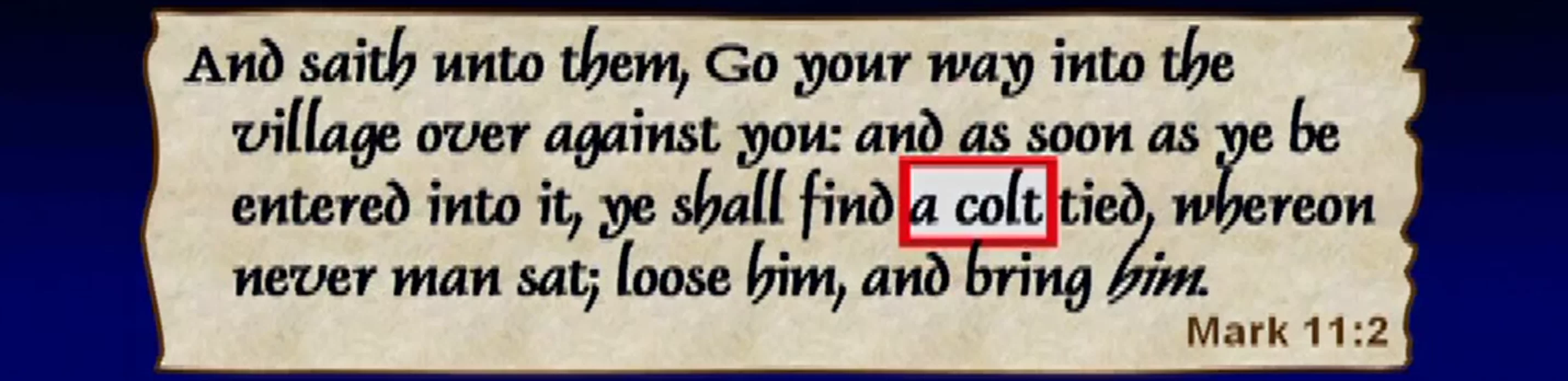
- “…a colt”: An unbroken colt (son of a female donkey) — an animal devoted to a sacred task was to be one that had not been put to ordinary use (Num 19:2, Deut 21:3, 1 Sam 6:7) — a man never sat on it so it would be suitable for the holy purpose
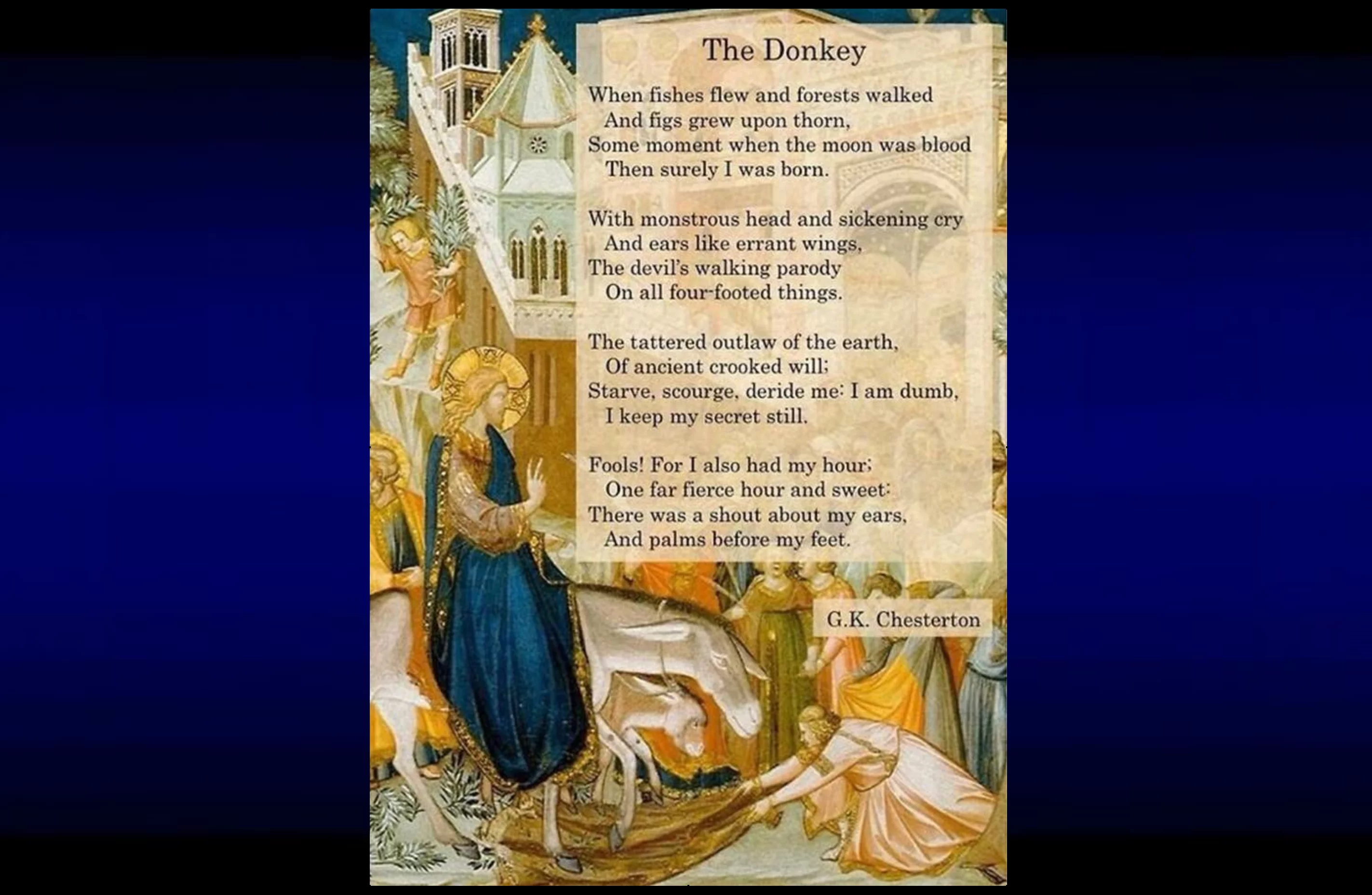
- [Do you want to hear a message from the donkey? by G.K. Chesterton]
Mark 11:3-4
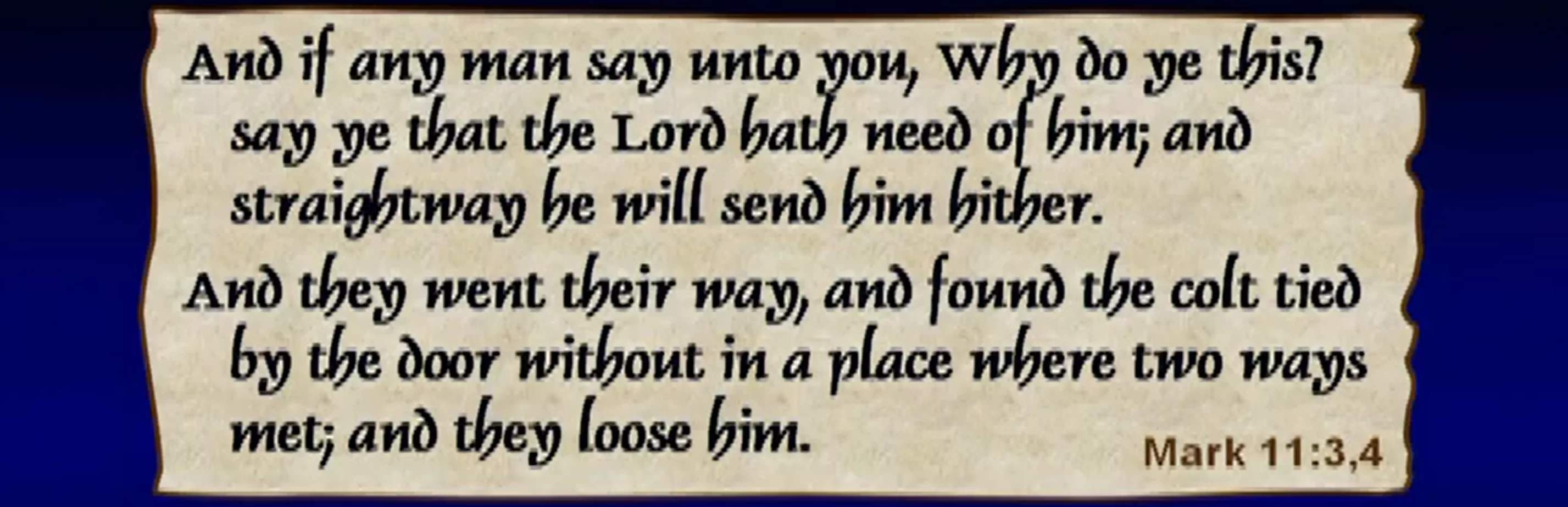
- A pre-arranged password or Jesus simply predicted it?
- Matthew states that there were two animals, an ass (donkey mother) and a colt (Matt 21:2)
- An unbroken colt is the focus of our attention here
Mark 11:5-6
Mark 11:7-8
- “…garments on him”: The garments placed on the colt were outer cloaks or robes, the bright colors of which would give the colt the appearance of bearing the accouterments of royalty (additional items of dress or equipment, paraphernalia)
- “…cut down branches”: Thus “Palm Sunday”
— The 10th of Nisan, four days before Passover
— Palm branches had become a nationalistic symbol when Simon Maccabaeus delivered Jerusalem 150 years earlier
— The palm frond was the symbol of the 2nd Maccabean Revolt (1 Maccabees 13:51)
- The Passover crowd had heard about Lazarus… (John 12:12-18)
- The spreading of outer garments before a king was not uncommon (2 Kgs 9:13)
Mark 11:9-10
- “…cried, saying”: The Greek indicates that those who followed repeatedly shouted
- This was probably an antiphonal chant between those in front and those behind…

- “…Hosanna”: This is a transliteration of a Hebrew expression meaning “Save, I pray”, coming from:
— “O LORD, do save, we beseech You;
O LORD, we beseech You, do send prosperity!
26 Blessed is the one who comes in the name of the LORD;
We have blessed you from the house of the LORD.” (Ps 118:25-26 NASB)
- [Victoria Hanna - The Aleph-bet song (Hosha'ana) Official video: https://youtu.be/Bl1epz3tSSA]
- “Blessed be he that cometh” is an exact quotation from the LXX of Ps 118:26
- “Stone which the builders refused has become the headstone of the corner” (Ps 118:22-23, Matt 21:42-44, Acts 4:11)
- Ps 118 was one of the Hallel Psalms sung in connection with the Passover festival, and was thus particularly appropriate at this time (this Psalm is actually declaring the King coming, that’s the key point here)
- That the crowd used the words in a Messianic sense is made clear by the next verse (you and I might miss the fact that it is Messianic, but the Pharisees didn’t, and they are really upset)

- Jesus is openly affirming His kingship as the Son of David (Pilate — personal representative of the ruler of the world will so label Him, several times. Pilate adopts His title and even puts it on the cross — King of the Jews)
— Crowds are singing and praising God, Pharisees are upset, but Jesus doesn’t want to rebuke the crowds: “…if these should hold their peace, the stones would immediately cry out.” (Luke 19:40)
— The promise to Mary: “…the Lord God shall give unto him the throne of his father David:” (Luke 1:32)
— James at the council of Jerusalem: “…I will return, and will build again the tabernacle of David…” (Acts 15:16-17, quoting Amos 9:11-12)
- Jesus actually wept for them all (while riding on that donkey), and predicted the coming destruction which took place 38 years later (Luke 19:29-48)
- Jesus held them accountable to know the relevance of this very day (Luke 19:39-44)
Mark 11:11
- He retired to Bethany on the eastern side of the Mount of Olives; within “a Sabbath’s days journey”: less than 2mi
- “…he had looked round about”: His eyes would surely take in the booths of the money-changers and of the sellers of doves, which were to be the objects of his displeasure on the following day
- Back in John 2:13-16, He has already cleansed the Temple once. He is going to that the 2nd time, tomorrow
Mark 11:12-13 The Barren Fig Tree
- The fig tree usually produces leaves in March or April and then starts to bear fruit in June, with another crop in August, sometimes a third in December
Mark 11:14

- Disciples will later come by there and it will be withered
- This is the only instance we have of our Lord using His miraculous powers to destroy something in nature
- He was making a lesson on failure to be fruitful
- [Jesus used it as a visual parable; it became in that sense the most fruitful tree that ever grew!]

- [An incident widely puzzling to those who have an unhealthy eagerness to find fault with the Bible]
- The condemning of the tree and the cleansing of the Temple were both symbolic acts that illustrated the sad spiritual condition of the nation of Israel: fruitless and corrupt (Cf. John 12:35-41)
- Jesus pronounces a “blindness” on the nation (Luke 19:41-44, Matt 23:37-39; cf. Rom 11:25)
- The fig tree is often associated with the nation Israel
(Jer 8:13, Jer 29:17, Hos 9:10, Hos 9:16, Joel 1:7, Mic 7:1-6, Nah 3:12)
- Jotham’s Parable of the Trees Judg 9:7-15 → See note in Mark 8 (Old Testament Parables) s08
- The tree dried up “from the roots” (v.20)
- The year before, John the Baptist had put the ax to the roots of the tree:
— “And think not to say within yourselves, We have Abraham to our father: for I say unto you, that God is able of these stones to raise up children unto Abraham. And now also the axe is laid unto the root of the trees: therefore every tree which bringeth not forth good fruit is hewn down, and cast into the fire.” (Matt 3:9-10)
- The disciples might also have remembered Jesus’ parable some months before:
⏩Ⓛ Luke 13:6-7
⏩Ⓛ Luke 13:8-9
- They might also have recalled Micah 7:1-6 where the prophet declares that God is seeking “the first ripe fruit” from His people (Cf. John 15:16)
Mark 11:15 Jesus Drives Merchants from the Temple
- What makes this so corrupt, these money changers were in the employ of Annas (the high priest) and the high priestly family. The animals were sold for sacrificial purposes, and the moneychangers exchanged the common currency for the half-shekel necessary to pay the temple tax. Exorbitant rates, however, were charged because this was a form of extortion
- Jesus had cleansed the Temple during his 1st Passover visit (John 2:13-22) (He does it again for His last Passover)
- But it was not long before the religious leaders had permitted the money changers and merchants to return (why would the priests do that? — they had a piece of the action… they were being bribed to let them do this)
- [btw, have you ever seen a table flipped over? We read this so glibly, but it is a very violent act…]
- Mark also emphasizes those that “sold doves”. The dove was one of the few sacrifices that poor people could afford (Lev 14:22)
- It was the sacrifice that Joseph and Mary brought (since they were poor) at Jesus’ dedication (Luke 2:24)
- Jesus was always especially sensitive to the poor (as seen in the next session: Mark 12:41-44)
— In the book of Proverbs, there is, again and again, a special blessing to those who would honor the poor (and a special curse on those who would abuse the poor)
Mark 11:16

- The Court of the Gentiles had become a convenient cross-town shortcut to the Mount of Olives
— Even the Mishnah (Jewish commentary) contained an ordinance aimed at curbing traffic by forbidding anyone to enter the Temple Mount carrying his staff or sandal or wallet, or to use it as a shortcut, but people still did so
- It became a huge religious circus
Mark 11:17
- Campbell Morgan (McGee — introduction to Hebrews) points out that “a den of thieves” is the place to which thieves run when they want to hide. The Temple was a cover-up
- Both Isaiah and Jeremiah warned that the presence of the Temple is no guarantee of blessing from God (Isa 1:10-17, Jer 7:1-16, “a den of robbers” → Jer 7:11)
— “Is this house, which is called by my name, become a den of robbers in your eyes? Behold, even I have seen it, saith the LORD.” (Jer 7:11)
- The quote from Isaiah highlights the purpose of the Court of the Gentiles specifically:
🟡 Isa 56:6-7
- This was a massive national sin against God and the lost people of the world! (this pollution of the Court of the Gentiles)
- The high priest’s family had perverted the Temple into a means of extortion. Thus:
— “The zeal of thine house has eaten me up;…” (Ps 69:9, John 2:17) (btw, Ps 69 is the 2nd most quoted Psalm)
- Jesus also thus exposed the sins of the leaders:
— they looked upon the Temple primarily as place of sacrifice
— Jesus saw it as a place of prayer
- Prayer is in itself a sacrifice to God:
— “Let my prayer be set forth before thee as incense; and the lifting up of my hands as the evening sacrifice.” (Ps 141:2)
Mark 11:18
- He is cutting into their business here and the leadership is out for a vengeance
- The scribes and chief priests obviously took a dim view of these proceedings and plotted to take Him. Judas would ultimately provide them an assist, but Jesus controlled the timing!
- Before we condemn them too quickly, let’s take inventory of our own ministries:
— Do outsiders see our activities as making merchandise of the Gospel?
— Do outsiders see our buildings as a house of prayer?
— Are all nationalities welcome there?
— Do we flee to our sanctuaries to hide from our real selves?
— If Jesus were to show up, what changes would He make?
Mark 11:19-21 The Lesson From the Fig Tree, MEV
- “…the fig tree dried up from the roots”: Spiritual decay is always from the roots
Mark 11:22-23
- The idea of “moving mountains” is a Jewish expression (Hebraism)
Mark 11:24

- “…believe…receive”: A present tense imperative, calling for persistent, continuing faith (not a one shot thing)
- Superior manuscript evidence favors the aorist tense—you did receive
In other words, we are to keep on believing that God has already granted us our request
- True faith in God is based on His Word (John 15:7, Rom 10:17) and His Word reveals His will to us
- The purpose of prayer is not to get man’s will done in heaven but to get God’s will done on earth
- Prayer is God’s way of enlisting you in what He is doing!
Mark 11:25-26
- Statements such as these, which make God’s forgiveness appear dependent on our forgiveness have been misunderstood as being legal in nature. But that’s not what we are talking about here. Christ does not here address Himself to the unsaved but to His disciples, those who have already entered into a saving relationship with Himself
- The forgiveness of which He speaks is not the initial forensic act of forgiveness which abolishes the guilt of sin. It is rather the forgiveness of a Father which restores fellowship
- The point here is that a disciple cannot pray effectively if an unforgiving spirit has broken his fellowship with God
- Prayer also involves forgiveness as well as faith
- I must be in fellowship with both my Father in heaven and my brethren on earth if God is to answer my prayers
(Cf. Matt 5:21-26, Matt 6:14-15, Matt 18:15-35)
- The first word in the “Lord’s Prayer” is Our:
— “Our Father which art in heaven” (Matt 6:9)
- No Christian ever prays alone; for all of God’s people are part of a worldwide family that unites to seek God’s blessing
— “For this cause I bow my knees unto the Father of our Lord Jesus Christ, 15 Of whom the whole family in heaven and earth is named,” (Eph 3:14-15)

The debates recorded in the following verses all took place on one busy day—Tuesday of the Passion Week:
- The source of our Lord’s authority → Mark 11:27-33
- The parable of the vineyard & husbandmen → Mark 12:1-12
- A question about taxation → Mark 12:13-17
- The resurrection → Mark 12:18-27
- The greatest commandment → Mark 12:28-34
- The Messiah’s relationship to David → Mark 12:35-40
- An account of the widow’s gift of two mites → Mark 12:41-44
Mark 11:27-28 The Authority of Jesus Challenged
- “…the chief priests, and the scribes, and the elders,” — now, that’s a gang of cutthroats (murderers or other violent criminals). And they are pretty unglued; they just got their income slashed
- “…By what authority…”: The leaders of the religious establishment were bent on tripping Him up…
- The officials referred to Christ’s purging of the Temple (both then and also back in John 2:18). It was said that the Temple could be cleansed only by the Sanhedrin, by a prophet or by the Messiah (“And who do you think you are?”)
- As official guardians of the Law, the members of the Sanhedrin had both the right and the responsibility to investigate anyone who claimed to be sent by God (Deut 18:15-22)
- But they did not have pure motives: they were seeking to destroy Him (v.18)
Mark 11:29-30
- Jesus knew full well that they would have been in a quandary (AI: a difficult situation or state of confusion where they would have to make a choice between two equally unsatisfactory options) because they would not admit either one:
— John was too popular for them to deny he was sent by God
— yet to acknowledge that he was sent by God would implicate them in admitting that Jesus could have been sent by God
- Why take them all the way back to John the Baptist?
— God does not teach us a new truth if we have rejected the truth He has already revealed!
— We should not be surprised that people are deaf to the Word of God if they don’t recognize Him as Creator
— One only learns of God’s redemption from His Word. Without His Word, there’s no visibility of it. But they are without excuse to recognize Him as Creator. That’s step #1. That’s His first jealousy — He has specific judgements pronounced on a culture that fails to acknowledge Him as Creator (Rom 1:18-32)
— God being the Creator is so obvious from applying straight scientific method — the field of mathematics called The Design of Experiments — if those well-established principles are applied, they prove the Bible
- “Obedience is the organ of spiritual knowledge.” — F. W. Robertson
[Frederick William Robertson (1816 – 1853, aged 37), known as Robertson of Brighton, was an English theologian]
[F. W. Robertson’s SERMONS from 1800’s: https://www.fwrobertson.org/]
- Jesus is not refusing to answer their question:
— He only refused to accept and endorse their hypocrisy
Mark 11:31-32
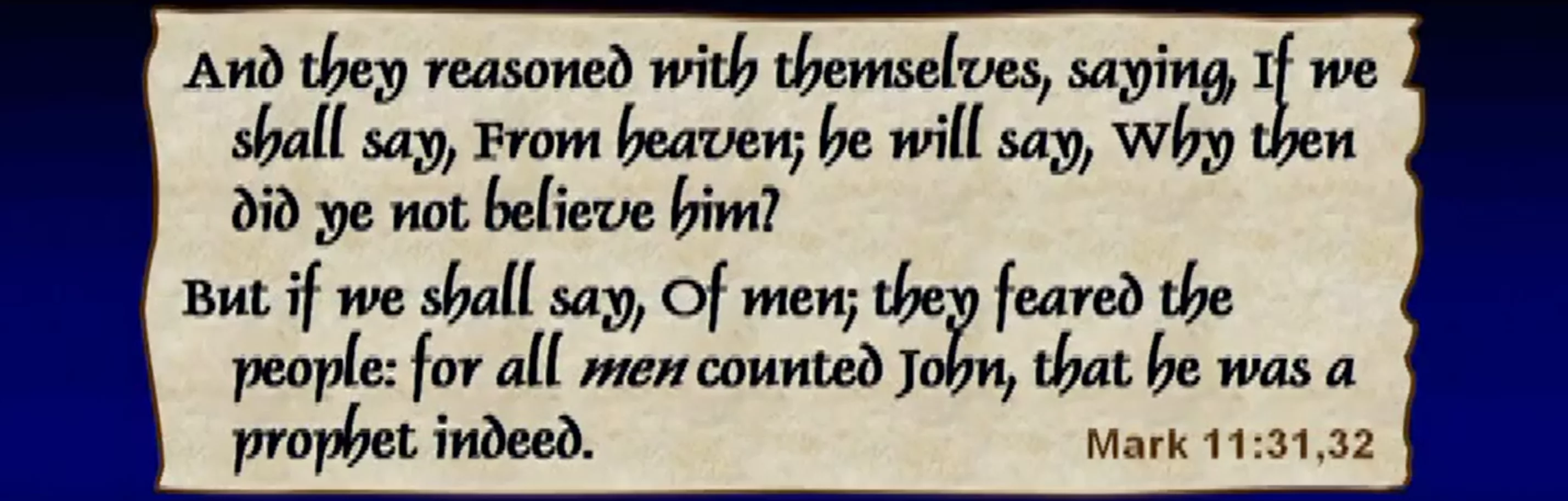
- Jesus hoisted them on their own petard (AI: they were harmed by their own plan to harm Jesus, essentially falling into their own trap)
- “And no man was able to answer him a word, neither durst any man from that day forth ask him any more questions.” (Matt 22:46) “…nor did anyone dare from that day on to ask Him another question.” NASB
Mark 11:33
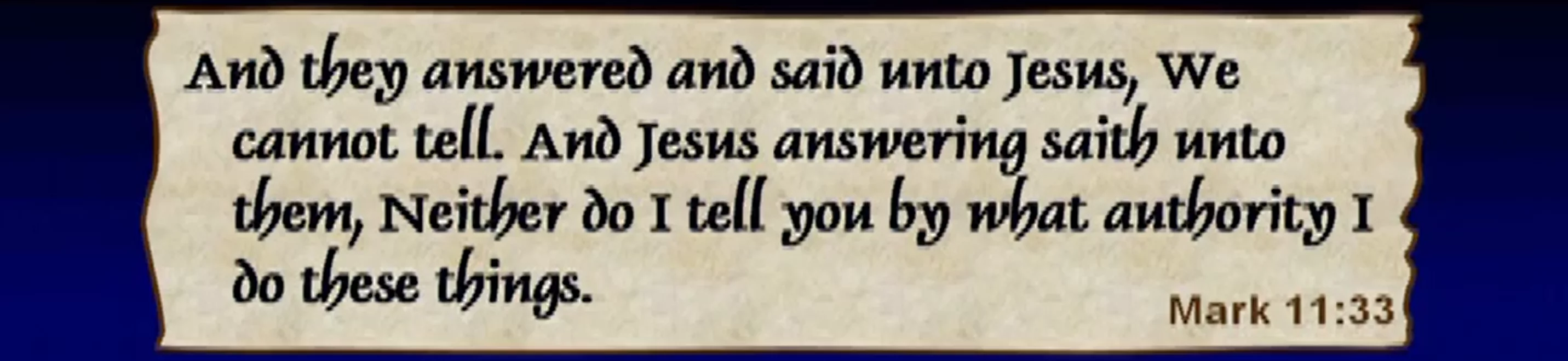
- In the next chapter, before they had opportunity to escape, He told them a parable that revealed where their sins were leading them…
- This conversation continues

→ Ps 80:8-16 → Isa 5:1-7
