s01 (Ch 1) Birth of John the Baptist, Annunciation of Messiah (studied 15-Jan-2026)
The Book of Luke with Dr. Chuck Missler (first 8 sessions recorded at River Lodge, NZ — 2011)
{View → Video Frame → Aspect Ratio → 185:100, which is a bit wider than Default (DAR)}
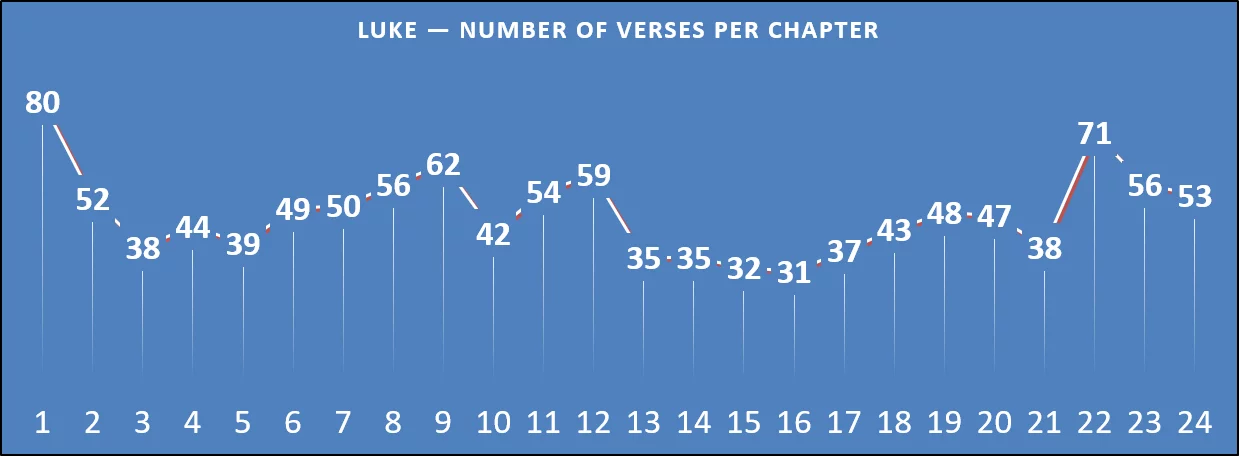
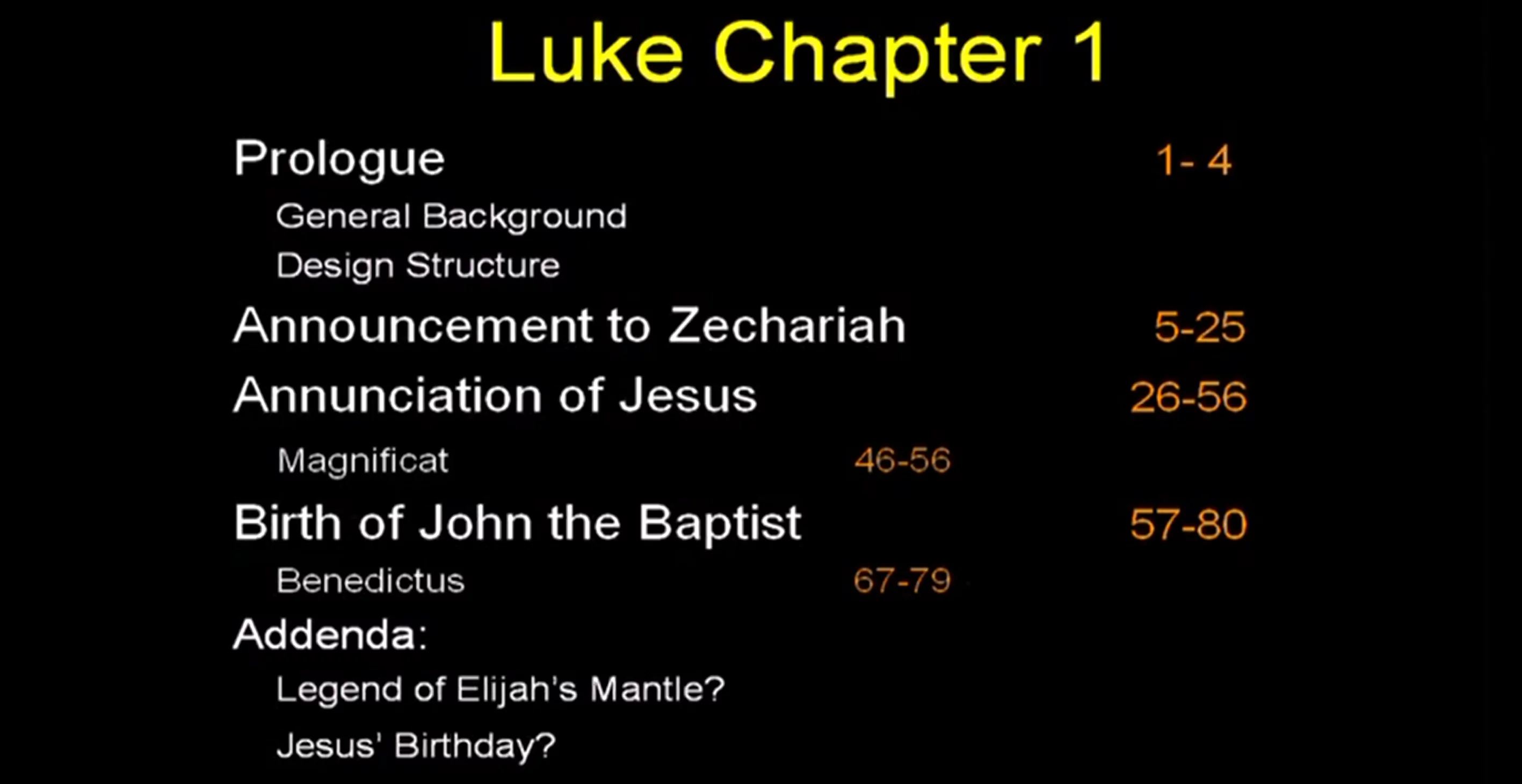
The subsections of Chapter 1 (per NASB/LSB/MEV) are:
{View → Video Frame → Aspect Ratio → Assume square pixels (SAR)}
{View → Options… → Miscellaneous → Brightness → +20 to distinguish borders of black background slides, esp verses}

- A provocative, true story of a 12 yo Maori girl Tarore
- In 1835, The Bible Society published 100 copies of the Gospel of Luke in Maori (Te Rongopai a Ruka)
- In 1836, missionaries gave one to a young Maori girl, Tarore, at a mission school near Matamata
- She read it to her father, the chief of the Waikato tribe (River Lodge is on Waikato river)
- She kept her treasured copy under her pillow when she slept
- Under threat of a neighboring warring Rotorua tribe, the mission school was in the process of relocating to Tauranga
- On October 19, 1836, at the Wairere Falls, a raiding party killed the 12-year old girl and took the treasured object from under her pillow
- Later, unable to read, the Rotorua chief discarded it until a slave boy who had learned to read, revealed its contents to the fascinated listeners
- The chief was convicted by its contents of the Gospel of Luke and resolved to become a Christian
- The Rotorua chief resolved to seek out the father of the murdered girl and beg for his forgiveness
- When finally confronting the father, the chief of the Waikato tribe — and risking the customary tribal response of revenge — the father of the murdered girl forgave him, and thus began a peaceful relationship between the two previously warring tribes!
- (This true story is distributed to school children as part of their Maori heritage)
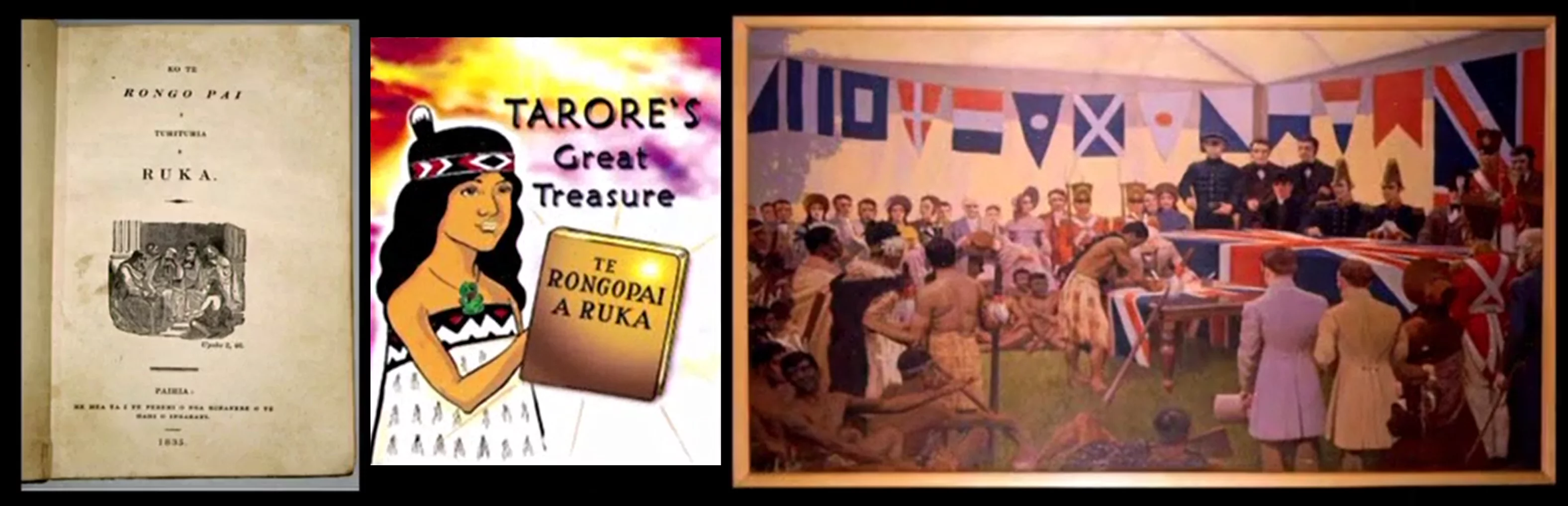
- A young girl murdered…
- A devastated father refusing to seek revenge…
- A murderer transformed through the Gospel he stole from his victim…
- Then forgiveness given and peace achieved!

- The story of this young Maori girl and her copy of the Gospel of Luke became the key to the conversion of many Maori tribes
- When missionaries visited both the North and South Islands, they discovered that many of the Maori tribes had already been converted to Christ due to the story of Tarore and her copy of the Gospel of Luke making its rounds…
- On February 6, 1840, the nation of New Zealand was born by the signing of the Treaty of Waitangi with the Maori tribes
- While primarily dealing with land rights and other issues, this foundational document obligates the Crown of the United Kingdom to safeguard and protect the Maori’s rights of worship
- Since a significant portion of the Maori tribes had previously been converted to Christianity, the government is legally committed to protect Christianity in New Zealand
- There are Bibles in schools, home schooling is encouraged, and many Christian schools receive significant government support

* * *

- Who was Luke?
- He was a Gentile (Cf. Col 4:11), while most of the writers of the Bible, of course, were Jewish. Thus Luke is an exception
— He is named only three times in the NT
— According to his own statement (Luke 1:2) he was not an “eye-witness and minister of the word from the beginning”
- He was the “beloved physician” of Col 4:14
— Used more medical terms than Hippocrates, the father of medicine
— He was probably a physician in Troas
— Accompanied Paul to Philippi (2nd missionary journey → “we”, “us” Acts 16:10-17)
— Did not accompany Paul after his release from Philippi imprisonment (cf. Acts 17:1 “they”)
— We meet Luke again on Paul’s 3rd visit to Philippi (Acts 20:5-15 and also Acts 21:1-18)
— Luke had probably spent the intervening time there, a period of seven or eight years
— During Paul’s trip to Rome, Luke was on the ship with him during the Shipwreck, maybe posing as his slave (Acts 27:1-28:16) and remains with Paul until the end of his 1st imprisonment in Rome (Phm 1:24, Col 4:14)
— Luke is last mentioned as the “beloved physician” in 2 Tim 4:11
— There are many passages in Paul’s epistles, as well as in the writings of Luke, that show the extent and accuracy of his medical knowledge
- Luke was chosen by the Holy Spirit to write
— Luke’s Greek is the highest form of Greek; the best of any New Testament writer
— His writings are regarded as one of the finest pieces of historical writing in ancient literature
— Sir William Mitchell Ramsay (1851-1939, aged 88), a skeptical archaeologist, went into Asia Minor to disprove/discredit Luke as a historian. After very extensive and careful investigation he concluded that Luke had not made one historical inaccuracy. Sir William Ramsay became a believer!
— Luke’s gospel is regarded as the most complete historically
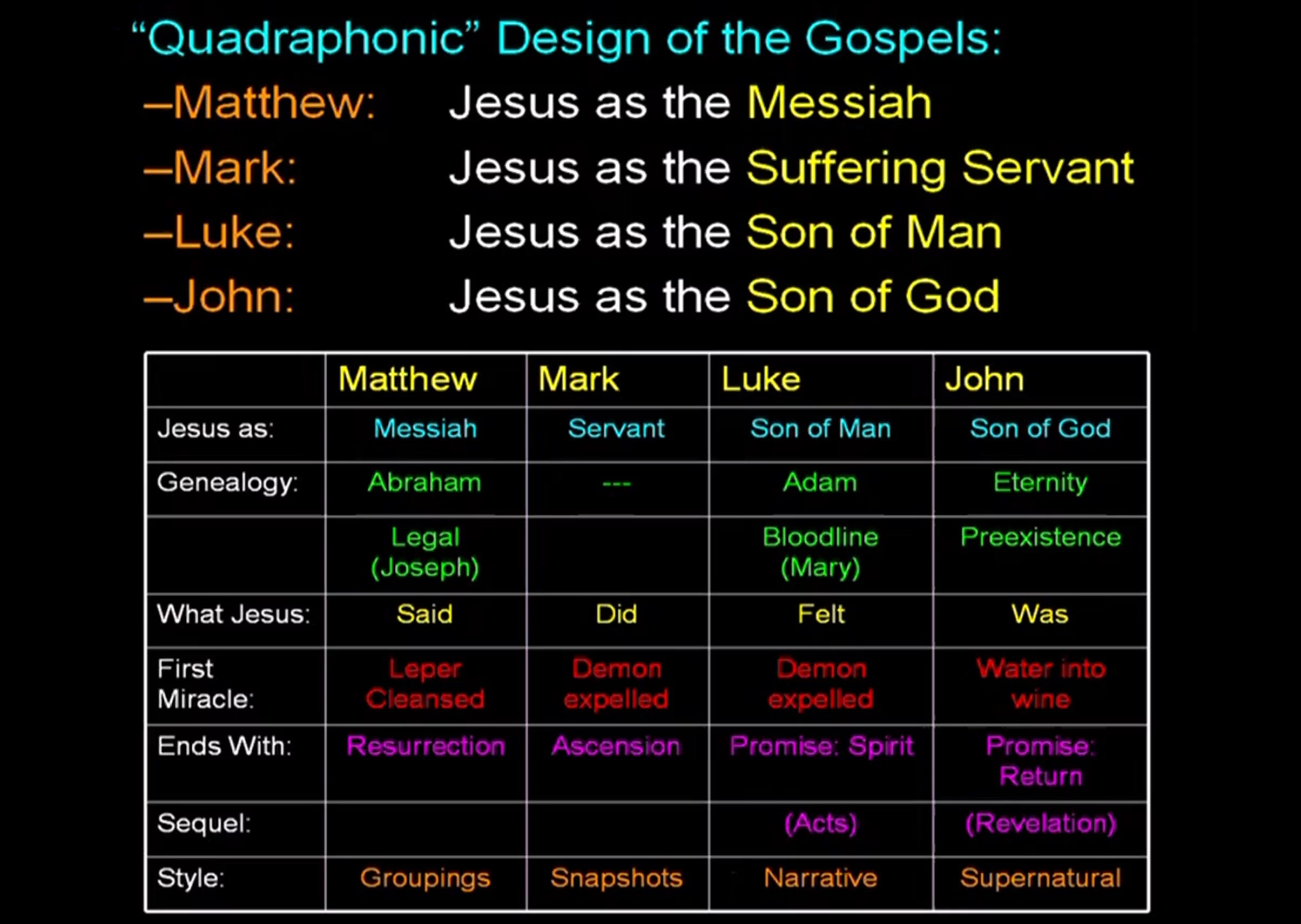
- Every detail of each of the four Gospels supports their specific design objective
- Matthew, Mark and Luke are “Synoptic Gospels” (very similar, while John is very distinctive). The three books detail many of the same experiences, often in the same sequence
— The Synoptics highlight Jesus’ Galilean ministry
— while John’s Gospel highlights Jesus’ Judean ministry (half of John’s Gospel is just the last week)
- Luke gives us many features omitted by Matthew and Mark:
— An obstetrical account of the virgin birth
— 20 miracles, six of which are in no other Gospel → 6 unique miracles
— 23 parables, 18 of which are nowhere else → 18 unique parables
— The Emmaus Road and other details of the resurrection
- Henry Allen Ironside (1876-1951, aged 74) had the following perspective:
— “The religion of Israel could only produce a Pharisee”
— “The power of Rome could only produce a Caesar”
— “The philosophy of Greece could only produce an Alexander, an infant at heart”
— “It was to this Greek mind that Luke wrote: he presents Jesus Christ as the perfect Man, the Universal Man, the very person the Greeks were looking for”

The first four verses of Luke are considered the most elegantly styled sentence in the Greek New Testament.
Luke 1:1 Luke’s Account of Things Fulfilled
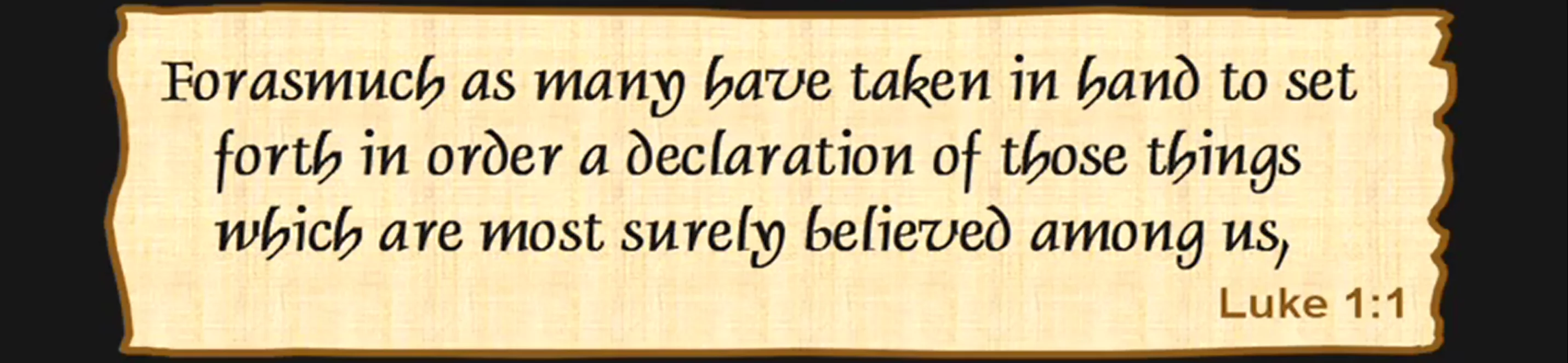
- Luke is writing to Theophilus, the addressee, who is a believer. He is some kind of very senior Roman dignitary
- Other gospels are in circulation, but Luke is called to add his perspective
- Luke’s gospel is a very early document, even though it was not an eyewitness account
- Luke identifies himself as a believer
- He apparently joined Paul in the Book of Acts (“we” passages, Acts 16:10-17)
Luke 1:2

- “…they” — the other Gospels. They were written by eyewitnesses, in contrast to Luke
- “…eyewitnesses” — αὐτόπτης (autoptēs): “to see for yourself” — a medical term “to make an autopsy”
- “…ministers” — ὑπηρέτης (hyperates): “Under-rower” (also a term for clerical assistant who knew shorthand)
Luke 1:3
- Luke is writing as an investigator, not an eyewitness
- He demonstrates diligence and thoroughness throughout his writings
- Luke is a skilled historian

- “Theophilus” = “lover of God” was a common name during the first century [Bogoljub]
- He was probably the direct recipient of Luke’s Gospel who then gave it wide circulation in the early church
- “…most excellent” — an official of some kind
— Cf. Acts 23:26, Acts 24:3, Acts 26:25, which use the same term κράτιστος (kratistos) for Felix and Festus
Luke 1:4


- Luke and Acts (“Luke Volume 2”) may have been trial documentation
- Roman law required historical background of a case to precede appeal to Caesar
- Such an undertaking was expensive and Theophilus may have been Paul’s sponsor
- Two observations about Luke’s writings:
— 1) Uprisings were the fault of Paul’s Jewish adversaries and
— 2) Centurions are always portrayed as good guys

Luke 1:5 John the Baptist’s Birth Foretold
- John by lineage, was one who was to become a priest (and priests were organized in the “courses”)
- His parents lived when Herod the Great ruled as king of Judea (from 37 to 4 BC)
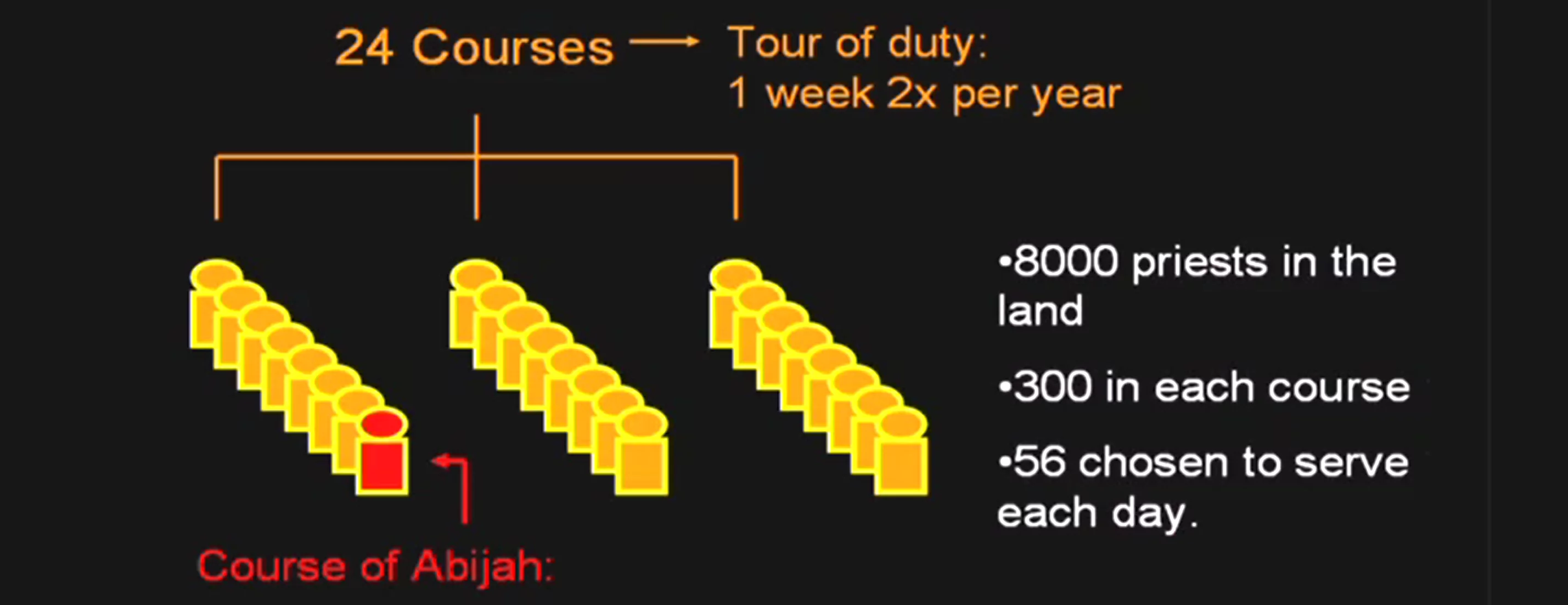
- “…course of Abijah” — Zacharias (Zechariah) was of the 8th of 24 “courses” (divisions) of priests, drawn up in David’s time (1 Chr 24:7-18). Basically, David organized the entire priesthood in 24 groups
Luke 1:6

- This verse is quite a statement for Zacharias and Elisabeth
► Zacharias = “God remembers”
► Elisabeth = “His oath”
► The two are one flesh: “God remembers His oath”
- The nation of Israel had no prophetic word for 400 years
— Malachi closes with the promise of the coming of Elijah (Mal 4:5-6)
— John the Baptist came in the spirit and power of Elijah (Luke 1:17)
— The OT period closed with John the Baptist (Matt 11:13, Luke 16:16)
Luke 1:7

- Barrenness was a shame in that culture. That it was an embarrassment to Elisabeth is evident in verse 25:
— ““This is the way the Lord has dealt with me in the days when He looked upon me to take away my disgrace among men.”” (Luke 1:25 NASB)
- God allowed several Old Testament women to experience barrenness:
— the mothers of Isaac, Samson and Samuel (all three gave birth very late in their lives)
Luke 1:8-9
- Zacharias was chosen by lot to be the priest who offered incense: ελάχε (eláche) — a Greek verb meaning "he was chosen by lot" or "his lot was". God is sovereign over the lot (Esther 3:7, Prov 16:33)
- This event was considered a "once-in-a-lifetime" honor for a temple priest — incense was offered at the Altar of Incense (Exo 30), which is associated with the Ark of the Covenant and the Mercy seat, but it stood just in front of the veil (at the Holy place side of the veil) so it could be tended
Luke 1:10

- Zacharias was tending the Golden Altar (the Altar of Incense), which is associated with the Ark of the Covenant in the Holy of Holies
- Only the High Priest went into the Holy of Holies (Lev 16:3), and only once in a year — on the Day of Atonement or Yom Kippur (cf. Lev 16:29-30 and Lev 16:34), and also after great ceremonial preparation
- The Golden Altar was just outside the veil that separated the Holy of Holies from the Holy Place
- The Altar of Incense represents the prayers of the nation:
— Outside, the people were praying while inside Zacharias offered incense at the altar
— The Ark was not in the Temple in those days, but the altar Zacharias tended is believed to be the original Golden Altar
— At that particular moment Zacharias was the focal point of the entire Jewish nation
Luke 1:11

- Luke mentions angels 24 times in his Gospel
Luke 1:12

- Zacharias was gripped with fear
— Greek φόβος (phobos): fear or dread, while it can also mean awe or deep respect
— This is a normal response when confronted with mighty acts of God
(cf. Luke 1:30, 65, 2:9-10, 5:10, 26, 7:16, 8:25, 37, 50, 9:34, 45, 12:4-5, 32, 21:26, 23:40)
Luke 1:13
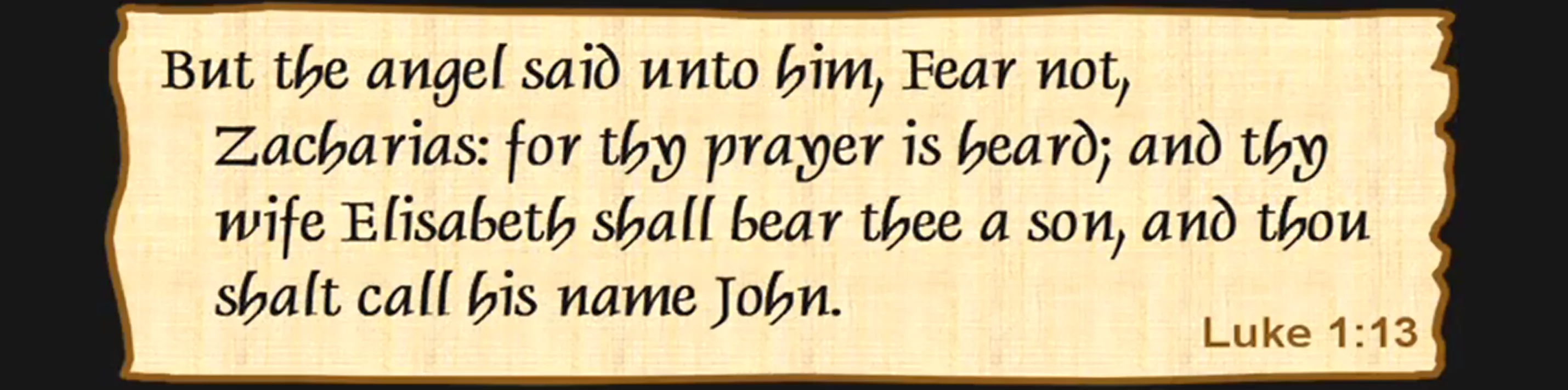
- “Fear not” occurs seven times in this Gospel
- The angel implies that Zacharias asked for a son along with his prayers for the nation
— Angel told Zacharias what to name his son. This will also be the case with Mary (Luke 1:31)
— “…thou shalt call his name John” = “YHWH is gracious” (the name John - Heb Johanan, means God is gracious)
— The angel not only gave the name of the son, but also detailed seven aspects of John’s character
Luke 1:14

Luke 1:15
Luke 1:16

Luke 1:17

- He will be a joy and a delight
— In Luke, “joy” is often closely linked with salvation (three times in Luke 15)
— His ministry brought joy to Israelites who believed his message of repentance for the forgiveness of sins (Luke 3:3)
- He will be great in the sight of the Lord
— How great? Jesus will say that no man born of woman is greater than John (Matt 11:11, Luke 7:28)
— He is above all OT heroes!
— (the expression “in the sight of” appears 35x in Luke and Acts, but it is used just one other time in John 20:30)
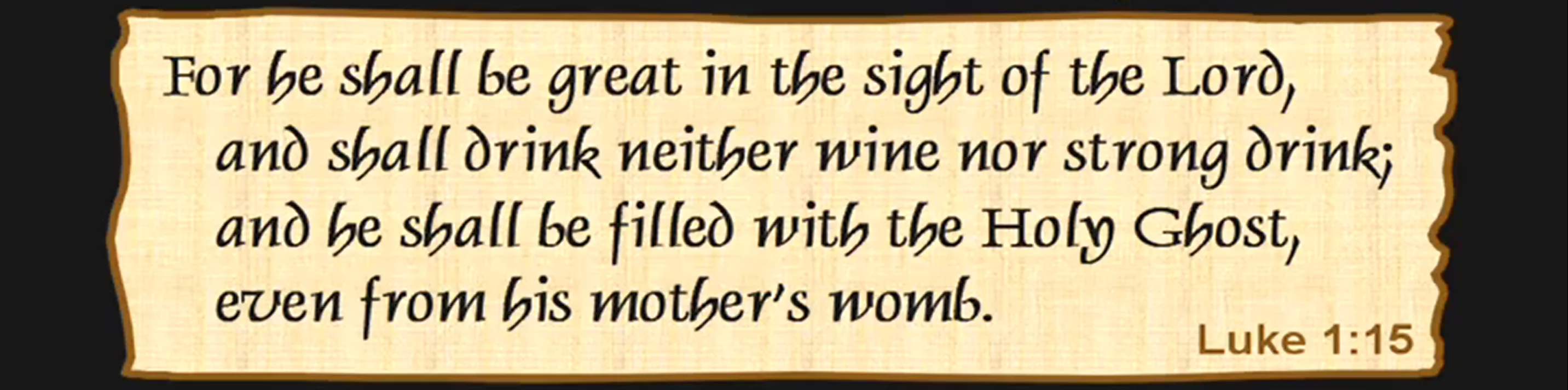
- He is never to take wine or other fermented drink
— Appears to take a lifetime Nazarite vow (Num 6:1-21, cf. Judg 13:4)
- He will be filled with the Spirit from the womb
— We will get to it below in verse 41 (Luke 1:41)
- Many of the people of Israel would he bring back to God
— Crowds of Israelites did turn to the Lord through John’s ministry (Matt 3:5-6, Mark 1:4-5)
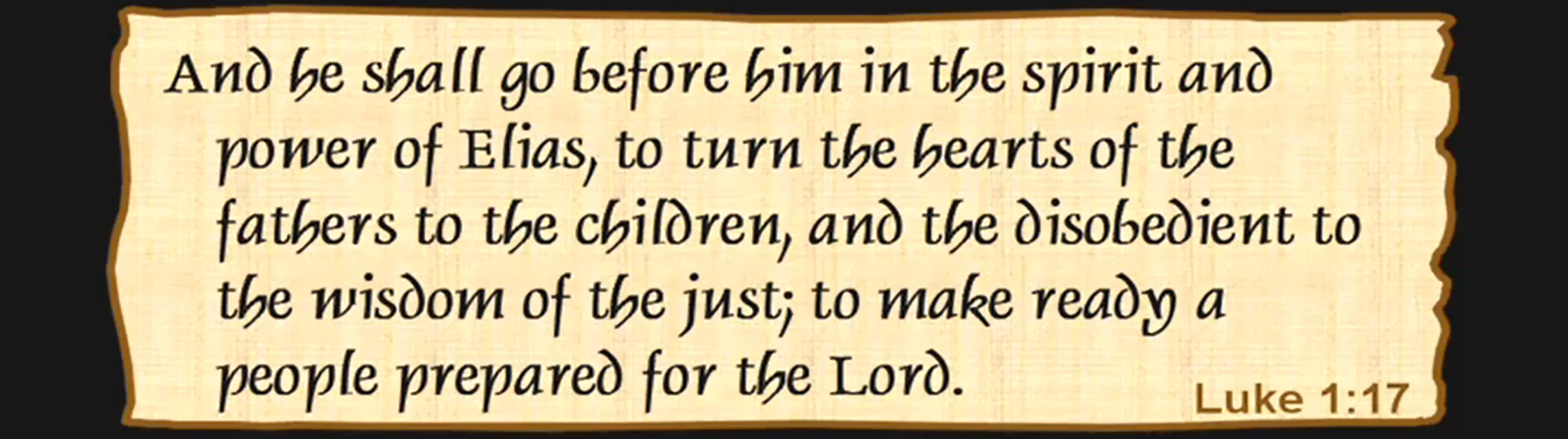
- He would adopt the manner and dress of Elijah
— Another way he emphasized the urgency of his message was to dress, act and eat like Elijah the prophet (Matt 3:4, 2 Kgs 1:8)
- He would be the Messiah’s Forerunner
— Prophesied in Isa 40:3 (cf. Matt 3:3, Luke 3:4, John 1:23)
— This is also how Jesus was different than any other religious leader — for one, He had an advance man to prepare the way for Him
Luke 1:18

- Zacharias was:
— not an atheist, but a priest and a righteous man
— offering prayer in the Temple and
— fully aware the messenger was supernatural
- His doubt results in a confirming sign…
Luke 1:19
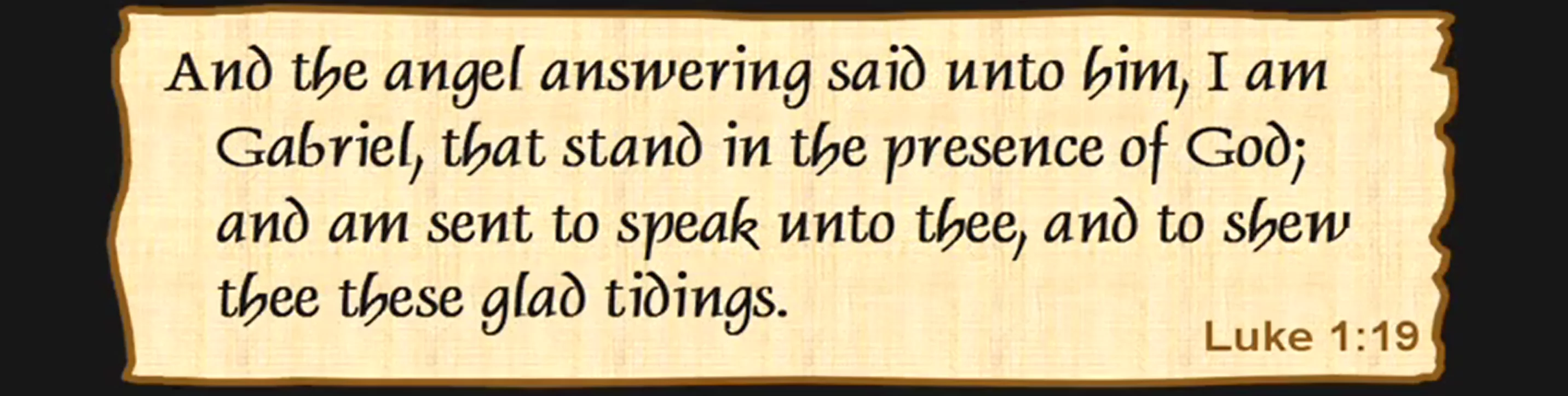
- Two named angels in the Scripture — Gabriel and Michael. They each have very specific job descriptions
- Gabriel is always on a Messianic announcement mission:
— Gabriel appeared twice to Daniel (Dan 8:16, Dan 9:21)
— Both times he also gave Daniel instruction and understanding
— We infer he did the same here with Zacharias (Luke 1:67-79)
- Michael is a warrior. He is the head of the Lord’s host (in a military sense)
Luke 1:20
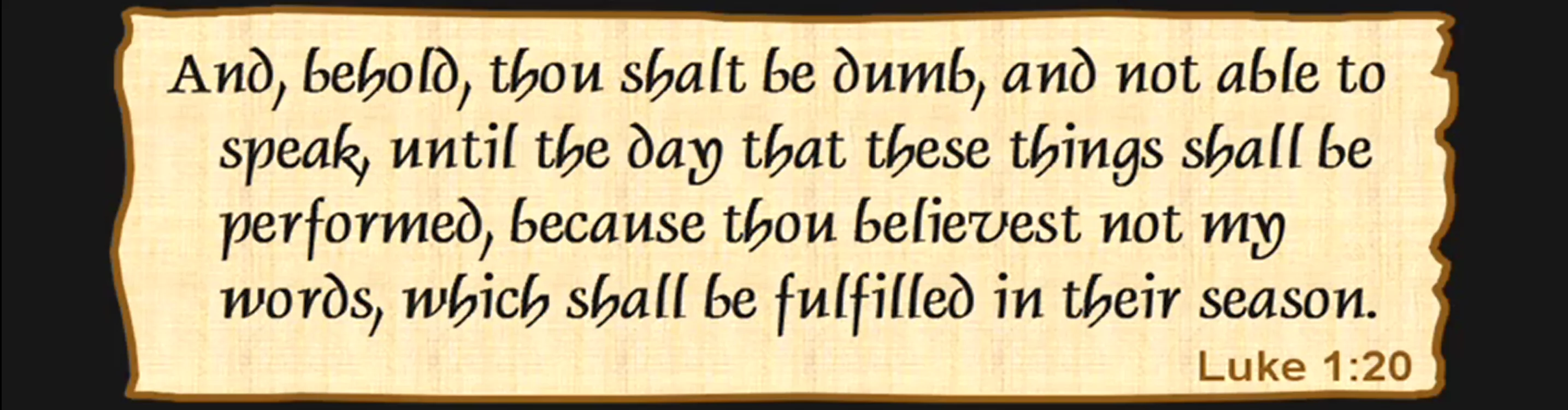
- A sign: Zacharias struck dumb
— Zacharias’ inability to speak (and hear, cf. Luke 1:62 — many people don’t realize he was probably also deaf) was partially a punishment for his unbelief, but it was also a sign (a confirmation)
— “One without faith should be silent.” —Elizabeth Barrett Browning
Luke 1:21

- Love the KJV: “…and marvelled that he tarried so long in the temple.”
Luke 1:22-23
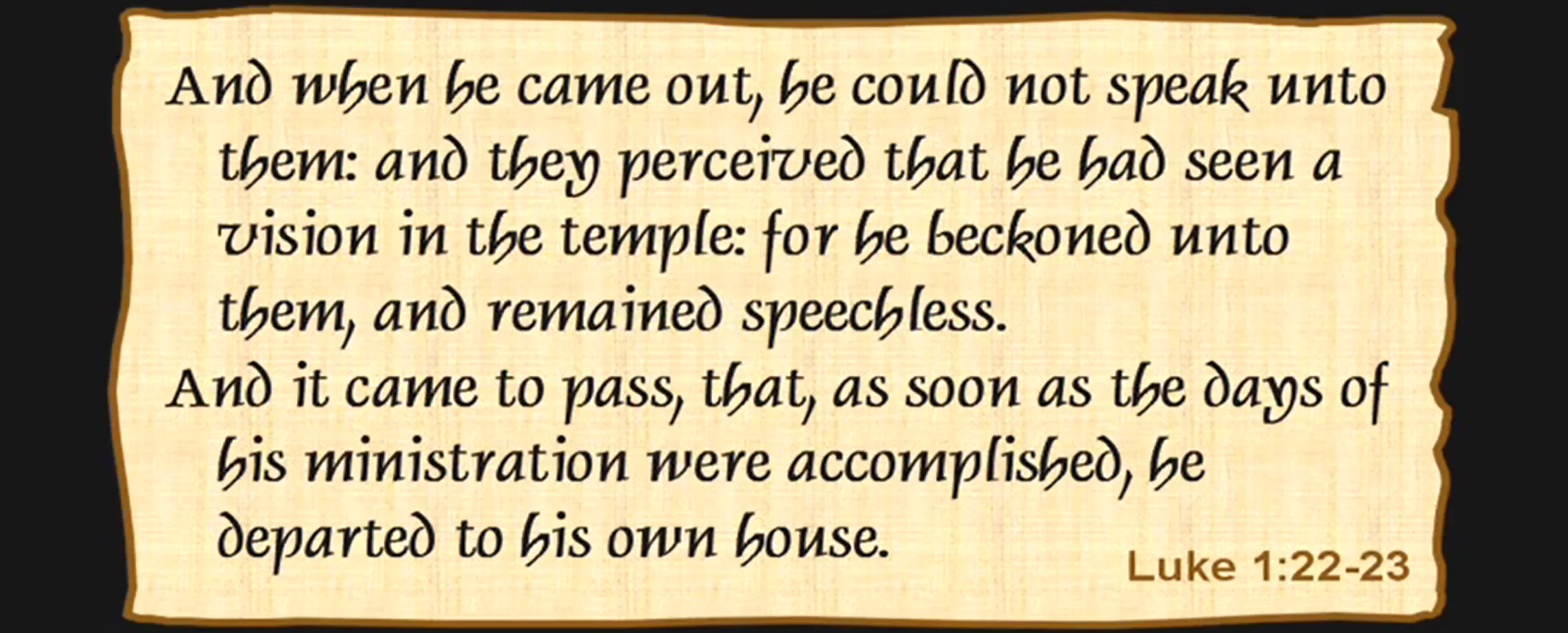
- “…the days of his ministration were accomplished” — He was on priestly duty for a week (the priests changed on Shabbat)

Luke 1:24-25
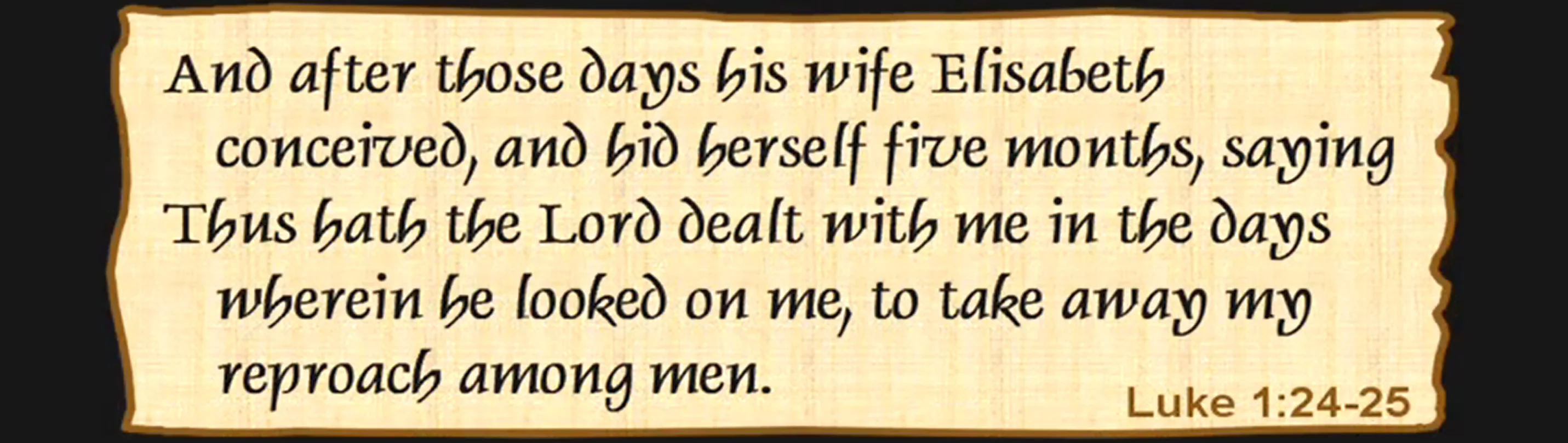
- Elisabeth remained in seclusion
— Mary, her cousin, may have been the first person to know the news which the angel had delivered (Luke 1:36)
- Luke doesn’t say, but Zacharias may have told her in writing about their son’s destiny
— Elisabeth knew before Zacharias could speak that his name was to be John

Luke 1:26 Jesus’ Birth Foretold

- “…city of Galilee” — Galilee was a somewhat Gentile area
- “…named Nazareth” — Nazareth was a town with an undesirable reputation (John 1:46)
- Nazareth was not considered “kosher”
- Matthew makes the note that Jesus’ subsequent association with Nazareth was also prophetic:
— “...He shall be called a Nazarene” (Matt 2:23, cf. Isa 11:1)
— There is a pun involved there, because that word can also means a sprout or a branch
Luke 1:27

- Mary: Heb Miriam (Gr Mariam, Serbian Marija)
- Mary is a nobody in a nothing town in the middle of nowhere…
— “And base things of the world, and things which are despised, hath God chosen, yea, and things which are not, to bring to nought things that are:” (1 Cor 1:28)
- But, both Mary and Joseph were of the House of David — the Book of Ruth links them with Bethlehem…

- Dr. Luke gives us the most extensive account of the Virgin Birth:
— Luke calls her a virgin: παρθένος (parthenos), which is very clear in Greek (no quibble as some do with the Hebrew of Matthew). Luke nails it down with a precision of Greek
— She had not yet had sexual contact with a man (Luke 1:34) — that’s what the word means
— He notes she was pledged to Joseph (Luke 2:5)
— In the prophecy in Isaiah 7:14, the Greek translation three centuries earlier (LXX) also uses παρθένος (parthenos), an unambiguous term. She was a virgin. It is clear for those who have done their linguistics homework
- Jewish Betrothal:
— A pledge: A man and woman pledged to each other for a period of time before actual consummation of marriage
— Binding: Much stronger than an engagement today. The two were considered married, but did not live together until after the wedding. It required a divorce to break the pledge
— We must understand this ancient Jewish ritual to fully appreciate the relationship between the Bridegroom and His Bride, the Marriage Supper, et al.
- Joseph the Carpenter:
— Nazareth was near Sephoris, a new capital being built
— Joseph may have been a “builder” or architect (Mark 6:3)
— The word is τέκτων (tektōn): a worker in wood, a carpenter, joiner, builder; any craftsman, or workman; a planner. The term can also include a developer or builder in our modern sense
— Even so, in a Greek-dominated culture, non-Greeks would only obtain modest roles
Luke 1:28

- Note: “among women” not “above women” (as Catholics are probably translating)
— Not even present in NASB: “And coming in, he said to her, “Greetings, favored one! The Lord is with you.””
- “…highly favored” — κεχαριτωμένη (kecharitōmenē): a participle related to the noun χάρις (charis) “grace”
— Mary was certainly a special recipient of His grace (favored one or woman richly blessed)
Luke 1:29-30
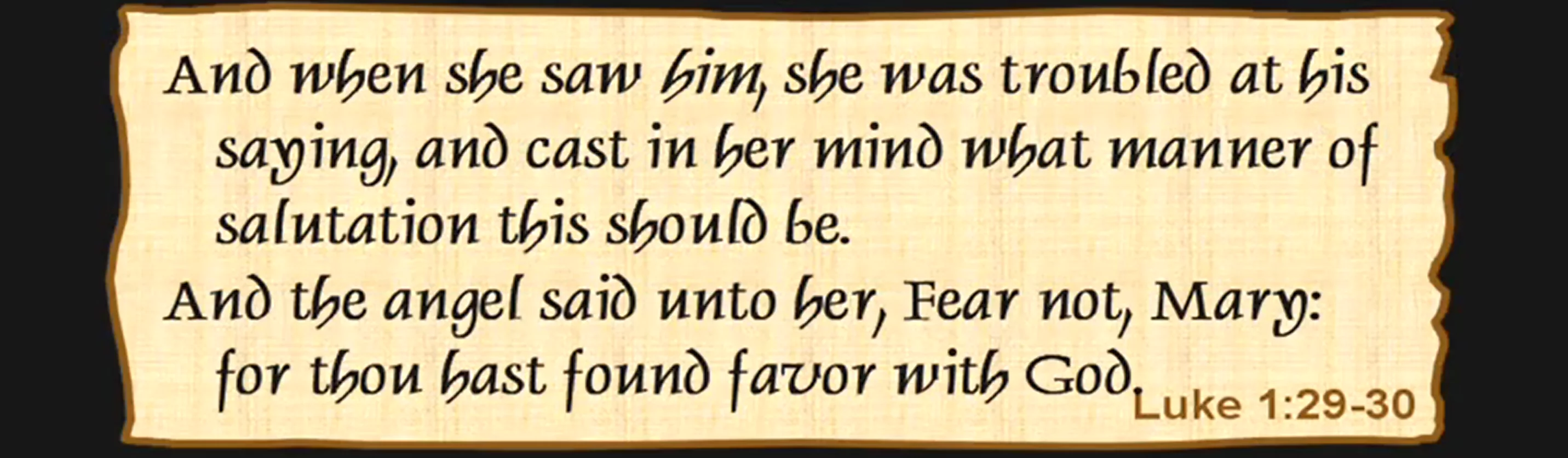
- Gabriel’s admonition was the same as to Zacharias:
— “Do not be afraid, for you will have a Son” (v. 13)
— And again, the angel gives the name for the baby
Luke 1:31

- Jesus is the Hellenized form of the Hebrew name Yeshua, which means “YHWH is salvation”
Luke 1:32-33
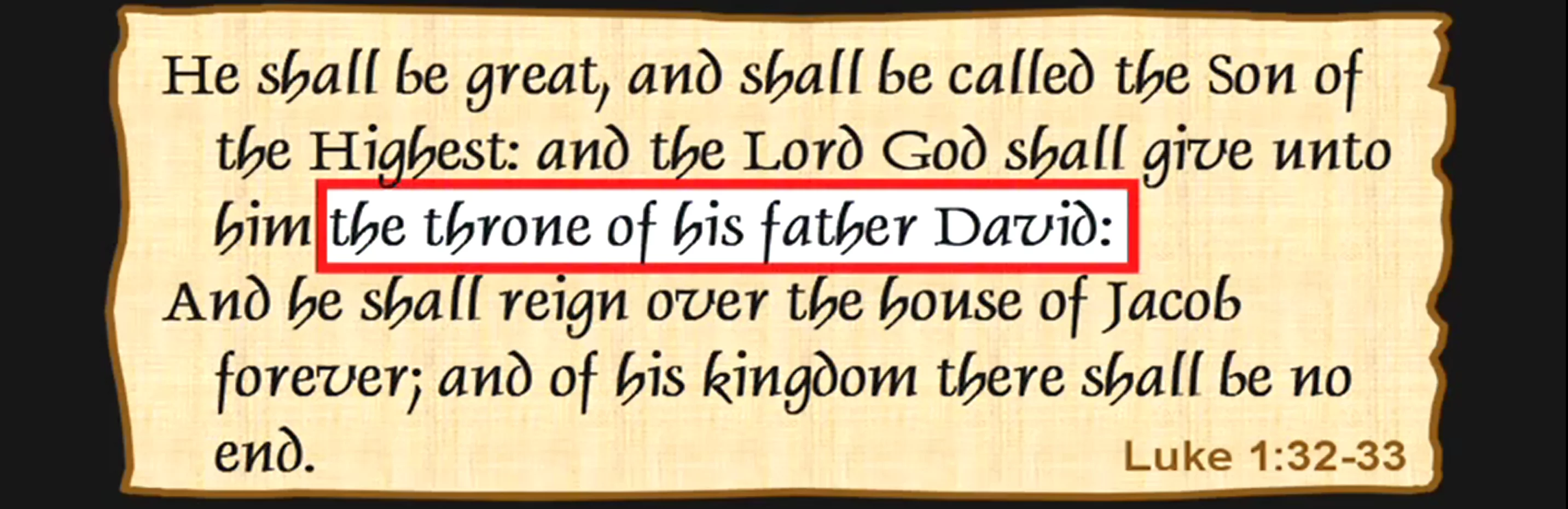
- “…the throne of his father David” — That is a strange phrase for him to use. Romans were running things in those days. Throughout the entire ministry of Christ, there was no throne of David, and yet that is the commitment that is here expressed and it is all through the Scripture — there are over 1,800 references to that in the OT alone!
- Jesus will reign on the throne of David forever. No end (that’s a long time)
- The Virgin birth was literal → David’s throne will be literal!
- The resurrection of Jesus Christ proves the Virgin Birth
— Once you can prove the resurrection of Christ, then everything else comes together
- His taking David’s Throne will usher in a new reality
- Mary would have understood that the angel was speaking to her of the Messiah
- All five predictions deal with the greatness of the son, not the greatness of the mother…

- He will be great
- He will be called the Son of the Most High
— The Septuagint often used the term “Most High” ὕψιστος (hupsistos) to translate the Hebrew עֶלְיוֹן(elyown) (Gen 14:18-22, et al)
— Mary could not have missed the significance of that terminology
— The fact that her Baby was to be called the “Son of the Most High” pointed to His equality with YHWH
— In Semitic thought a son was a “carbon copy” of his father, and the phrase “son of” was often used to refer to one who possessed his “father’s” qualities (e.g. the “son of wickedness” in Ps 89:22 means a wicked person)
- He will be given the throne of His father David
— Jesus, as David’s descendant, will sit on David’s throne when He reigns in the Millennium
(2 Sam 7:16, Ps 89:3-4, Ps 89:28-29, Isa 9:1-7, Isa 11-12, Isa 61, Isa 66, Jer 33)
— This is profoundly significant: the Throne of David did not exist during Christ’s earthly ministry and has yet to be fulfilled literally
— Today He is on His Father’s throne in heaven (Acts 2:29-36), not on David’s throne
— Many churches attempt to dodge the implications of this — and the myriad of Old Testament prophecies regarding a literal earthly rule — a view known as “Amillennialism”
- He will reign over the house of Jacob forever
— From the beginning of the Millennium and continuing into all eternity
- His kingdom will never end
— These promises must have immediately reminded Mary of the promise of YHWH to David (2 Sam 7:13-16)
— David understood the prophecy as referring not only to his immediate son (Solomon) who would build the temple, but also to the future Son who would rule forever. David stated that YHWH had spoken of the distant future (2 Sam 7:19)
Luke 1:34

- Her question was not an indication of doubt, but an inquiry into how such a thing would be accomplished
(Cf. Luke 1:18)
Luke 1:35
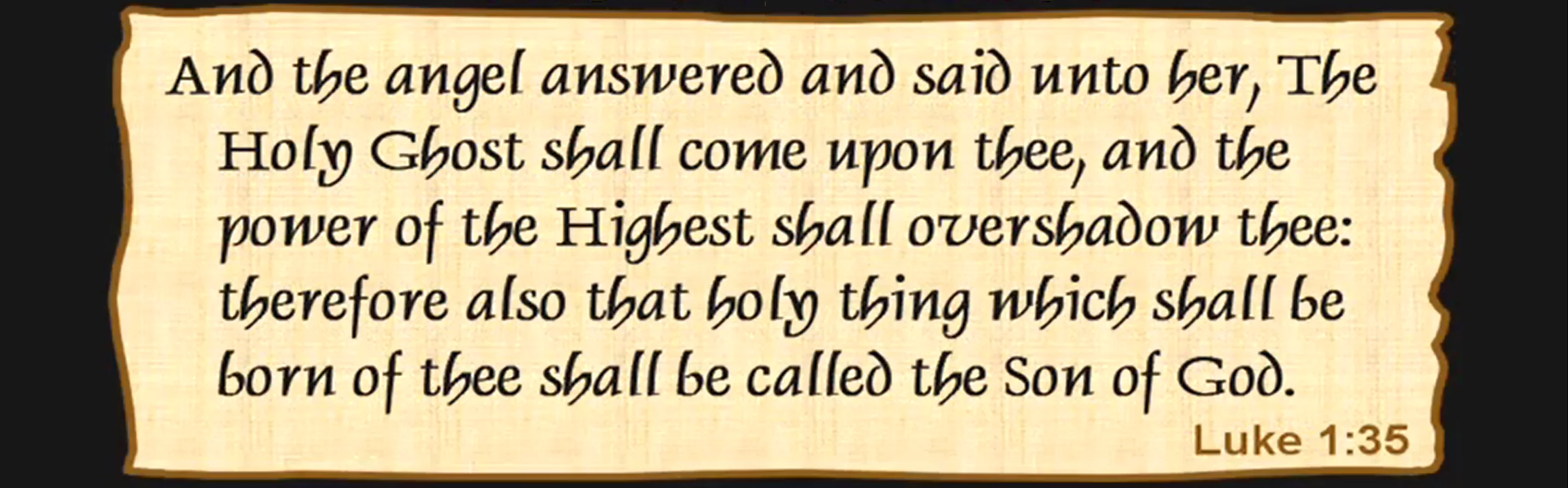
- The word “overshadowed” here is the same word for “overshadowed” in the Holy of Holies (Exo 40:35)
- Mary’s womb would become a holy of holies for the Son of God
- The Holy Spirit would bring out the miraculous conception and virgin birth of Christ

- Because of Christ’s deity and preexistence (Isa 7:14, Isa 9:6, Micah 5:2, John 1:1-3, Col 1:15-17)
- It avoids the blood curse pronounced on Jehoichin’s line (more in Chapter 3 — The Genealogy of Jesus)
- Jesus would be legally identified as the son of Joseph (Luke 3:23, Luke 4:22, John 1:45, John 6:42)
- But He would be accused of being illegitimate (John 8:41, Ps 69:7-12)
- Messianic Genealogy — The most distinguished Family Tree in history:
— Encrypted in Torah (Gen 38)
— Prophesied in the time of the Judges (Ruth 4)
— Evades the blood curse on Jeconiah (Jer 22:30)
— Fulfills the Virgin Birth (Gen 3:15, Isa 7:14, Ps 69, Ps 110)
Luke 1:36
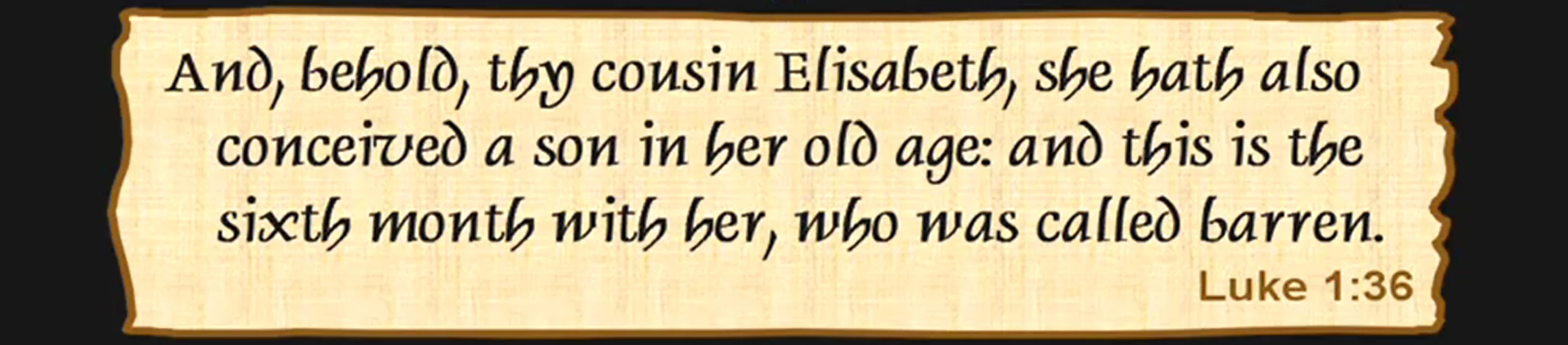
- Mary is also given a confirming sign: her cousin’s barrenness being relieved
Luke 1:37

- Dostoyevsky noted:
— “Without God nothing is impossible” (referring to the depravity of humanity)
- If only we could really grasp this verse!
— If we simply embrace: “In the beginning God created the heaven and the earth.” (Genesis 1:1), all the rest easily follows (follows very comfortably). That’s the key
Luke 1:38

- Mary affirmed her part in her Son’s subsequent birth by assenting to the plan of God, calling herself a δούλη (doulé), a female bondslave (Cf. Luke 1:48)

Luke 1:39 Mary Visits Elizabeth

- After learning of the sign, Mary hurried to see Elisabeth
- The hill country in Judea may have been near Jerusalem (probably because Zacharias was officiating priest), about 20 miles from Nazareth (a non-trivial trip)
Luke 1:40-41
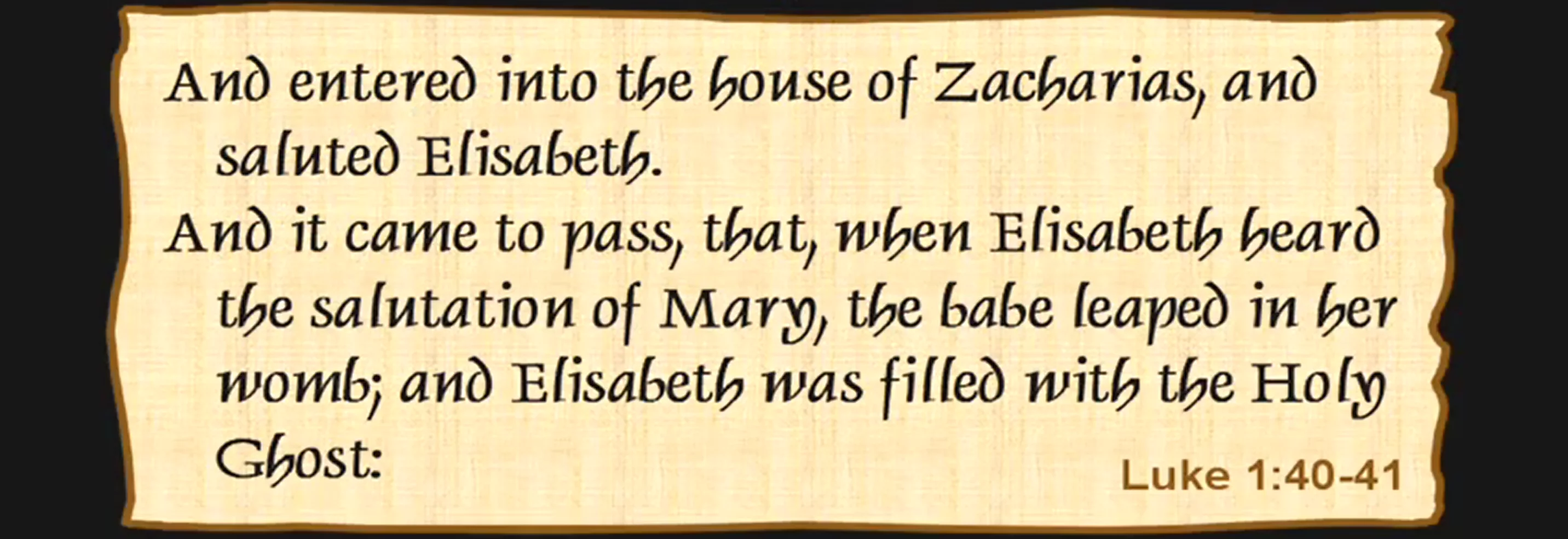
- “…the babe leaped in her womb” — The baby received the Holy Spirit first, then the mother did
- As a fetus of six months, John the Baptist:
— was about nine inches long and weighed about 1½ pounds
— had translucent skin with fingerprints and footprints
— could open his eyes for brief periods and gaze into the liquid darkness of the womb
— was capable of emotion, of recognizing the presence of the Lord
— had capacity to be filled with the Holy Spirit
- Believers are filled with the Holy Spirit for specific tasks
— Elisabeth’s baby leaped in the womb for joy
— Elisabeth was filled with the Holy Spirit
— Zacharias was later filled with the Holy Spirit (v. 67 Zechariah’s Prophecy)
Luke 1:42

- “…she” — Elisabeth
- Mary is the most honored of all women
- A balanced view of Mary:
— She is highly honored, yet angel says “among” not “above” women
Luke 1:43

- Elisabeth called her “the mother of my Lord”, who was only a few days old as a zygote in Mary’s womb
- In Luke the term “Lord” κύριος (kurios, kyrios) often describes Jesus
— “Lord” would be more important for a Greek reader than would the term “Christ” (meaning “Messiah”, as Matthew uses, writing to a Jewish reader), for the Gentiles had not been anxiously awaiting the Messiah
- On the other hand, the Septuagint (LXX) often used the word “Lord” kyrios to translate YHWH (cf. v. 45)
Luke 1:44-45
- Elisabeth said Mary was blessed, μακάρια (makaria) = “happy” because she believed what God had told her
- Mary visited joyously to confirm the Lord’s word

Luke 1:46 Mary Magnifies the Lord / The Song of Mary / The Magnificat

- From the Latin Vulgate for Luke 1:34: Et ait Maria magnificat anima mea Dominum
- “…magnify” — μεγαλύνω (megalunó): to make great, magnify; to deem or declare great; to esteem highly; to extol, laud, celebrate; to declare glory and praise
- “The Magnificat” consists almost entirely of Old Testament allusions and quotations
— The same is true of the songs of Zacharias and Simeon (Luke 1:68-79, Luke 2:29-32)
- Mary’s recital has similarities to Hannah’s song (1 Sam 2:1-10)
— First, Mary praised God for His special favor on her (Luke 1:46-50) → Mary saw herself as part of the godly remnant that had served Yahweh
Luke 1:47

- She called God “my Savior”, showing an intimate acquaintance with Him
Luke 1:48

- “…he hath” — He has (NASB)
The Magnificat contains eight He haths which describe God’s:
— Faithfulness (v. 48)
— Power (v. 49)
— Holiness (v. 49) and
— Mercy (v. 50)
Luke 1:49-51
- Second, Mary praised God for His special favor on Israel (Luke 1: 51-55)
— Through the Child that she was to bear, God was being merciful to Abraham and his descendants
— (All of our blessings and opportunities as Gentiles derive from the Abrahamic Covenant → through our relationship with the Son of David)
- Links to Abraham:
— The Title (Gen 14) used by Gabriel (v. 32) was from an episode before Abraham was promised the land of Israel (Gen 15) and before he was circumcised (Gen 17)
Luke 1:52-55
Luke 1:56

- Mary stayed with Elisabeth until John was born (cf. v. 36)
- The Greek words for “her own home” indicate that she was still a virgin and was not yet married to Joseph
- But by now, the tongues would have begun to wag…
- But by now God had given the good news to Joseph and instructed him what to do (Matt 1:18-25)

Luke 1:57 John the Baptist Is Born

- The record of John’s birth is given in a single verse, with friends sharing in the joy
- The birth of Jesus will occupy an entire chapter (Luke 2)
Luke 1:58-59
- Several verses focus on and emphasize the obedience of Zacharias and Elisabeth
- The old couple was careful to follow the Law in circumcision of the boy
Luke 1:60-62
- Zacharias was, apparently, deaf as well as dumb
Luke 1:63-64
- The fact that Zacharias immediately was able to speak amazed the crowd
- Zacharias — and everybody else — praised God
Luke 1:65-66
- Word then spread through the whole hill country (probably including the Jerusalem area) that this was an unusual child. The people continued to note that the Lord’s hand was with him
- Thirty years later, when John began his preaching ministry, many went out from this district who no doubt remembered the amazing events surrounding his birth (Matt 3.5)
- Priests served from ages 30-50
- John and Jesus both began their ministries at the age of 30

This psalm by Zacharias is filled with Old Testament quotations and allusions.
Luke 1:67-69 Zechariah’s Prophecy
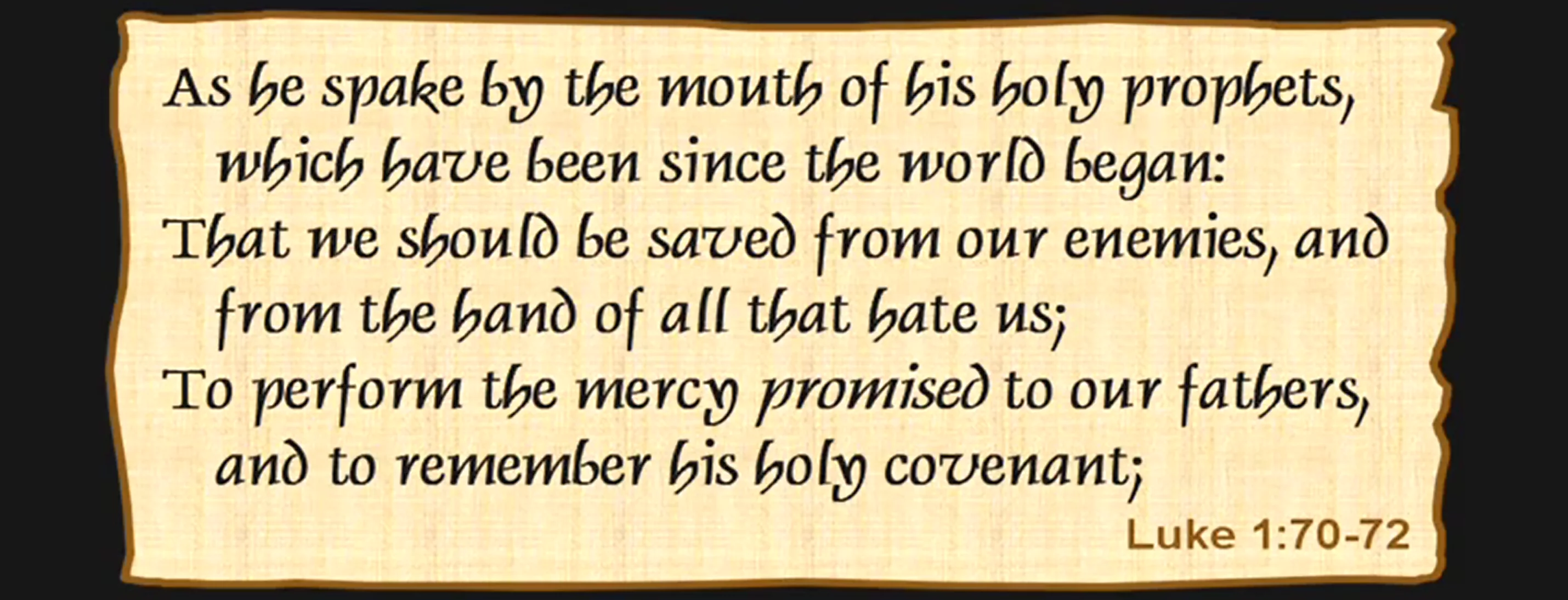
Luke 1:70-72
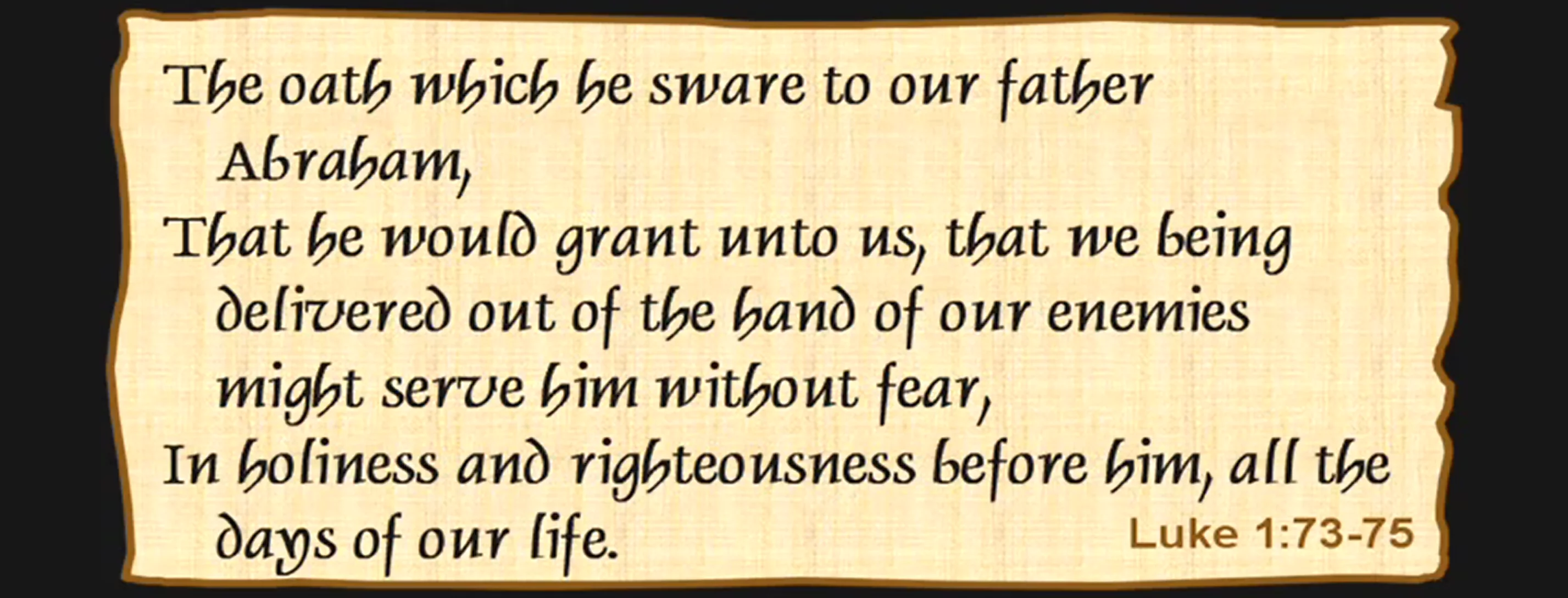
Luke 1:73-75
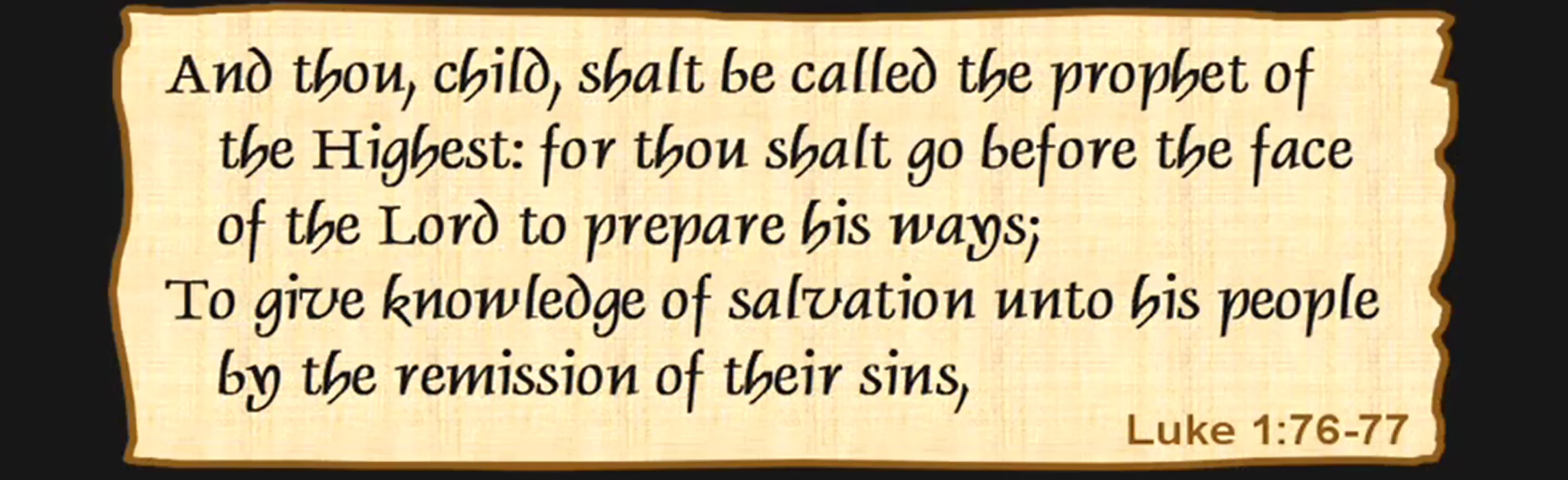
Luke 1:76-77
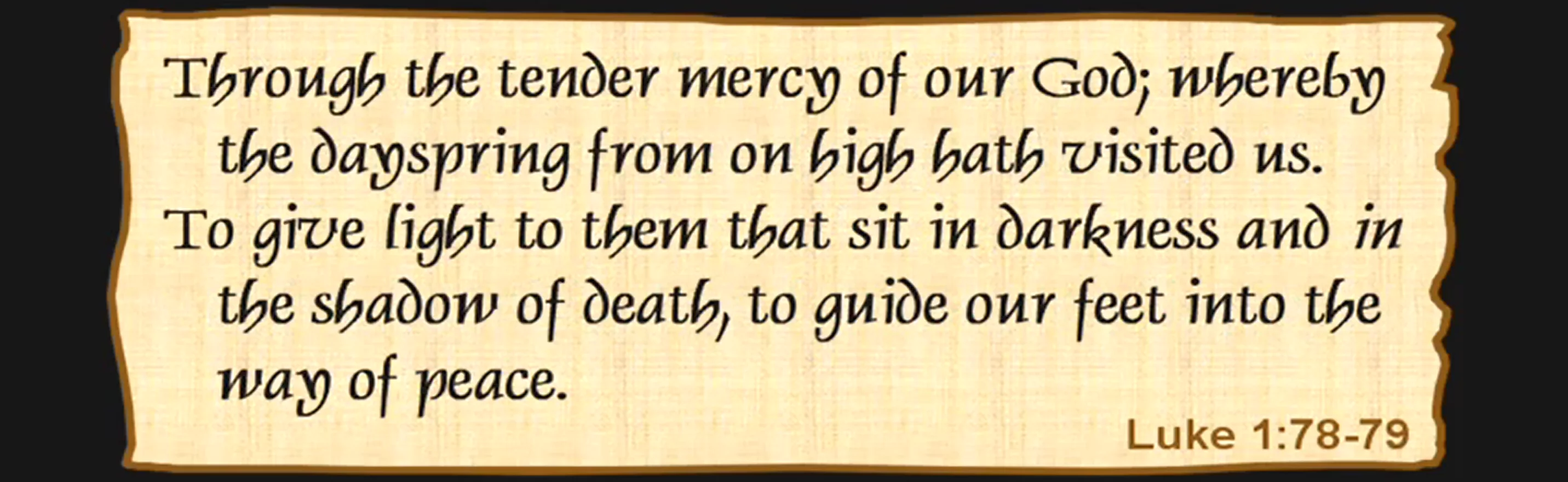
Luke 1:78-79
- Zacharias’ “Benedictus” expounded four ideas:
1) An exhortation to praise God → Luke 1:68a
2) The reason God should be praised — He has come and redeemed His people → Luke 1:68b
3) Deliverance for Israel through the Messiah → Luke 1:69-75
— The Messiah was to be Israel’s horn of salvation → Luke 1:69
— The horn of an animal is an idiom for power and is a common symbol in ancient literature. Thus the Messiah would be strong and would deliver the nations from her enemies → Luke 1:74
— The mention of God’s holy covenant (Luke 1:72-73), the oath God swore to Abraham (cf. Gen 22:16-18) occured on the very site of the crucifixion
— The title “Son of the Most High” is not uniquely Jewish. Melchizedek used the title, prior to the institution of circumcision. He was not a Levitical priest. Also, Nebuchadnezzar calls Daniel’s God the “Most High”
4) Describes John’s ministry → Luke 1:76
— John would prepare the way for the Messiah → Isa 40:3, Mal 3:1
— (Verse 77 may refer to the Lord rather than to John, but it works either way, because John did preach the same message of forgiveness of sins Luke 3:3)

Luke 1:80

- Because of the special mission which John knew from an early age he would perform, he chose to follow the role of Elijah by living in a desolate area (he made no use of the Temple and did not matter to him that he was destined to be a priest)
- As the son of a priest he would begin his ministry at age 30 (Num 4)

- A provocative legend — not scriptural
- Legend says that when Elijah was translated (raptured, 2 Kgs 2:11), his mantle fell on the ground and Elisha picked it up (2 Kgs 2:13-14)
- When Elisha died, the mantle was placed inside the Golden Altar (the Altar of Incense)
- When Zacharias received the visit of the angel, he was told to take the mantle with him (cf. Luke 1:17)
- This may have been the very mantle that John the Baptist was wearing 30 years later (cf. Mark 9:13)
- [There seems to be evidence that this original Golden Altar was in the second Temple]
- John was preaching at Beth Bara. People would travel 20 miles of windy desert road from Jerusalem to hear John preach. The Scripture tells us he was preaching in the spirit and power of Elijah. The conjecture is that he was actually wearing the mantle of Elijah!

- The records of the announcements and births of John and Jesus were arranged by Luke in parallel fashion
- However, the emphasis is on the birth of Jesus, which will be described in greater detail than the birth of John
- A strong case can be made that Jesus was born on September 29, 2 BC (Feast of Trumpets)
— We know which course was officiating when Jerusalem fell in 70 AD
— It’s complicated, but can be calculated when Zacharias was serving in the Temple
— We know the flocks were in the fields, so it couldn’t be in winter
— The Roman registration would not have occurred in winter. More likely summer or fall
— John the Baptist was possibly born April 19-20 (Passover)
- Thus, it is very plausible that Jesus’ Birthday is not December 25th

