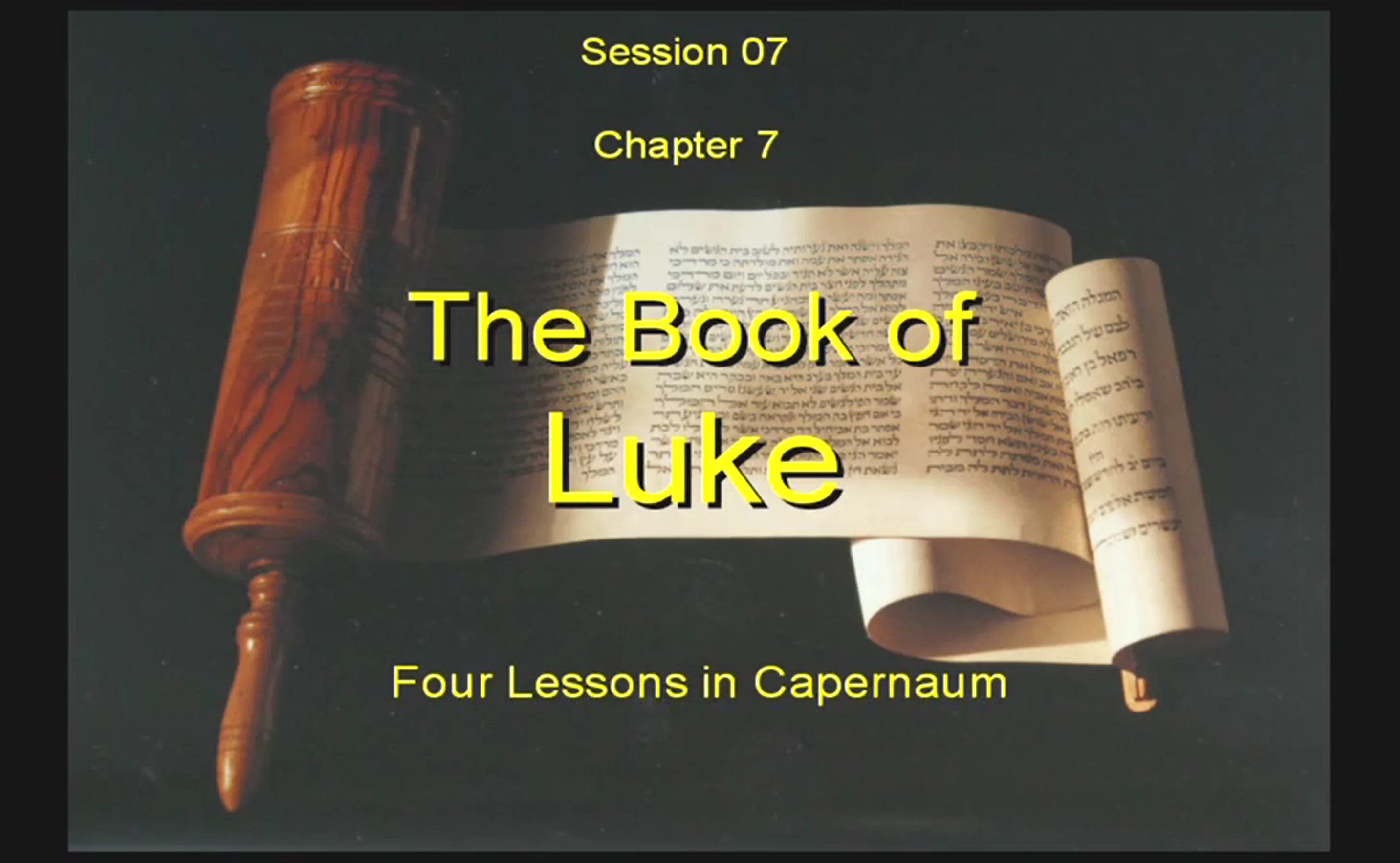
s07 (Ch 7) 4 Responses in Capernaum (studied 31-Jan-2026)
The Book of Luke with Dr. Chuck Missler
The subsections of Chapter 7 (per NASB/LSB/MEV) are:

- In Chapters 7 and 8, there is a confluence between:
— The ministry of Jesus in Miraculous Signs, which again authenticated that He is the Messiah (Luke 7:1-17, Luke 7:36-50, Luke 8:22-56), and
— His Teaching, which has authority based on the message He was proclaiming in Luke 4. He used Isaiah 61:1-2 as his mandate (Luke 7:18-35, Luke 8:1-21)
- In this chapter, we encounter four hurting people: (and 4 special lessons)
— a dying servant → Response to Faith (centurion, vv. 2-10)
— a grieving widow → Response to Despair (widow’s son raised from dead, vv. 11-17)
— a perplexed prophet → Response to Doubt (John the Baptist’s disciples, vv. 18-35)
— a repentant sinner → Response to Love (woman’s tears wiped with her hair, vv. 36-50)
Luke 7:1

- Leaving the countryside, Jesus entered His adopted “hometown”: Caper Naum = “Village of Nahum”
- (Usually associated with Nahum the Prophet, but that’s conjecture)


Luke 7:2 The Centurion’s Faith / The Healing of a Centurion’s Servant (MEV)

- “…a certain centurion” — a Roman officer in command of a hundred men, comparable to a modern-day captain
- In Luke’s writings—both the Gospel and Acts—centurions are always presented as quality men of good character:
— A centurion here, the one of a great faith (Luke 7:2-10)
— Cornelius: the first Gentile convert, was a centurion (Acts 10:1, Acts 10:22)
— A centurion watched the crucifixion of our Lord: When he saw the wonders attending it, he exclaimed “Truly this man was the Son of God.” (Matt 27:54, Luke 23:47)
Luke 7:3

- It is interesting that he had influence over some elders of the Jews and he sent them as messengers
- Jewish leaders had very little love for Romans in general and even less for soldiers in particular
- And synagogue leaders are not given to running errands for anyone, let alone a Gentile officer
- This centurion loved the Jewish people and even built them their synagogue! (v. 5)
- Mat 8:5-13 records the same event, but doesn’t highlight the use of intermediates, messengers
Luke 7:4

- They presented the centurion as “deserving” and “worthy”. They were judging from “externals”
Luke 7:5

Luke 7:6

- That’s a very strange posture for a Roman to take to a Jew. Usually, it’s the other way around:
— A Gentile is not worthy to step under the roof of a Jew
- In other words, that’s a switch. That’s how the Jews usually felt about Gentiles
- Roman soldiers were not characterized by humility, especially in front of their Jewish subjects
- A Roman officer told a poor Jewish rabbi that he was unworthy to receive Him into his house?
Luke 7:7
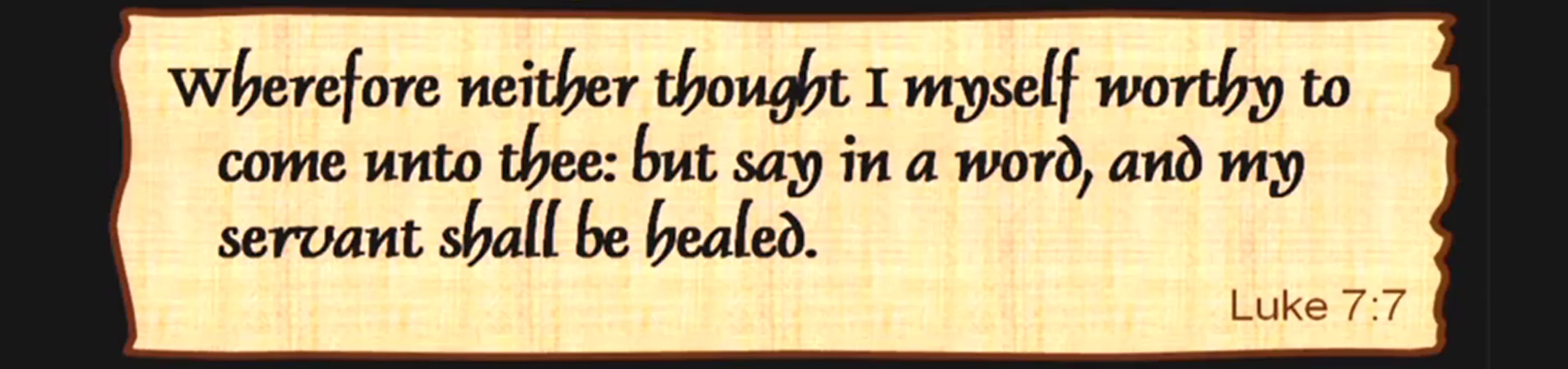
- His faith is, indeed, remarkable:
Luke 7:8
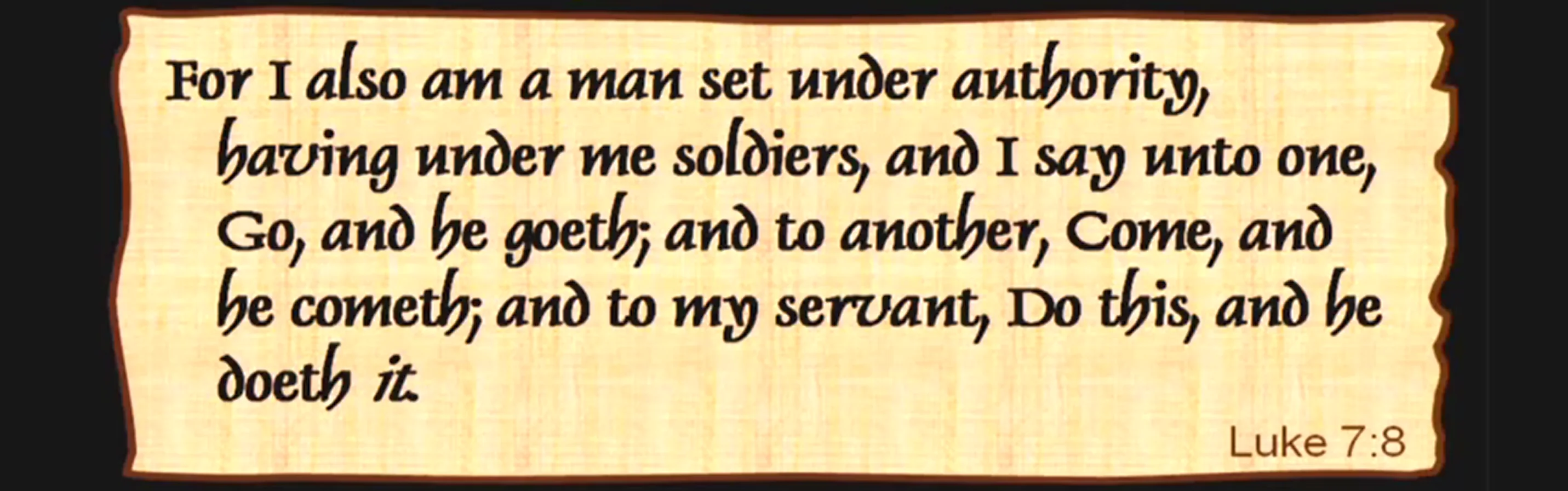
- Parallel verse is Matt 8:9
- The centurion understood:
— Authority, that Christ had authority like he had
— Action at a distance
— The parallel between him and Jesus: he commanded soldiers, and Jesus commanded diseases!
Luke 7:9

- Twice in the Gospels we are told that Jesus “marvelled”:
— In Capernaum, He marvelled at the centurion’s faith
— In Nazareth, He marvelled at the Jews’ unbelief (Mark 6:6, cf. Luke 4:14-30)
- This centurion had faith Jesus had not found in all of Israel
- Why did Jesus “marvel”?
1) The man’s background: uncircumcised Gentile, raised outside the Covenant, without the tutoring of the Scriptures
2) The man’s occupation: He was a soldier; an instrument of the oppressive pagan establishment. As an officer, he wielded considerable power, yet humble
3) The man’s wealth: an unusually rich soldier; he’d built a synagogue. Riches are not a spiritual advantage; they foster this-world attachments (cf. Luke 18:24-25)
4) The man’s confidence: His certitude (absolute certainty or conviction that something is the case) was expressed in stark simplicity: “Say the word and my servant will be healed”
- Somehow he had embraced Jesus with far more perception than the Jews
- The only other person Jesus commended for having “great faith” was a Gentile (Canaanite) woman whose daughter was delivered from a demon (Matt 15:28) “yet the dogs eat of the crumbs which fall from their masters’ table”
- In both of these instances, Jesus healed at a distance
🩺 Psalm 107:20

🩸 Eph 2:11-12

🩸 Eph 2:13

- This is Paul’s summary of what we’ve just seen here
Luke 7:10

- No surprise
- Indeed. Would that we, with our greater available revelation of God, might have such faith
- “Lord, increase our faith!” (Luke 17:5)


Luke 7:11 The Raising of the Widow’s Son (MEV)
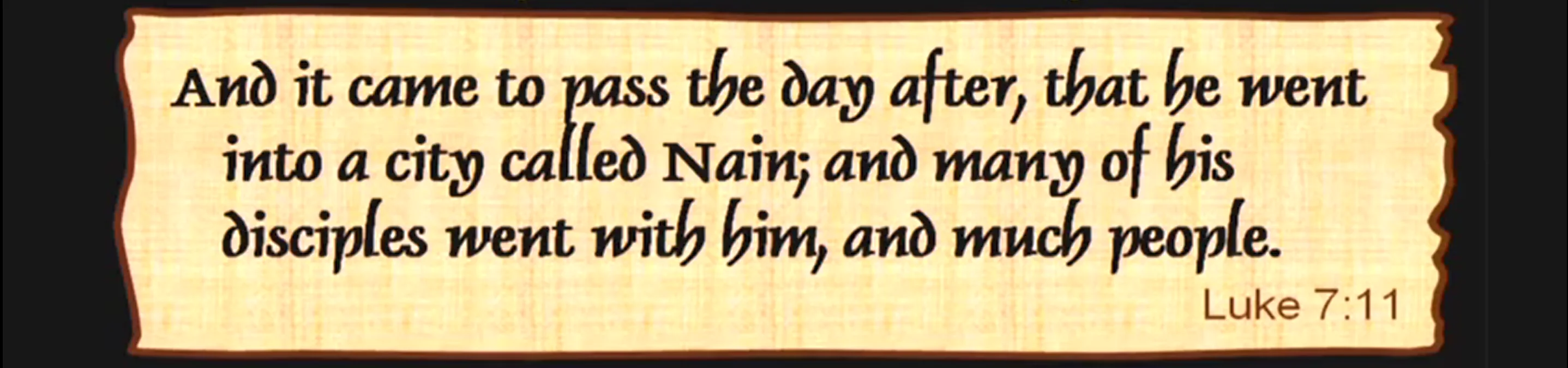

- Nain was about 25 miles southwest of Capernaum—a full day’s journey
- (He went even though He was not requested to go)
Luke 7:12
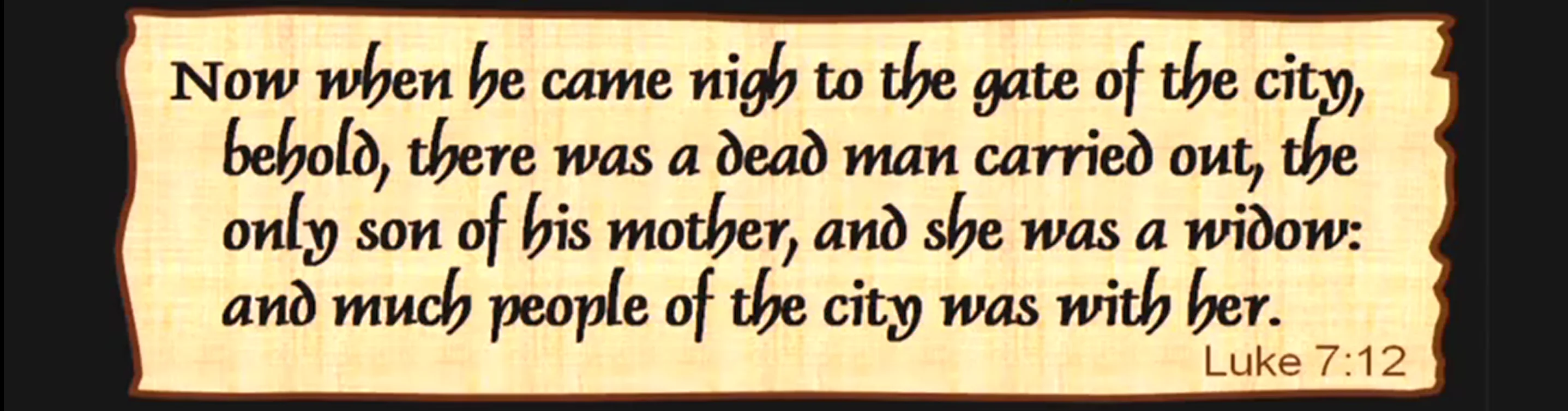
- She has lost not only her son, but her only male provider and faces being destitute
— The woman was not only grieving
— She was now completely alone and seemingly unprotected, without a close male relative
- The death of a child is most unnatural and hardest to bear. Death is a cruel thief when it strikes down the young
— Carl Jung calls it “a period placed before the end of the sentence”
- Help for widows is a major theme in both the Old and the New Testaments, especially under the Covenant as related in Deuteronomy (cf. the saga of Naomi with Ruth, etc.)
- Warren Wiersbe suggests that there were four special meetings at the city gate that day:
1) Two contrasting crowds met: One group was rejoicing in the blessings of the Lord; the other was lamenting the death of an only son. Jesus had not been summoned, but He had an appointment
2) Two only sons met: one alive but destined to die; the other dead but destined to live
3) Two sufferers met: The “Man of Sorrows” could easily identify with the widow’s heartache (Isa 53:3)
4) Two enemies met: The Way, the Truth and the Life met “the last enemy”, death (1 Cor 15:26, 51-58)
⚰️ Heb 2:14-15
Luke 7:13

- The verb “had compassion” translates the noun σπλάγχνα (splanchna), “inner parts of the body”
— the viscera (the soft, internal organs housed within the major body cavities such as the heart, lungs, liver, intestines and kidneys); the bowels, guts (“heart went out” NIV)
— The inner organs collectively were considered to be the seat of the emotions (we use the term “heart”)
— This noun splanchna is used 10 times in the NT (Luke 1:78, 2 Cor 6:12, 2 Cor 7:15, Phil 1:8, Phil 2:1, Col 3:12, Philemon 7, 12, 20, 1 John 3:17)
- “…Weep not” — literally “Do not go on crying”, as a prelude for what He was about to do:
Luke 7:14
- Touching a coffin or bier violated the ceremonial laws (Num 19:11, Num 19:16)
— Yet, mercy above sacrifice (Hos 6:6)
— A word, from the Logos Himself
- He always is precise about whom he is raising
— Maybe more people would rise from the dead otherwise?
— Cf. “Lazarus, come forth.” He was the only one who was supposed to come forth!
Luke 7:15

- The boy heard Him!
— (He apparently was fully “alive” somewhere!)
- The young man heard the voice of Christ and obeyed — as must every deceased human in its own time
☝️ Heb 9:27

- Hebrews 9:27 is often used to support the view that the 2 witnesses in Rev 11 are Enoch and Elijah
— (Chuck believes they are Moses and Elijah for other reasons)
- Not everybody dies just once. Some people have died twice:
— Lazarus
— Jairus’ daughter
— The son of the widow of Zarephath (by Elijah) in 1 Kings 17:19-24
- Hebrews 9:27 refers to the general pattern, and is simply a rebuttal (a refutation) to reincarnation, etc.
Luke 7:16

- Imagine the situation: a grieving widow and her son who has died
— They were getting used to the idea of his death
— It shook them up to have him back (this was not a casual thing)
— This was a profound discontinuity, a nonlinearity that has its impact
- Scientists have been shaken up lately — they have discovered:
— The speed of light is not a constant
— DNA is a digital code (digital code implies language and language implies a prior design)
— The universe is finite (not infinite) and digital
- These are staggering shocks. The same kind of fear and awe is seen here
- No doubt the people here were reminded of the ministries of Elijah and Elisha
— Elijah and Elisha were also sent to deal with the unbelief and decay in the Northern Kingdom on its path to ruin… (their kings went from bad to worse, ultimately causing that kingdom to be blotted out)
— The inference is that there was another prophet risen up to arrest their decay and unbelief before they were wiped out as a nation
— (btw, Jerusalem fell 40 years later)
Luke 7:17

- “…rumour” — report (NASB)
- Luke may have recorded this raising of the widow’s son from the dead here to set the stage for the interchange between John the Baptist’s disciples and Jesus
- This is a deliberate parallel between John and Elijah


Luke 7:18 Questions from John the Baptist / A Deputation from John / The Messengers From John the Baptist (MEV)

- This event happened while John was in prison (Matt 11:2)
- John’s moral courage to condemn Herod’s marriage to Herodias, Herod’s one-time sister-in-law, caused his incarceration in the dungeon of Machaerus, the desert fortress-palace perched on a desolate high ridge of the Dead Sea (cf. Luke 3:19-20)
— The remains of the castle’s dungeons can still be seen, complete with iron hooks
— It must have been difficult for one accustomed to the al fresco freedom of the wilderness to be confined
- John expected that the Messiah would set up the kingdom as he had been announcing. But suddenly John found himself in prison and in danger of being put to death, and still the kingdom, apparently, had not come
- Thus John was anxious concerning the Messiah. He knew the Old Testament well and knew of the works of the Messiah—but apparently now, John was confused
- It is not unusual for religious leaders to have their days of doubt and uncertainty
— Moses was ready to quit (Num 11:10-15)
— Elijah as well (1 Kings 19)
— Paul knew the meaning of despair (2 Cor 1:8-9)
— Jeremiah had despair: he is known as the “weeping prophet” (Jer 20:7-9, Jer 20:14-18)
- There is a difference between doubt and unbelief:
— Doubt is a matter of the mind: we cannot understand what God is doing or why
— Unbelief is a matter of the will: we refuse to believe God’s Word and obey what He tells us to do
- “Doubt is not always a sign that a man is wrong; it may be a sign that he is thinking.” —Oswald Chambers
Luke 7:19

- That might be an expression of doubt on John’s part (many people think so), or it might have been just a way for John to train his disciples, to give them an errand that would be fruitful for them
- John had promised that “the kingdom was at hand”, but apparently there was no evidence of it so far
Luke 7:20-21
Luke 7:22
- He gave them deeds, not discourse
- He gave them empirical as well as Scriptural evidence
- He’s reminding them of his mandate from Isaiah 61:1-2 (cf. Luke 4:16ff)
- At least four separate Isaiah texts were alluded to in Jesus’ answer:
— “Thy dead men shall live…” (Isa 26:19)
— “On that day the deaf will hear words of a book, And out of darkness and thick darkness the eyes of the blind will see.” (Isa 29:18ff)
— “Then the eyes of the blind will be opened, And the ears of the deaf will be unstopped.” (Isa 35:5ff)
— “The Spirit of Lord Yahweh is upon me Because Yahweh has anointed me…” (Isa 61:1-2)
Luke 7:23

- Jesus’ response is derived from Isa 8:14-15:
14 “Then He shall become a sanctuary;
But to both the houses of Israel, a stone to strike and a rock to stumble over,
And a snare and a trap for the inhabitants of Jerusalem.
15 “And many will stumble over them;
Then they will fall and be broken;
They will even be snared and caught.” (NASB)
- Much of the time, Jesus’ words come directly from the Old Testament (because He wrote it!)
— “In the volume of the book it is written of me,” (Psalm 40:7) (and “me” is Messiah Himself)
- “…offended” (take offense at — NASB)
— a metaphor: to offend; to entice to sin; to cause a person to begin to distrust and desert one whom he ought to trust and obey; to cause to fall away
— to cause one to judge unfavorably or unjustly of another (since one who stumbles or whose foot gets entangled feels annoyed)
— to cause one displeasure at a thing; to make indignant; to be displeased, indignant
Luke 7:24
- John was not a compromiser, not seeking the praise of the crowd
Luke 7:25

Luke 7:26-27
- Not only a prophet, but one whose ministry was prophesied! (Isa 40:3, Mal 3:1-2)
- Gabriel had referred to the Malachi passage (Mal 4:6) in his announcement to John’s father, Zechariah (Luke 1:17)
- In Mal 3:1-2 two messengers are spoken of:
1) the Forerunner, revealed here as John the Baptist, and
2) “the Messenger of the Covenant” who will purify His people. That is, the Messiah Himself
Luke 7:28
- “…Among those that are born of women there is not a greater prophet than John the Baptist” — that is a wild statement
- But notice what He adds to end the sentence: “…but he that is least in the kingdom of God is greater than he.”
- Are you in the kingdom of God? Are you saved? Are you one of Christ’s?
— Then you are part of that second clause: you are greater than John the Baptist!
- “The law and the prophets were until John: since that time the kingdom of God is preached, and every man presseth into it.” (Luke 16:16, cf. Matt 11:13)
— In other words, it supersedes the Law and the Prophets
— We are in a different dispensation; staggeringly different (and not just in terms of the use of metaphors)
- John the Baptist ends the Old Testament period
— He is saved, but he is part of the Old Testament dispensation and not part of “the Church”
— The Church in the mystical sense: ἐκκλησία (ekklesia) — an entity that was birth in Acts 2 and continues until Harpazo (the Rapture, the removal of the Church)
- The concept of dispensations is very important: there is an era that closes with John the Baptist
Luke 7:29

- Verses 29 and 30 are the words of Jesus, not an explanation from Luke (cf. Matt 21:32)
- “…that heard him” — “him” = John the Baptist
— (NASB & LSB: “…heard this” — “this” is wrong, although consistent with not being words of Jesus)
Luke 7:30

- Verses 29 and 30 are the words of Jesus, not an explanation from Luke (cf. Matt 21:32)
- The common people accepted John’s message and were baptized by him as proof of their repentance
— They “justified God” in that they agreed what God had said about them (Ps 51:4)
- But the religious leaders justified themselves, not God, and rejected John and his message (Luke 16:15)
— That was the choice they made by not accepting his message, justifying themselves
Luke 7:31

- He is groping for a parallel here
- Luke highlighted the deep division in the thinking of the people who listened to Jesus’ words:
— Those who had been baptized by John had
• repented of their sins and had been baptized to show their sincerity
• agreed with Jesus and acknowledged that God’s way was right
— In contrast, the Pharisees and experts in the Law
• rejected God’s purpose for themselves
• refused to be baptized by John
• showed that they did not accept John’s message of repentance or accept the kingdom
• thus they rejected God’s plan of salvation for them
- It is often said: “God does not send anyone to hell”
— People go to hell because they refused to accept the provision God has made to avoid it
— It is their choice that gets them to hell, not God
Luke 7:32

Luke 7:33-34
- You can never win with these people
- They wanted neither the funeral nor the wedding (is another way of phrasing the dilemma of the leadership)
Luke 7:35

- God’s wisdom is not frustrated by the sophistry of the “wise and the prudent”
— (sophistry — the use of clever but false arguments, especially with the intention of deceiving)


Luke 7:36 A Sinful Woman Forgiven (MEV)
- Simon’s invitation may have been insincere
- Common courtesies were omitted:
— the greeting of a kiss
— the anointing with a touch of olive oil
— the washing of sandaled feet
- Because most roads were unpaved and the normal foot attire was sandals, it was common for people’s feet to be dusty or muddy
— Simon did not provide for Jesus’ feet to be cleaned at the beginning of the dinner party (v. 44) (common custom)
— For special dinner parties low-lying recliners or couches were provided for the guests to recline on their left elbow, while eating with the right hand, feet extending away from the table
Luke 7:37
- Some chutzpah!
— Women were not invited to banquets in those days
— She apparently had a reputation that preceded her
— Jewish rabbis did not speak to women in public
— A woman of this (apparent) type would not have been welcomed in the house of Simon the Pharisee
— Her life was known enough for the Pharisee to characterize her as a sinner (v. 39)
— She was not an invited guest at the dinner gathering, but went in anyway with a jar of perfume
Luke 7:38

- This should not be confused with
— a similar event involving Mary of Bethany (John 12:1-8)
— nor with Mary Magdalene (Luke 8:2, Mark 16:9)
- Mary Magdalene is often confused with this immoral woman and even a very famous sermon by a Pope Gregory on Easter (AD 591) made that confusion (it was many years later, in 1969, that Catholic Church admitted that it was a mistake)
— Mary Magdalene gets inappropriate reputation from the similarities of the two events
Luke 7:39
- Simon, the Pharisee, revealed the state of his heart:
— “…he spake within himself” — not expecting Jesus would know his thoughts
— “…This man, if he were a prophet…” — he obviously did not have a high opinion of Jesus
- Simon was embarrassed and judgmental:
— where was the spiritual discernment expected of a prophet?
— …revealing by this attitude his arctic heart and a permafrost soul
- She was apparently known to Simon (you sort of wonder how the Pharisee knew that?)

Luke 7:40 Parable of Two Debtors (no section break in MEV)
- “…“Tell me, teacher,” he said.” NIV (hypocrite that just judged Jesus in his thoughts)
- Jesus was about to deal with Simon’s blindness:
— the Pharisee was blind to the woman, blind to Jesus, and even blind to himself
Luke 7:41
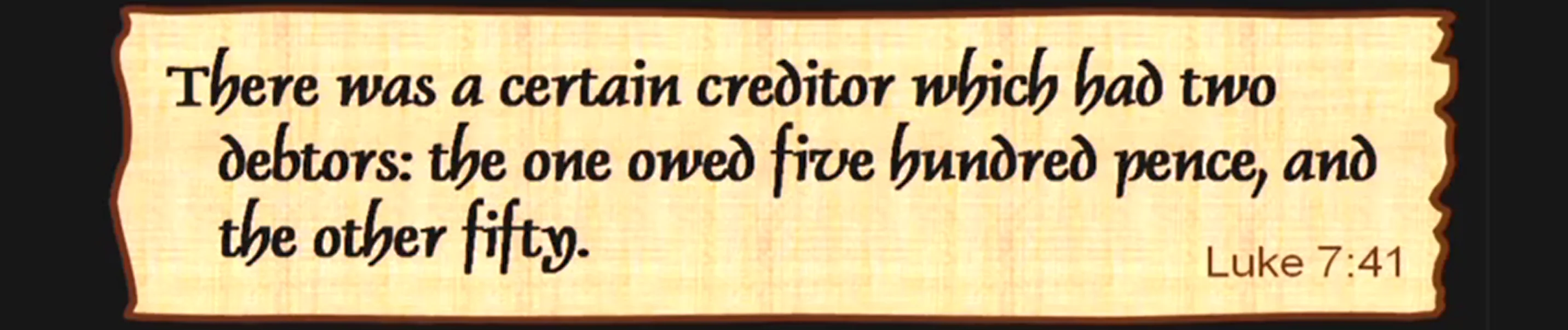
- These were huge debts: for one pence (denarius coin) was worth a day’s wages
Luke 7:42-43
Luke 7:44-45

Luke 7:46-47

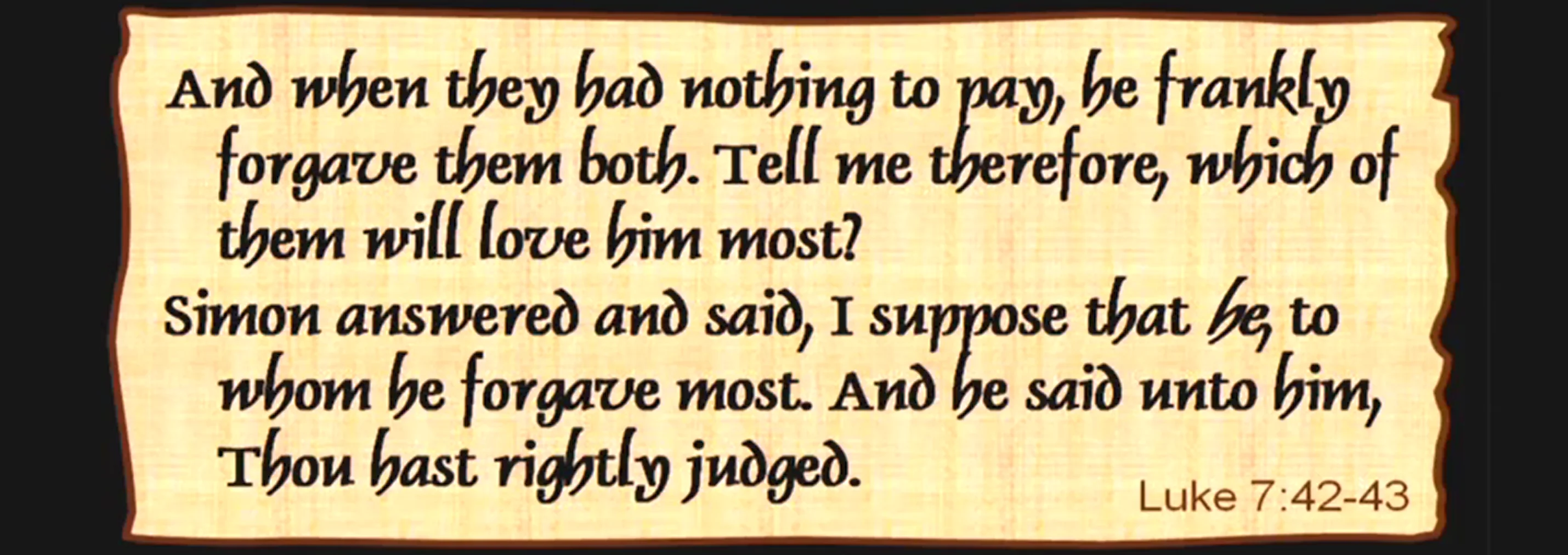
- The most penetrating point was that they were both sinners
— Both were equally insolvent
— The woman was guilty of sins of commission
— but Simon was guilty of sins of omission
- (cf. Abraham at the oaks of Mamre in Gen 18:1-8. Abraham received the three visitors, one of whom was the Lord. Abraham was sensitive as to who his visitors were)
Luke 7:48-49
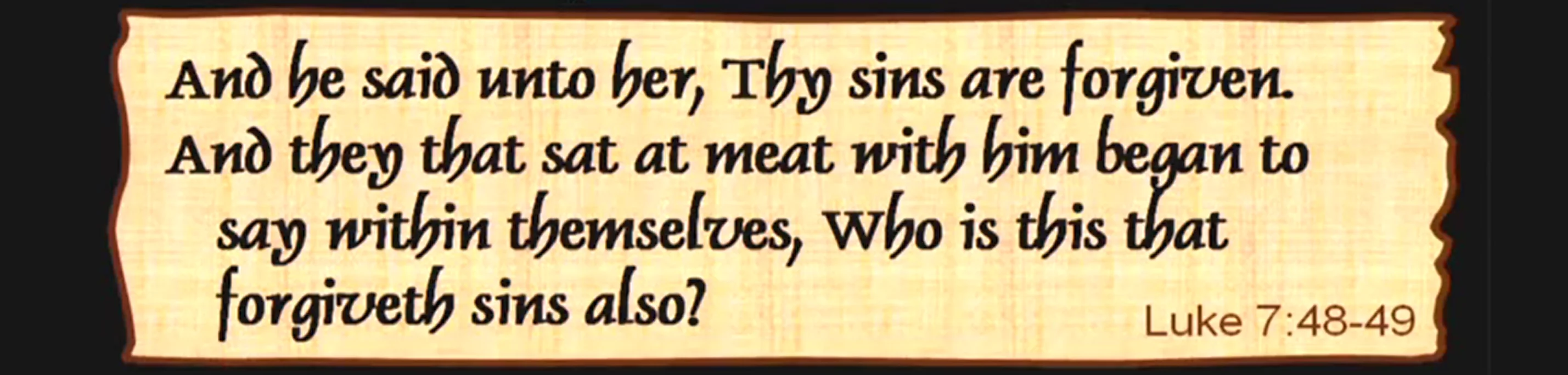
- What Jesus said is either a blasphemy, or they are in the presence of God himself
- Jesus clearly claimed to be God. Repeatedly
— If He thinks He is God and He is not, He is a lunatic
— If He says He is God and He is not, He is a liar
— He really is who He claimed to be — the Lord!
Luke 7:50

- She was not saved by her tears or her gift:
— Jesus made it clear that it was her faith alone that saved her
- No amount of works can pay for salvation (Titus 3:4-7)
- Jesus accepted her tears and her gift because her works were the evidence of her faith (James 2:14-26)
- How did she know her sins were forgiven?
— Jesus told her
- How do we know our sins are forgiven?
— God tells us in His Word
— Cf. Isa 1:18, Isa 43:25-26, Isa 55:6-7, Acts 13:38-39, Rom 4:7-8, Eph 4:32, Heb 8:12
- In this Chapter we’ve seen:
— Jesus healed the centurion’s servant: a great miracle
— Jesus raised the widow’s son from the dead: a greater miracle
— But here was the greatest miracle of all: saving this woman from her sins and making her a new person