s09 (Ch 9) 5k, Transfiguration (studied 5-Feb-2026)
The Book of Luke with Dr. Chuck Missler (Recorded live in KH, Post Falls, Idaho — 2011) and also remainder of sessions
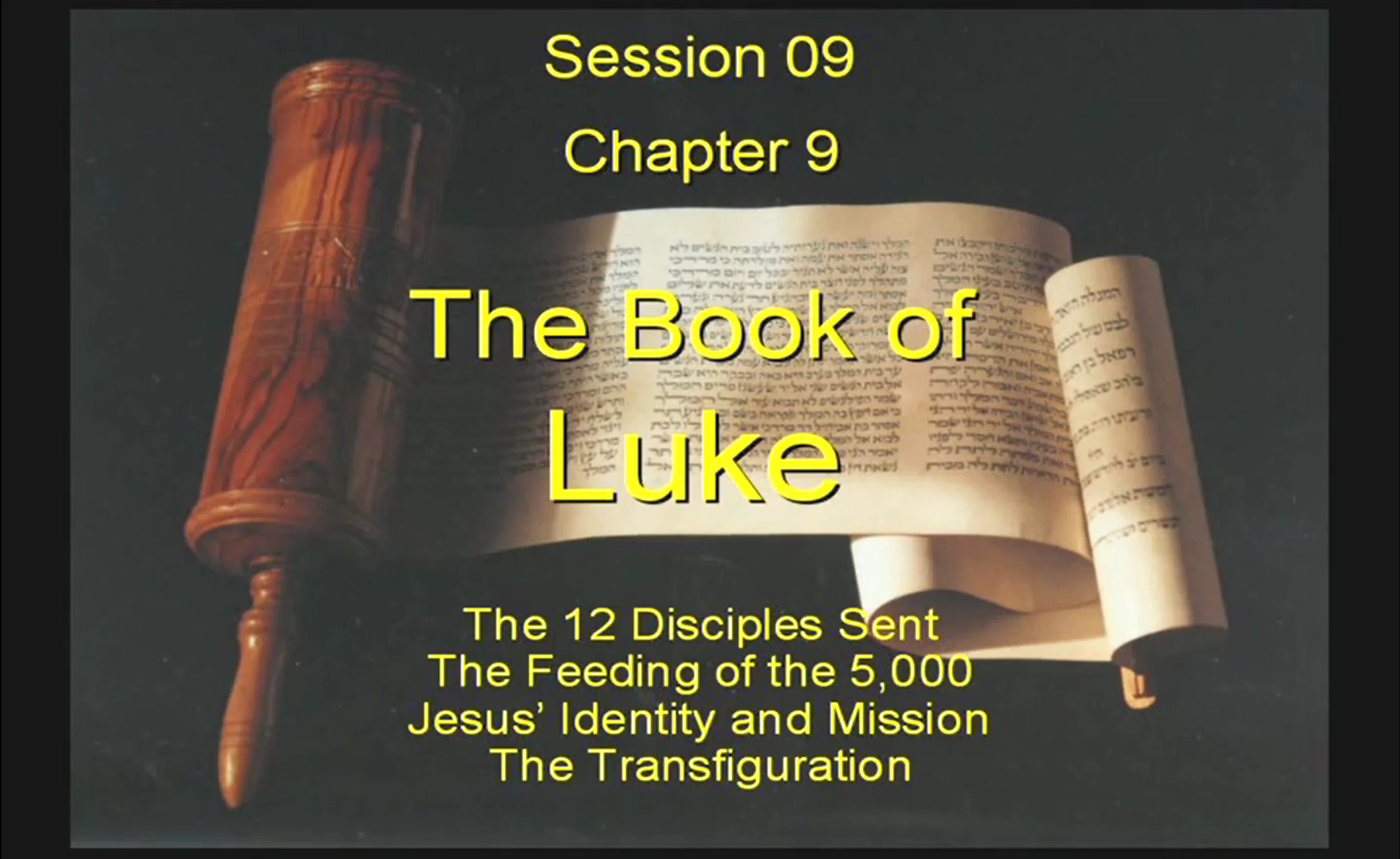
The subsections of Chapter 9 (per NASB/LSB/MEV) are:
- The Twelve Disciples Sent Out → Luke 9:1-6
- Herod’s Anxiety (MEV) → Luke 9:7-9
- Jesus Feeds Five Thousand → Luke 9:10-17
- Peter Confesses Jesus Is the Christ → Luke 9:18-20
- Jesus Foretells His Death and Resurrection / Take Up Your Cross → Luke 9:21-27
- The Transfiguration → Luke 9:28-36
- Jesus Casts Out a Demon / The Healing of a Boy With an Unclean Spirit → Luke 9:37-43
- Jesus Foretells His Death and Resurrection / Jesus Foretells His Death a Second Time → Luke 9:43-45
- Who Is the Greatest? → Luke 9:46-48
- He Who Is Not Against You Is for You (MEV) → Luke 9:49-50
- A Samaritan Village Refuses to Receive Jesus (MEV) → Luke 9:51-56
- The Cost of Following Jesus / Exacting Discipleship / The Would-Be Followers of Jesus (plow) → Luke 9:57-62
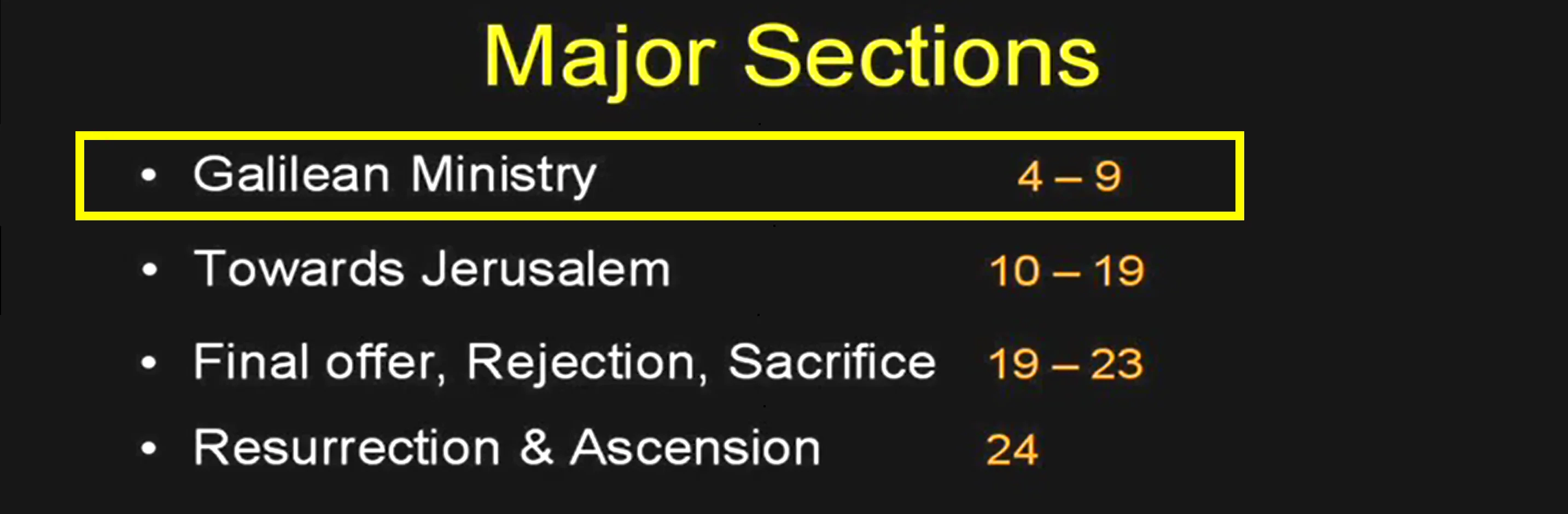

- In this chapter, Luke’s section on the Galilean ministry closes and the ministry shifts to Jerusalem
- Jesus’ journey toward Jerusalem is the highlight of Luke’s Gospel:
— The events recorded in this chapter form a climax to this portion of Jesus’ ministry (Luke 4:14-9:50) and
— a bridge from the Galilean ministry to his journey to Jerusalem, which begins in Luke 9:51 (…he stedfastly set his face to go to Jerusalem)

- When Disciples are sent, they become an “apostle” — a “sent one” (on an errand)
- A disciple is an apprentice (cf. Matt 10:5-15, Mark 6:7-13)
Luke 9:1 The Twelve Disciples Sent Out
- They were able to carry out His mission because Jesus gave them:
— “…power” — δύναμις (dunamis): “spiritual ability” (cf. Luke 4:14, Luke 4:36, Luke 5:17, Luke 6:19, Luke 8:46
— “…authority” — ἐξουσία (exousia): “the right to exercise the power” over the demonic realm and over the physical realm of diseases
— You may have a gun (power), but not the authority to use it
- Jesus had just shown His power over both of these realms (Luke 8:26-56)
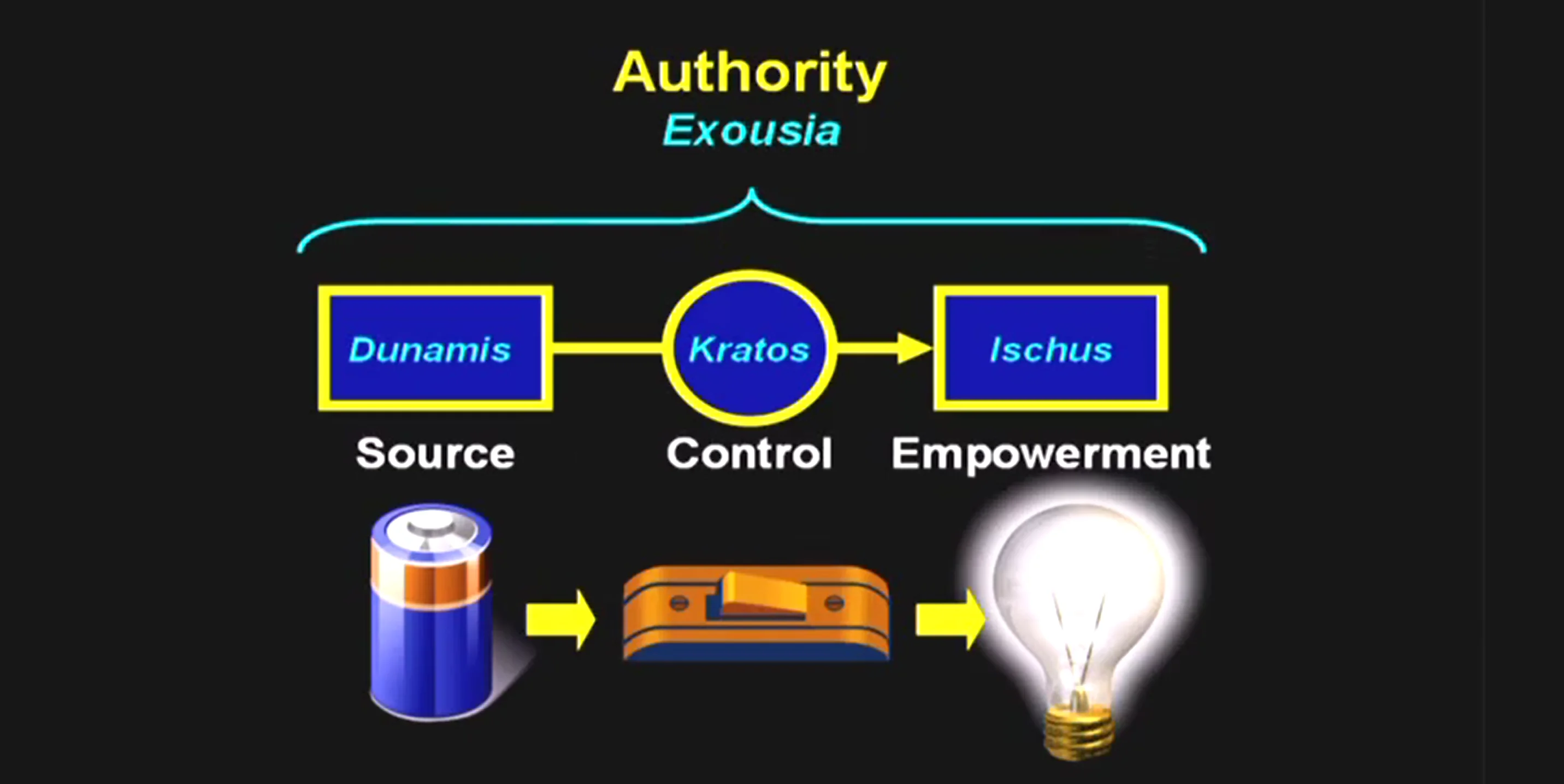
- Their healing ministry was to authenticate their preaching ministry
- The fact that his disciples exercised that power showed that He was the Messiah who could bring in the Kingdom
— Therefore it was necessary that people believe the Twelve
- Today is different:
— Does God heal today? Yes
— Does He heal predictably? No → His sovereignty is at issue here
Luke 9:2

- Two assignments: Preach & Heal
- This is their “solo flight”: on-the-job training in preparation for “their own” ministry, because He is going to leave
- Matt 10:5-6 indicates that they were sent primarily to the people of Israel
— Luke, as a Gentile, doesn’t emphasize this
Luke 9:3
- He wants them to go out on faith
- Jesus is emphasizing urgency and simplicity
- This would be a self-validating ministry: when they are out there on their own and God provides what they need, they will experience God’s handiwork
Luke 9:4-5
- Jesus instructed them not to go from house to house
- Shaking the dust off their feet:
— This was a familiar practice of orthodox Jews whenever they visited Gentile territory (Acts 13:51, Luke 10:10-11)

- Healing gifts were essential for authentication
- These were specific signs for authentication, given before Jesus died on the cross
- Even near the end of Paul’s ministry we note that he didn’t seem to avail himself of these
— He told Timothy to take a little wine for his stomach’s sake but did not heal him (1 Tim 5:23)
— Paul himself had a “…thorn in the flesh…” and though he asked God to remove it, God did not (2 Cor 12:7)
— Paul wrote to Timothy “…Trophimus have I left at Miletum sick” (2 Tim 4:20)
• Why did not Paul heal his friend Trophimus?
— Paul did not need healing for authentication, he was authenticated otherwise
- God does heal — we are instructed to pray for the sick
— But it’s presumptuous on our part to assume that God will
— God may have a purpose that we don’t know about
— We have to go at that in full awareness of the prerogatives (prerogative — a right or privilege exclusive to a particular individual or class) of the Divine One. He doesn’t put Himself in a box on that
Luke 9:6
- They caused such a commotion that it reached Herod (cf. Matt 14:2, Mark 6:14-29)
- Herod was the regent over the Galilee

Luke 9:7 Herod’s Anxiety (MEV)
- Herod Antipas was the son of Herod the Great
— “…Herod the tetrarch was reproved by him [John the Baptist] because of Herodias, his brother’s wife, and because of all the wicked things which Herod had done” (Luke 3:19) LSB
— he was the man who had John the Baptist killed (Luke 3:19-20, Matt 14:1-12)
- Herod put John to death and the rumor that John is back alive upset Herod (guilty conscience)
— Even though John the Baptist did no miracles in his ministry
Luke 9:8
Luke 9:9

- Who is this Miracle Worker?
— John the Baptist did no miracles (John 10:41)
— Unlike some Christian “celebrities”, Jesus did not court the high and mighty, and was not intimidated by worldly power
- When Herod and Jesus did finally meet, the king had hoped to see a miracle, but the Son of God did nothing and said nothing to him. The evil king had silenced God’s voice to him (Luke 23:6-12)


- The feeding of the 5,000 is the only miracle of Jesus which is recorded in all four Gospels
— cf. Matt 14:13-31, Mark 6:30-44, John 6:1-14 and here Luke 9:10-17
— In many ways it is the climax of Jesus’ ministry of miracles
— It was designed to produce faith in His disciples, not the crowd (the focus was disciples, not the public)
Luke 9:10 The Feeding of the Five Thousand (MEV starts here)
- A new term is introduced — now they are called ἀπόστολοι (apostoloi), apostles, “sent ones”
— (as opposed to “disciples” or “apprentices”)
- After receiving their progress report, they took off for a rest (Mark 6:30-32)
Luke 9:11
Luke 9:12 Jesus Feeds Five Thousand (LSB/NASB start here)
- “…victuals” — (pronounced "vittles", /ˈvɪt.əlz/): refers to food, provisions or supplies, often implying a ready supply for consumption, travel or storage
Luke 9:13
- In the comparative versions (John 6:9), we learn they got the food from a boy
- There were 5,000 men, but may have included 10,000 people or more
- Jesus was simply getting the twelve to acknowledge the impossibility of provision by human means alone
— It is good to remember when the crisis is great and your resources are low, God has already solved the problem
Luke 9:14
- The 5,000 men, ἄνδρες (andres): “males”, is no doubt a round figure, not counting the women and children
— Including women and children, probably 10,000–15,000 people (Matt 14:21)
Luke 9:15

Luke 9:16
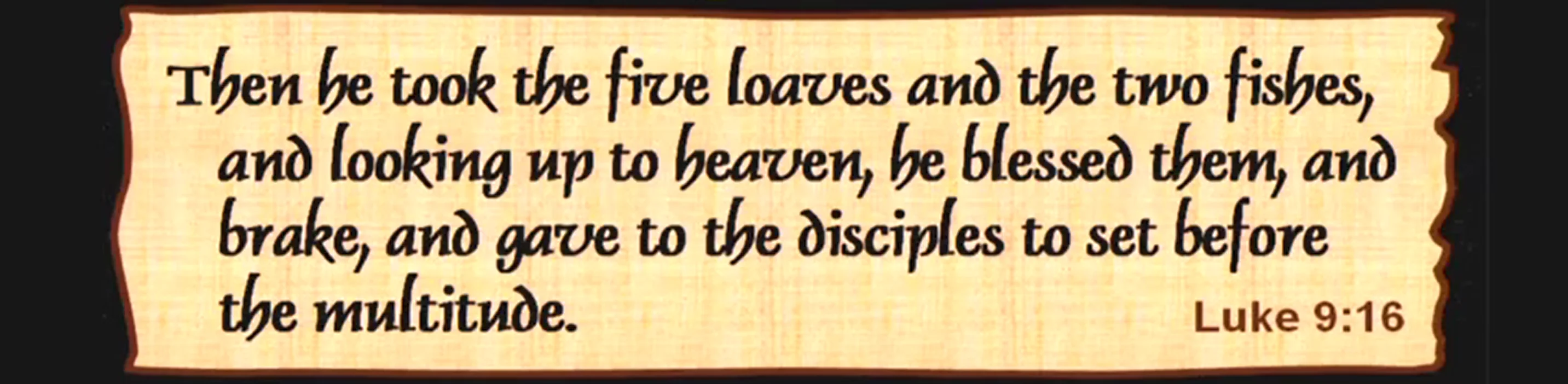
Luke 9:17
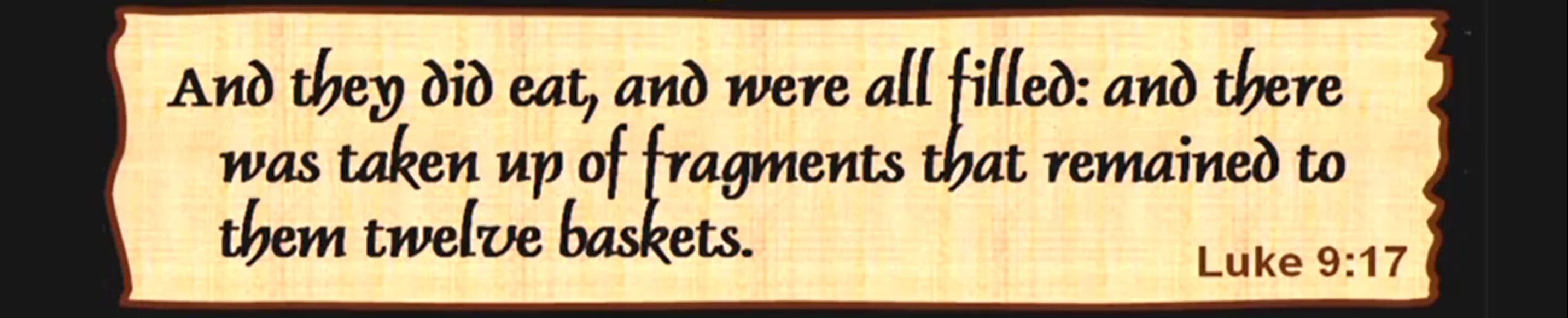
- The word used for baskets, κόφινοι (kophinoi), was considered typical of Jewish commerce
— Kophinoi are hand-baskets, such as were carried while traveling on foot (smaller than when feeding 4k)
— The seven baskets from the feeding of the 4k, σπυρίς (spuris), were a different (larger) kind of basket (Mark 8:8)
- Why twelve baskets left over?
— One for each Apostle
— The feeding of the 5,000 clinched the truth for the disciples that Jesus truly is the Messiah
- Jesus, by this act of provision, had shown Himself sufficient for the nation Israel
— He is the One who could provide prosperity if the people would believe His message
— This miracle is reminiscent of Elisha when he spoke the Word of the Lord and a small amount of food fed many people, with some left over (2 Kgs 4:42-44)
- In John’s account, the next day Jesus preached a sermon on “the bread of life” and they received Him as they had the bread (John 6:22-59)
— They desired to make Him king so that He would give them bread the rest of their lives (John 6:14-15)
— However, he slips away and does not let them make Him king — His “hour had not yet come”
— He would present Himself as king on the specific day that Gabriel had explained to Daniel (Dan 9:25)


- Cf. Matt 16:13-28, Mark 8:27-9:1
- The feeding of the 5,000 marks the end of what some call “the Great Galilean Ministry” (Luke 4:14-9:17)
— There is a parallel between His journey from Nazareth to Jerusalem, and Paul’s journey from Jerusalem to Rome
— That’s an interesting assignment to think thru it by yourself. List a number of ways they parallel
- First, we have some lessons about:
— His person
— His sacrifice and
— His kingdom
Luke 9:18 Peter Confesses Jesus Is the Christ / Peter’s Declaration About Jesus (MEV)
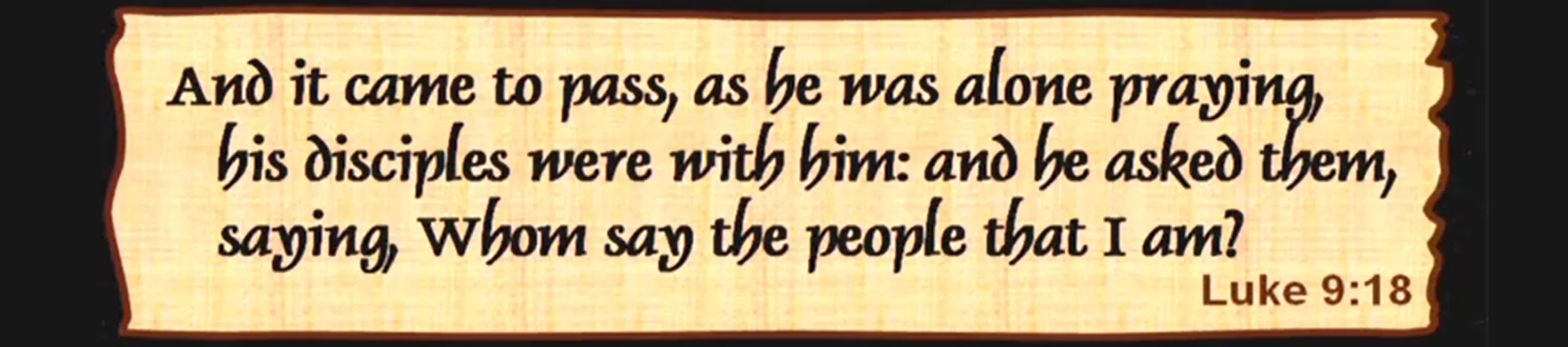
- Mark indicates that they were at Caesarea Philippi (Mark 8:27)
- Subsequently the Transfiguration takes place and Mt Hermon is a probable location due to proximity to Caesarea Philippi (some believe that it might have been Mt Tabor)
- Herod had raised the issue as to who Jesus is (Luke 9:7-9)
— Jesus will now raise the same issue (vv. 18-20)
Luke 9:19
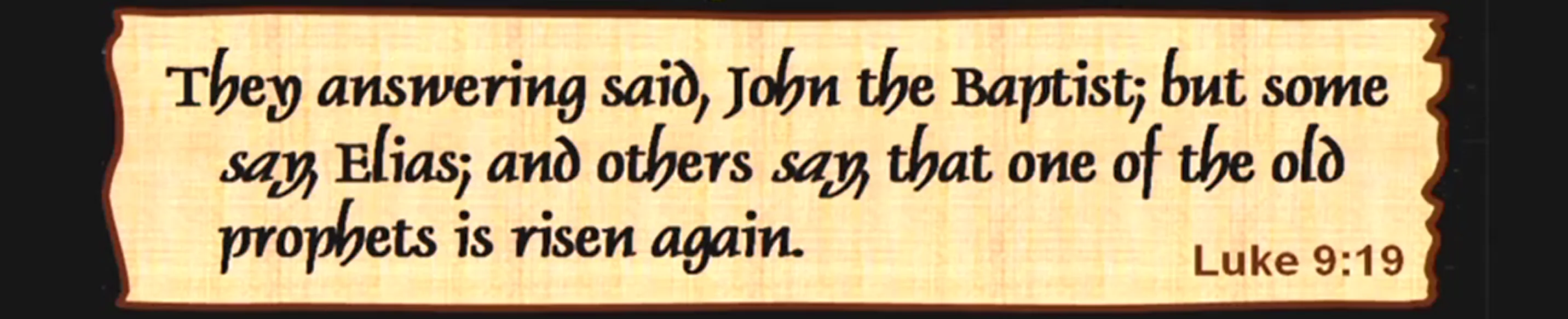
- The same expectations were encountered in John 1:21 when John the Baptist was preaching by Bethabara
— There was an expectation of Moses, or Elijah or the Messiah (cf. Matt 16)
Luke 9:20

- One of Peter’s shining moments
— This was Peter’s second time confessing Jesus publicly (John 6:68-69)
Luke 9:21

- Luke is triggering this from the feeding of the 5,000 and the disciples believed He was the Messiah
— But if His popularity is based on miracles, it could trigger a popular uprising against Rome
— His Messiahship has to be linked to His death (not miracles)
— The disciples know He is the Messiah, but He teaches them early He will be killed

Luke 9:22 Jesus Foretells His Death and Resurrection (MEV)
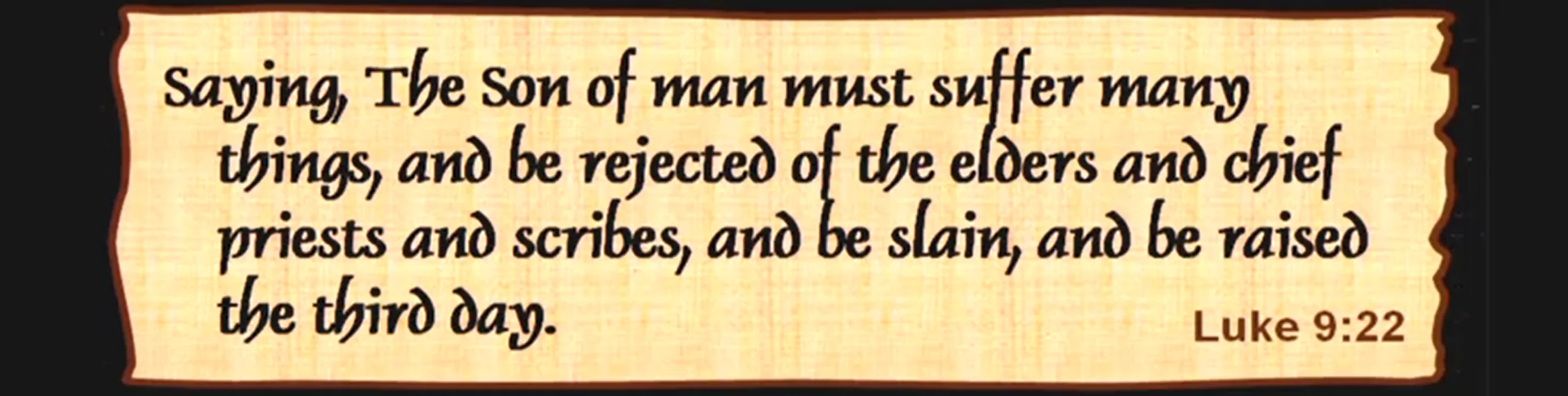
- For the first time, in v. 22 Jesus taught His disciples about His ultimate mission
— the fact that He had to die (cf. Dan 9:26, Ps 22, Isa 53)
- John the Baptist had first introduced Him publicly as “…The Lamb of God that taketh away the sin of the world” (John 1:29) — What “Lamb”? → The Passover Lamb… (Luke does not emphasize this very Jewish perspective)
- Jesus also predicted the “destruction of the temple” (of His body) in John 2:19
— This would be the basis of the accusations in His trial before the Sanhedrin
- “…be raised the third day“ — Jesus compared Himself to the Brazen Serpent in the wilderness (John 3:14, Num 21:9), which gave rise to the most famous quote of all: John 3:16
— In the entire OT, cover to cover, there is not a single explanation as to why would God use this weird way (just by looking at the Brazen Serpent) to heal the people from snakebites. It can only be understood after the cross and the explanation is in John 3:14
- Jesus also pointed out that the Jewish leaders would play a prominent part in His death (v. 22)
— That also must have shocked the disciples
— Being part of a deviant group was accepted, but to discover that they are going to be under attack by the leadership must have been a shock to them
- Jesus gave His first express indication that He would be resurrected (v. 22)
— Jesus compared Himself to Jonah (Matt 12:38-40)

Luke 9:23 Take Up Your Cross
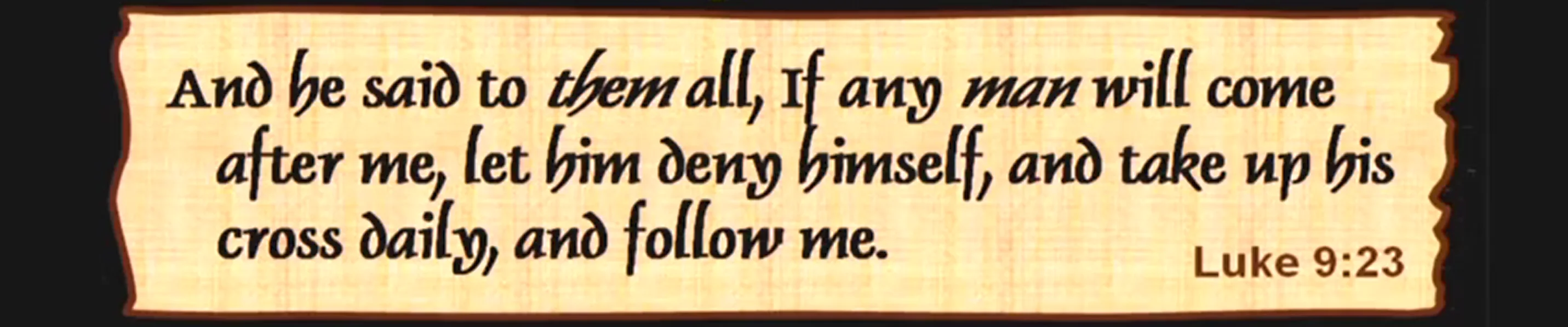
- Jesus compared Himself to Jonah — Jonah spent 3 days and 3 nights in the belly of a great fish, if we study the text very carefully, it may be that Jonah died and came back to life — Jonah is more than just a metaphorical model
— “For as Jonas was three days and three nights in the whale’s belly; so shall the Son of man be three days and three nights in the heart of the earth.” (Matt 12:40)
- It is easier to die for Jesus than to live for Him (if we got a chance for martyrdom, many of us would willingly take it)
- Jesus is talking about discipleship, not sonship
— Sonship was won on the Cross (sonship is being saved — justified)
— But, we should become disciples after we become sons (discipleship is sanctification)
- In Koinonia Institute, we believe that we are called to be the ambassadors to the King and we believe in the 3rd Commandment:
— “Thou shalt not take the name of the LORD thy God in vain; for the LORD will not hold him guiltless that taketh his name in vain.” (Exo 20:7 and Deut 5:11)
— 3rd Commandment does not deal with the vocabulary, but ambassadorship
— If you are going to take the Name of the King, you better be prepared to represent Him competently and faithfully
Luke 9:24
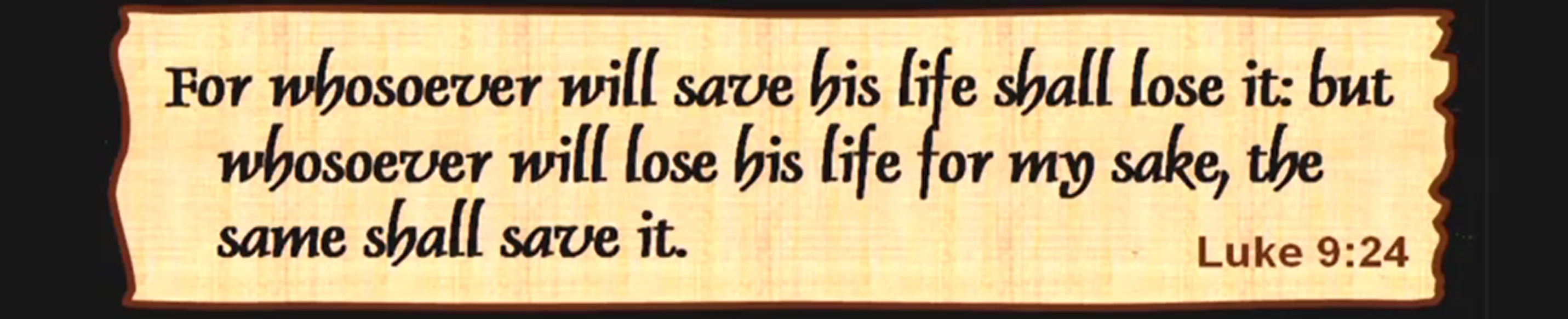
- Insight from the Holy Spirit: I have already died in Christ!
— It is not about physical death of the body
— It is about being saved, the moment of regeneration, circumcision of heart, receiving a new heart
Luke 9:25
Luke 9:26
- Every day that He tarries gives us a day to get our act together, gives as a chance to repair that report card
- In the Roman world, crucifixion was a symbol of shame, guilt, suffering and ultimate rejection
— There was no more despicable way to die (painful – yes, despicable – indeed)
— One thing is to be executed, but quite another to be crucified publicly
— Crucifixion was not mentioned in polite society
— People would no more think of wearing crosses as we would think of wearing electric chairs!
Luke 9:27
- Widely misunderstood verse
— Especially in Matthew’s account as it ends Chapter 16 (Matt 16:28) and Transfiguration starts in Chapter 17
— In Luke, it’s connected: there are three Apostles standing there that are going to see the Transfiguration
- “…see the kingdom of God” is referring to the forthcoming Transfiguration


- The Transfiguration (cf. Matt 17:1-8, Mark 9:2-8)
- The greatest “Bible Conference” on the greatest topic: Jesus’ “Departure” from Jerusalem (as Peter tells us)
Luke 9:28 The Transfiguration
- “…eight days” — Mark wrote that the event occurred after six days (Mark 9:2). A contradiction…?
— Six or Eight Intervening Days?
• Mark is speaking of the intervening days
• Luke is including the days of Jesus’ teaching as well as the day on which the transfiguration took place
• Jewish reckoning vs. Greek reckoning (all inclusive)
- Location?
— Mount Hermon — near Caesarea Philippi (Mark 8:27)
— Some suggest Mount Tabor
Luke 9:29

- Matt 17:2 and Mark 9:2 use the word μεταμορφόω (metamorphoó), which means “to change from within”, from which we get “metamorphosis”
Luke 9:30-31
- “…decease” is the word ἔξοδον (exodon), which should be translated “departure”
— (Peter will reference this event in 2 Pet 1:16-18)
- At the transfiguration four events can be highlighted:
1) Jesus’ face and clothes became as bright as a flash of lightning
• This would have immediately reminded those present of Moses’ face shining
• Moses’ face shone with a bright light when he received the tablets of the Law (Exo 34:29-35)
2) Moses and Elijah appeared and spoke with Jesus
• God buried Moses’ body (Deut 34:5-6)
• Michael and Satan fought over the body of Moses (Jude 9)
• Elijah did not die but was taken up to heaven (2 Kgs 2:11-12, 15-18)
3) Moses and Elijah spoke about His departure
• exodon – “going out or away”, which He was about to bring to fulfillment at Jerusalem
• “Departure” referred to Jesus’ leaving the world through which He would bring salvation
• God had brought deliverance to Israel in its Exodus (departure) from Egypt
• Moses had led Israel out of the bondage of Egypt
• Elijah had delivered them from the bondage of false gods
• Jesus would die to deliver a sinful world free from bondage to sin and death (Gal 1:4, Col 1:13, Heb 2:14-15)
• This departure was to be fulfilled in Jerusalem
• From this point on, Jesus indicated several times that He was headed toward Jerusalem
• (Cf. Luke 9:51, Luke 9:53, Luke 13:33, Luke 17:11, Luke 18:31)
4) The Father spoke out of a cloud (v. 35)
• Jesus did not want His miracles widely publicized at that time, for the fulfillment had to be at Jerusalem
• This was confirmed by Elijah’s and Moses’ words referring to departure at Jerusalem
- Moses and Elijah represent the beginning and the end of Israel
— Moses, as the Lawgiver, founded the nation
— Elijah is to come back before the great and terrible day of the Lord (Mal 4:5-6)
— (Reason that in Passover, they always have an empty chair — waiting for Elijah to be there)
- The two witnesses will have four unique powers (Rev 11:5-6)
— To call fire from heaven (1 Kgs 18:37, 2 Kgs 1:10, 12, Jer 5:14) — Elijah
— To shut heaven, that it rains not (1 Kgs 17:1, for 3.5 years! cf. Luke 4:25, James 5:17) — Elijah
— Power over waters to turn them to blood (Exo 7:19) — Moses
— To smite the earth with all plagues, as often as they will (Exo 8-12) — Moses
Luke 9:32

Luke 9:33
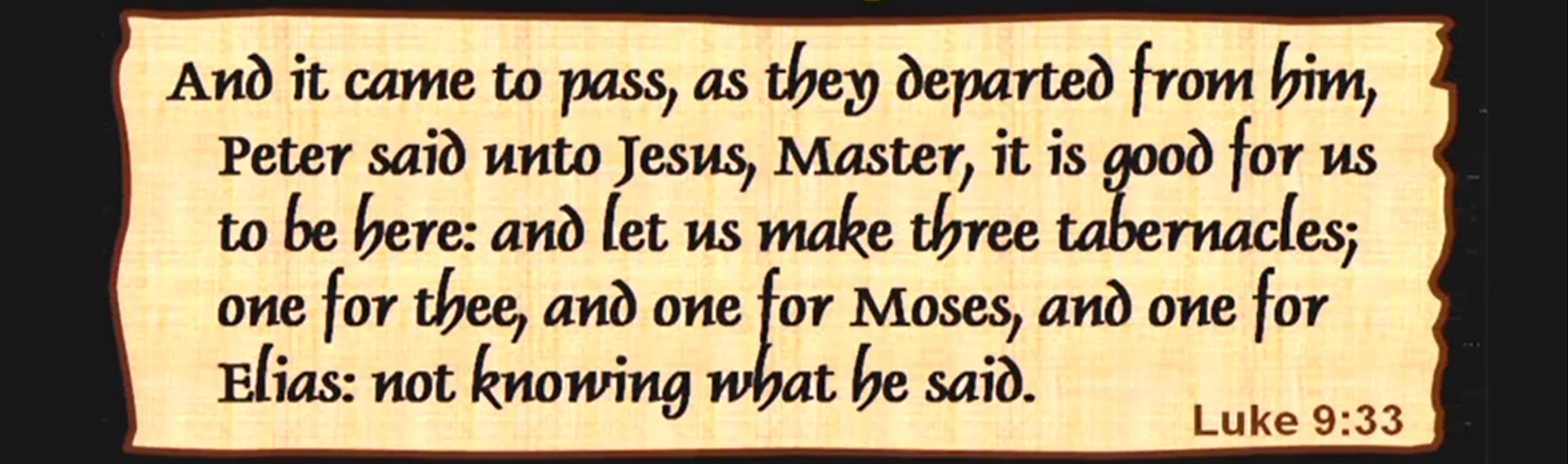
- Peter is implying equality among the three
- “…let us make three tabernacles”
— Some believe that this suggests a proximity to the Feast of Tabernacles on the 15th of Tishri
— Peter may have been thinking of the Feast of Tabernacles, when the Jews would build and sleep in booths to remind them of the wilderness wanderings
— The Feast of Tabernacles is associated with the coming kingdom (Lev 23:33-44, Zech 14:16-21)
Luke 9:34-35
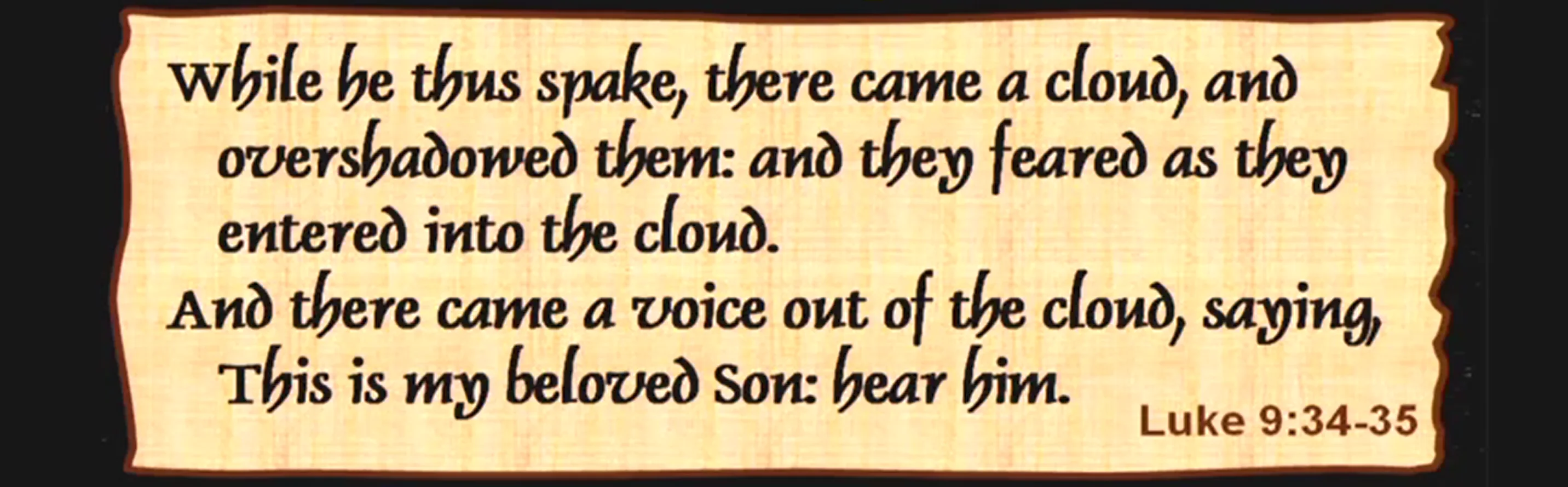
- “…“This is My Son, My Chosen One; listen to Him!”” NASB/LSB
- A cloud was often a symbol of God’s divine presence (Shekhinah) (Exo 13:21-22, Exo 40:35, 38)
- Peter gets interrupted by the Trinity:
— The Father interrupts Peter here
— The Son interrupted Peter (Matt 17:24-27)
— The Spirit also (Acts 10:44)
- We discover that major events in the Bible are attributed separately to each of the Three members of the Trinity, e.g. the Creation, Incarnation and Resurrection
- “…This is my beloved Son: hear him”:
— He said similar at Jesus’ baptism: “Thou art my beloved Son; in thee I am well pleased.” (Luke 3:22)
- Disciples, who were familiar with the Old Testament, doubtless immediately recognized the reference (in the words “listen to Him”) to Deut 18:15 with its messianic prediction of a prophet greater than Moses
👂 Deut 18:15
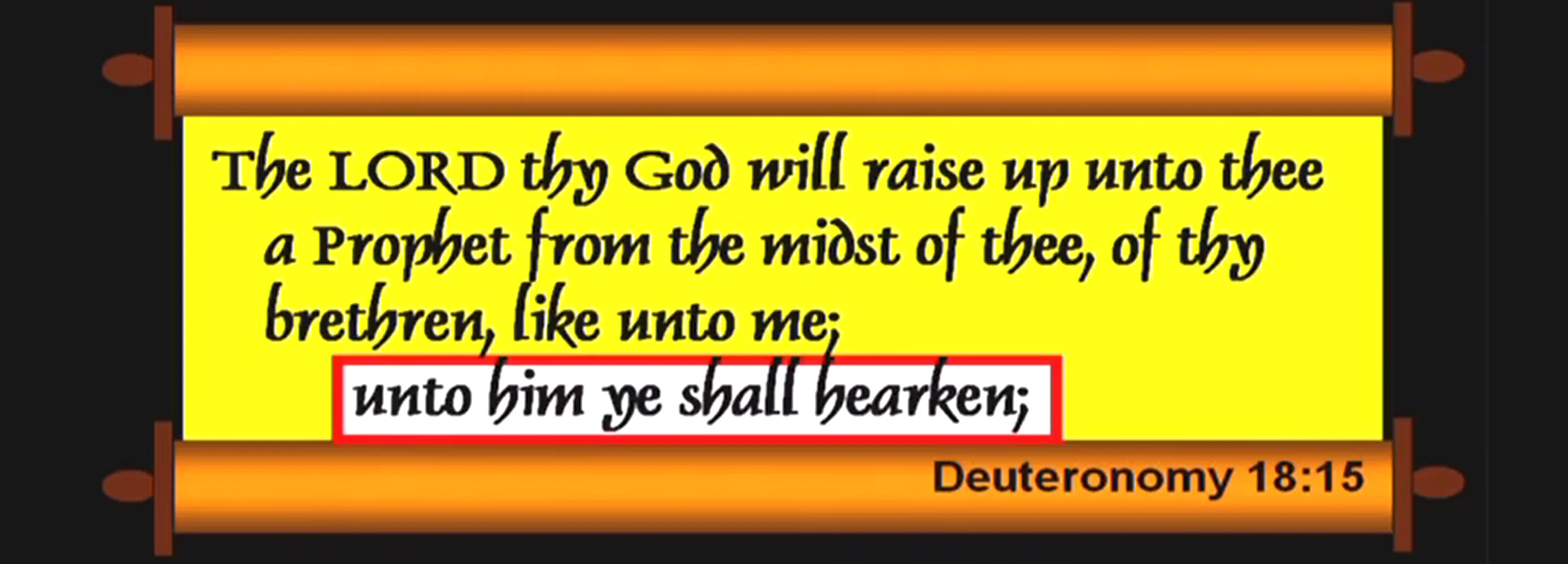
- “This is my beloved Son…”
— This is an authentication from the Father
— The people were to listen to (obey) the Prophet
— The Father would speak a third time in the Final Week (John 12:27-30, cf. Ps 2:7, Isa 42:1)
Luke 9:36
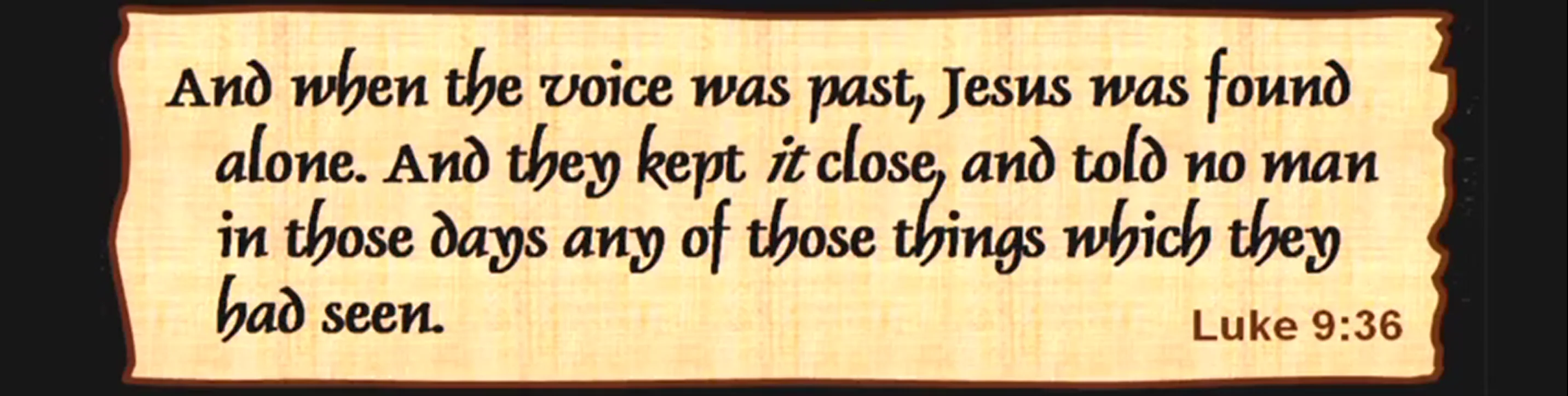
- They kept it to themselves. They didn’t disclose it prematurely
- Three of the disciples did see a manifestation of the Kingdom of God before they died
— Peter alludes to it in his second epistle (2 Pet 1:12-21)

- The rest of the chapter: “How long shall I put up with you?” (Luke 9:37-62)
- The frustration of our Lord:
— The disciples saw 5,000 people fed
— They saw people raised from the dead
— Three saw Elijah and Moses on Mt. Hermon
— Yet… they still had little faith

- (Claude) "demonic" describes something evil in itself, so "the demonic boy" reads as the boy being evil
— The usual term is demon-possessed — "Healing the Demon-Possessed Boy"
- This is not epilepsy
— The child is demon possessed (Matt 17:14-18, Mark 9:14-27)
Luke 9:37-38
Luke 9:39-40
- Jesus expected them to be able to (cast him out) and they didn’t
Luke 9:41
- When you compare the three accounts (Matt 17:14-18, Mark 9:14-27, Luke 9:37-41), you discover what was lacking in their lives:
— Faith (Matt 17:19-20) — they lacked faith and we all do
— Prayer and fasting (Mark 9:29)
- The exercise of spiritual gifts is not automatic — it requires spiritual discipline
— They were thought, they had the gifts, but they didn’t have the faith to exercise them
Luke 9:42
- “…threw” — ῥήγνυμι (rhégnumi), a wrestling term

- Jesus Foretells His Death a Second Time (cf. Luke 9:22)
Luke 9:43 Jesus Foretells His Death and Resurrection (new paragraph starts mid this verse)
- “…they were all amazed” — ἐκπλήσσω (ekpléssó): “struck out of their senses” at the greatness of God
- Two other appearances of ekpléssó in earlier chapters:
— “When they saw Him, they were astonished, and His mother said to Him, “Child, why have You treated us this way? Behold, Your father and I have been anxiously searching for You.”” (Luke 2:48) LSB
— “and they were amazed at His teaching, for His message was with authority.” (Luke 4:32) LSB
Luke 9:44

- There is a certain urgency on His part:
— Hey guys, let this sink in! I’m gonna be gone. You’re gonna be on your own (not really)
- Jesus taught the disciples a second time that He would die by being betrayed into the hands of men
— He will be gone
— They will have to carry on the message (without Him)
Luke 9:45
- The disciples were still confused as to how Jesus, with His glorious power, could experience a humiliating death
— They have seen how incredibly supernaturally powerful He is
— For Him to experience a death at all was unthinkable
— Especially a humiliating death was beyond their capacity to imagine
- Nor could they put together the crowd’s reaction to His miracles and His prediction that the nation would turn against Him and kill Him

Luke 9:46 Who Is the Greatest?

Luke 9:47-48

Luke 9:49-50 He Who Is Not Against You Is for You (MEV)
- Luke doesn’t pick up the real tension of James and John
— Sons of Thunder were ready to call down fire on these guys
- “Who is the greatest?” is linked to “Whose ministry is better?”
— Some people think their ministry will be diminished because somebody else does it differently
— They should have rejoiced that the power of God was being manifested on earth by others as well

- The previous section dealt with Jesus’ authentication in His Galilean ministry (Luke 4 - 9:50)
- In this next section (Luke 10–19):
— Authentication will no longer be the issue
— The issue is now acceptance: Jesus will not be accepted by most of the nation
— Therefore He has to teach His followers how they should live in the face of opposition
- This next segment of this Gospel extends from Luke 9:51 – 19:27, and is comprised of two parts:
🛑 The rejection of Jesus by most on His journey toward Jerusalem (Luke 9:51 – 11:54)
🛑 Jesus teaching His followers in view of that rejection (Luke 12:1 – 19:27)
- The rejection will get more and more visible
— He will instruct the disciples how to deal with the fact that they will also be rejected

Luke 9:51 A Samaritan Village Refuses to Receive Jesus (MEV)
- In order to go to Jerusalem, Jesus passed thru Samaria
- The following map represents a simple geography of Jesus’ day:

- A bit of a history — post king Salomon — how did Samaria came to be:
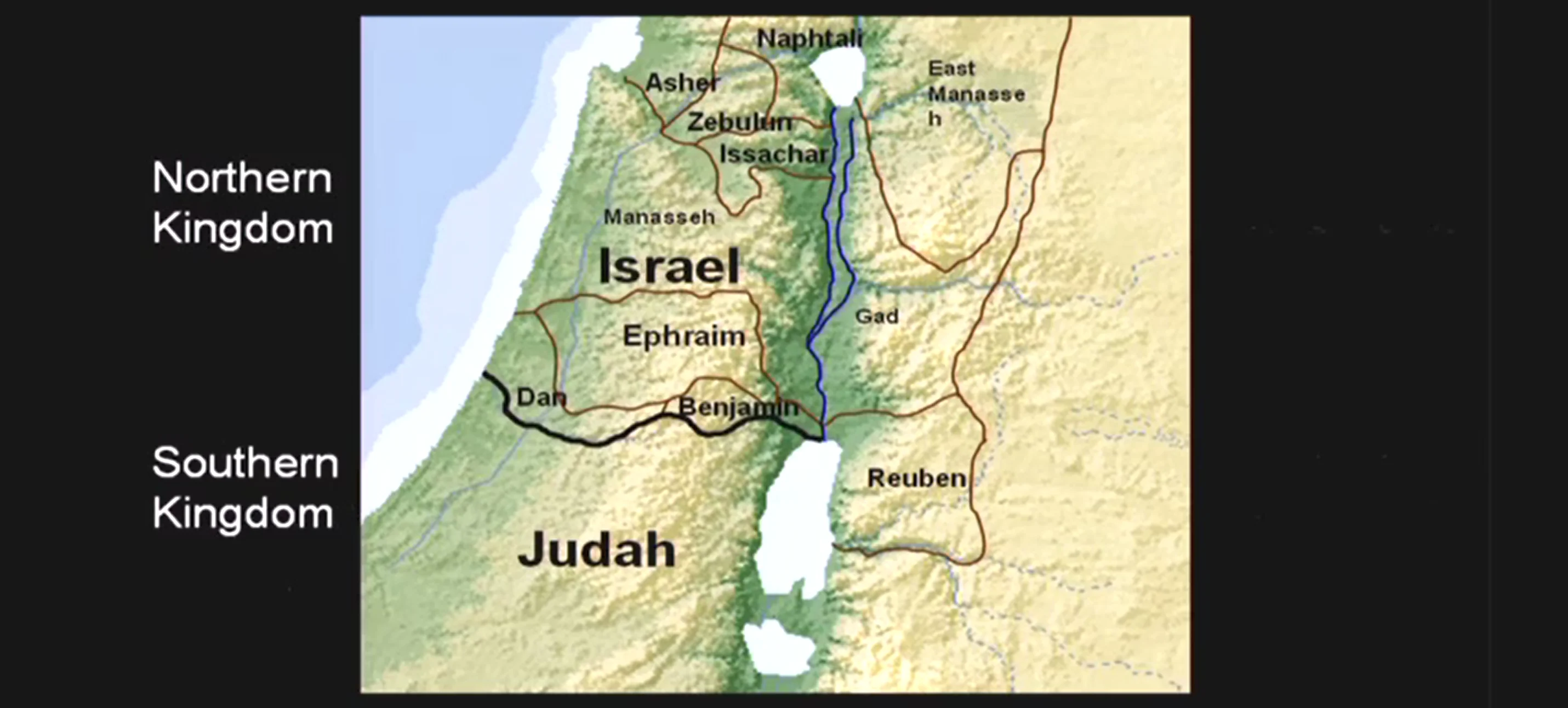
- Norther Kingdom — House of Israel
- Southern Kingdom — House of Judah
- We learn in 1 Chr 11 that those who were faithful in the Northern Kingdom, went south to Judah:
— In order to worship at the Temple
— For example, Levites migrated south
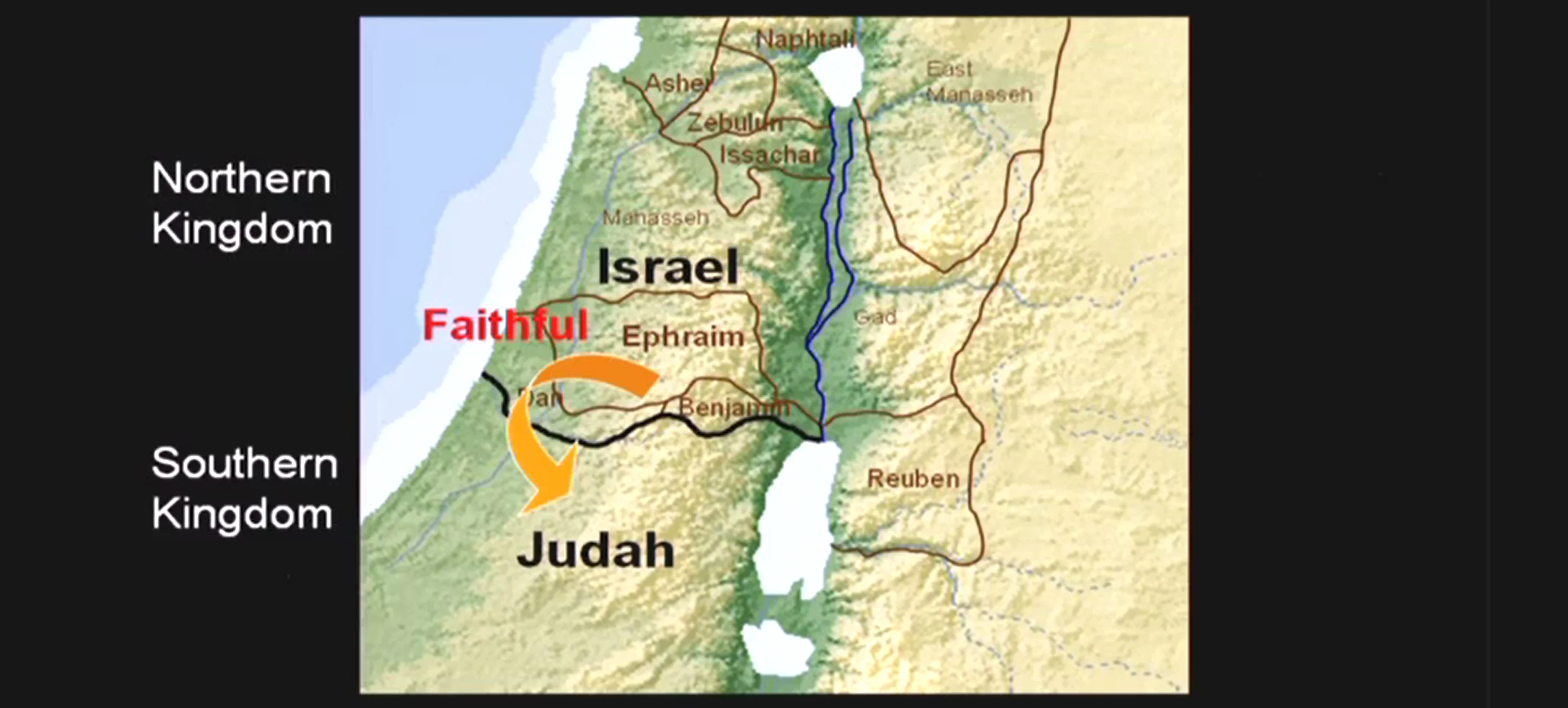
- It doesn’t say, but can be reasonably inferred that people in the south that wanted to worship idols (unfaithful) went up north, where that was politically correct thing to do
— Jeroboam the first in the Northern Kingdom worshipped idols, golden calves at Dan and Bethel
- Don’t confuse the geographic designations from people themselves
— Prophetess Anna was from the tribe of Asher. She recognized the Babe
— Lost 10 tribes is a foolishness
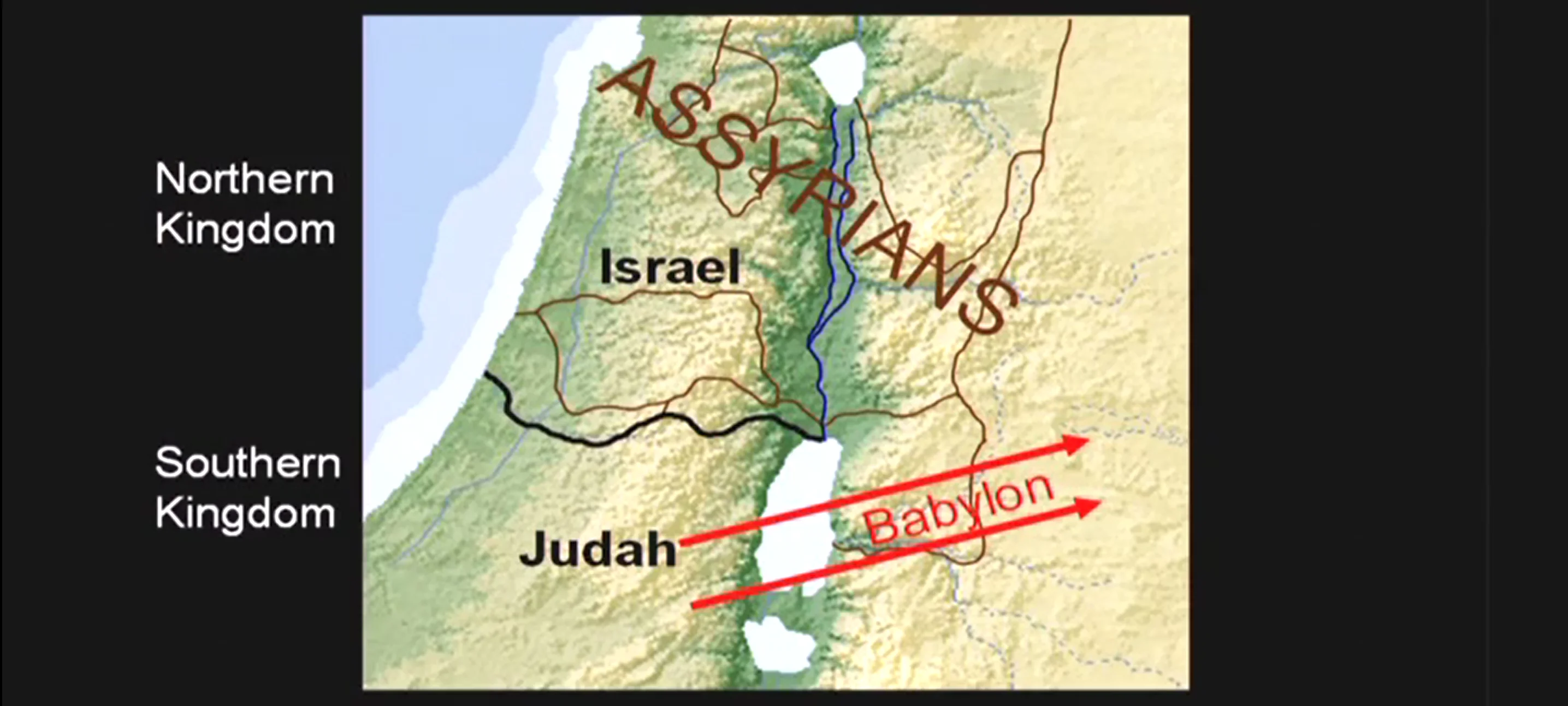
- Assyrians took over the Northern Kingdom (God had abandoned them as they went from bad to worse)
- Assyrians had a policy of comingling their captives. They deliberately destroyed the cohesion among people so the people could not rebel against them
— Jews from the Northern Kingdom were deported to other camps
— Many Jews were sent to Babylon that was under Assyria at the time
- Later on, Judah was captured and taken to Babylon as a group with intention to bring them back 70 years later
— Babylon continued to be a major Jewish conclave even after the return, even to the present day
Luke 9:52 (slide missing)

Luke 9:53

- Conflict between Jews and Samaritans had been going on for several hundred years
- This general rejection climaxed when Jesus was accused of having demonic power (Luke 11:14-54)
— The rejection that starts in Samaria gets worse and worse
— At one point he is accused of healing by the power of Satan
— That is the “straw that breaks the camel’s back” (Luke 11:14-54, Matt 12:25-13:34)
— From that point on, He only speaks in public in parables
Luke 9:54
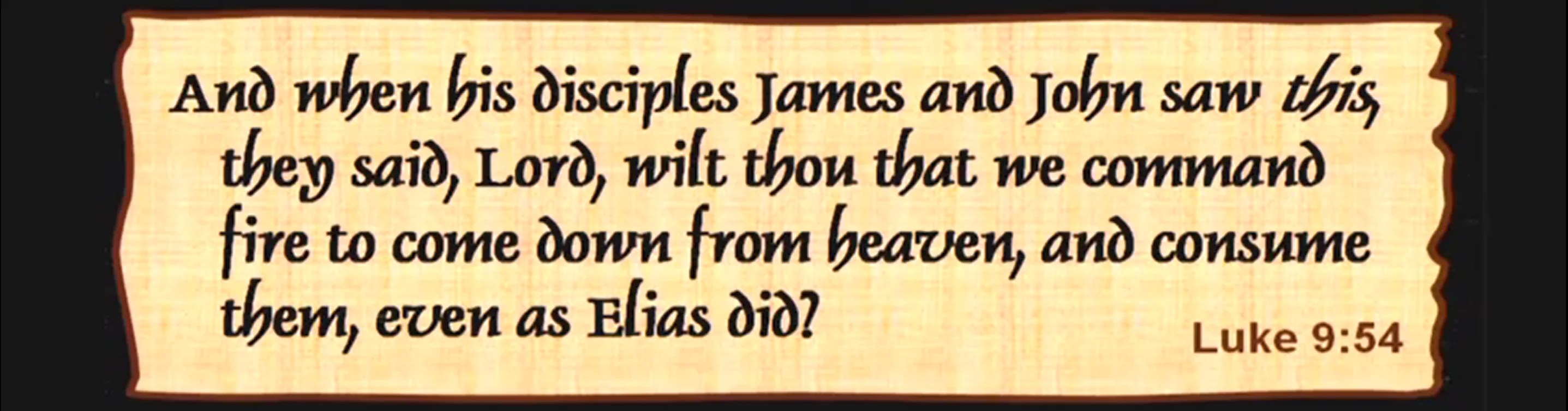
- 🔥 Cf. Elijah 2 Kgs 1:9-12
- Jesus told us to pray for those who persecute us
Luke 9:55

- There will come a time when the ministers of God will call fire down on God’s enemies (Rev 11:5)
- Not now…
Luke 9:56
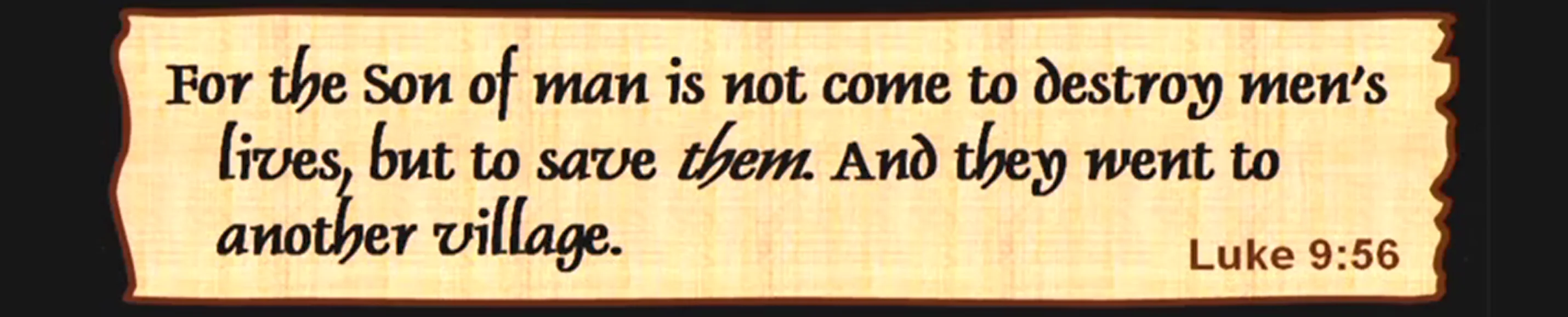

- Jesus introduced three men who wanted to come along
— Three failed disciple candidates
- Something more complicated than being rejected is dealing with three who want to help
Luke 9:57-58 The Cost of Following Jesus
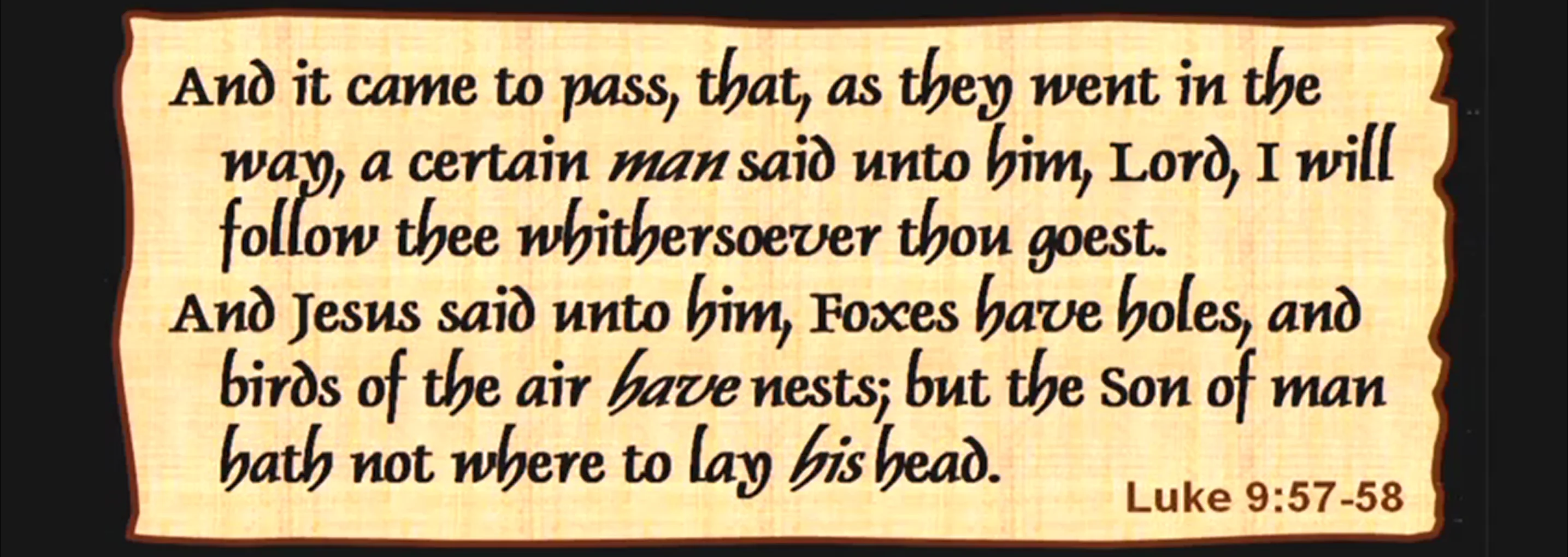
- This is along the line of “Count the cost first” — The Cost of Discipleship (Luke 14:25-35)
- We don’t find out what happened here — did that scare the guy off? Maybe
- Jesus’ response was that a person desiring to follow Him must give up what others consider necessities
— Jesus had no home of His own nor did His followers
— They were on their way to Jerusalem where Jesus would be put to death!
— You wanna sign up for this, guys?
Luke 9:59
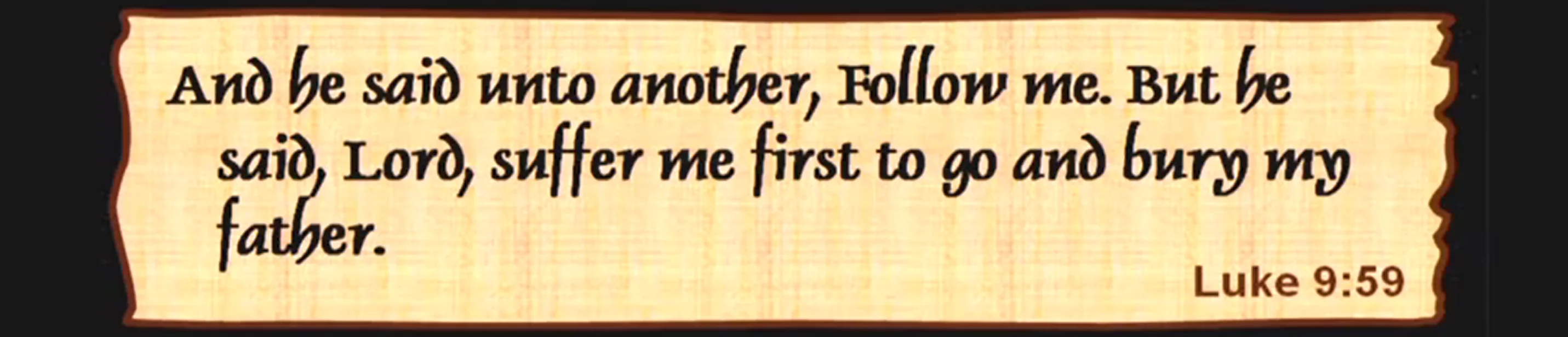
- Jesus called the next man with the same words with which He had called His disciples in Luke 5:27
- The man’s reply that he first wanted to go and bury his father has been interpreted in several ways:
— Some maintain that the man’s father was dead already. It would seem strange if that was the case for he would certainly have been engaged in the burial procedure already
— It is more likely that the man’s father was ready to die. His request was to let him wait just a little while before following Jesus
- Jesus’ response was that His call is more important than family
— That offends a lot of people
— But that’s really what the implication is
Luke 9:60
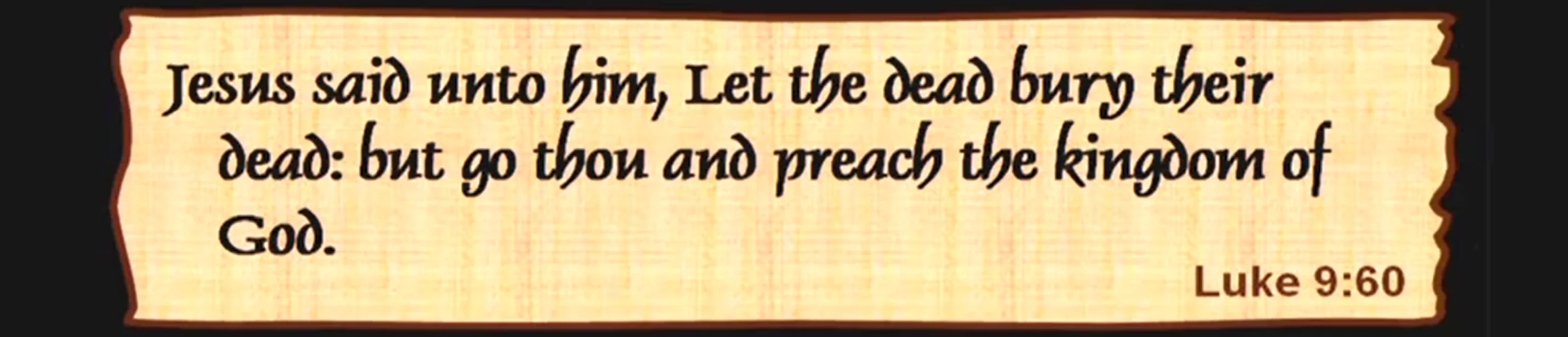
- Our Master is serious. He has a sense of urgency and a sense of priority
- Our Lord doesn’t want to be #1 on the list of 10. He wants to be #1 on the list of 1
- Luke does not tell us what any of these three men decided to do in the end. He leaves them hanging
Luke 9:61
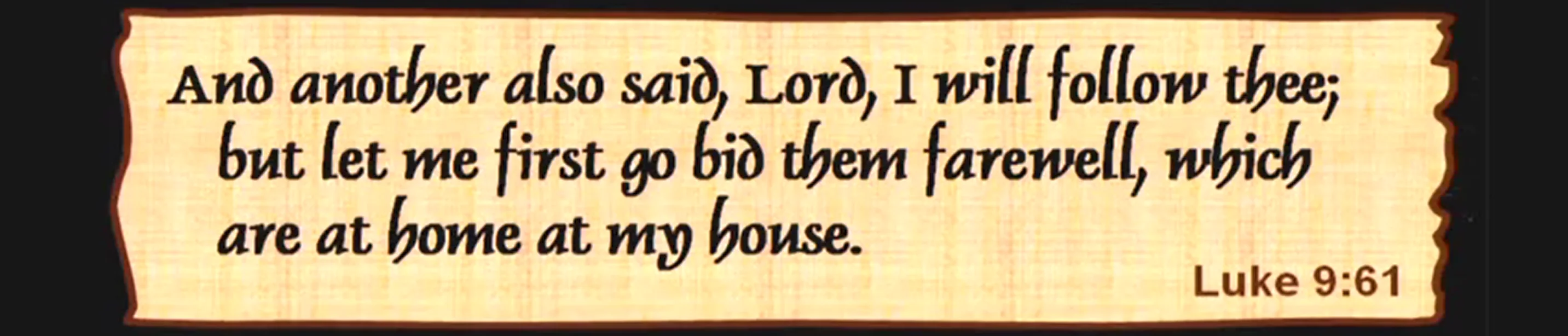
- Elijah had allowed Elisha to do this very thing when Elisha was plowing (1 Kgs 19:19-20)
- Jesus’ words underscore the fact that His message of the kingdom of God was more important than anything else
— More important even than family members
— There is an urgency — all thru the Scriptures, the message is: Do it now
— Satan loves tomorrow:
• Tomorrow is when we start the day
• Tomorrow is when the fools repent
• Tomorrow is when the sloth will work
— The message and the Messiah cannot wait
— Jesus’ message was more important than Elijah’s message
Luke 9:62