s15 (Ch 15) 3 Parables: Lost Sheep, Lost Coin, Prodigal Son (studied 24-Feb-2026)
The Book of Luke with Dr. Chuck Missler
The subsections of Chapter 15 (per NASB/LSB/MEV) are:

- In this chapter we encounter three of the best known of Jesus’ parables:
The Lost Sheep, The Lost Coin and The Prodigal Son
- Three words summarize this chapter: Lost, Found and Rejoice!
Luke 15:1-2
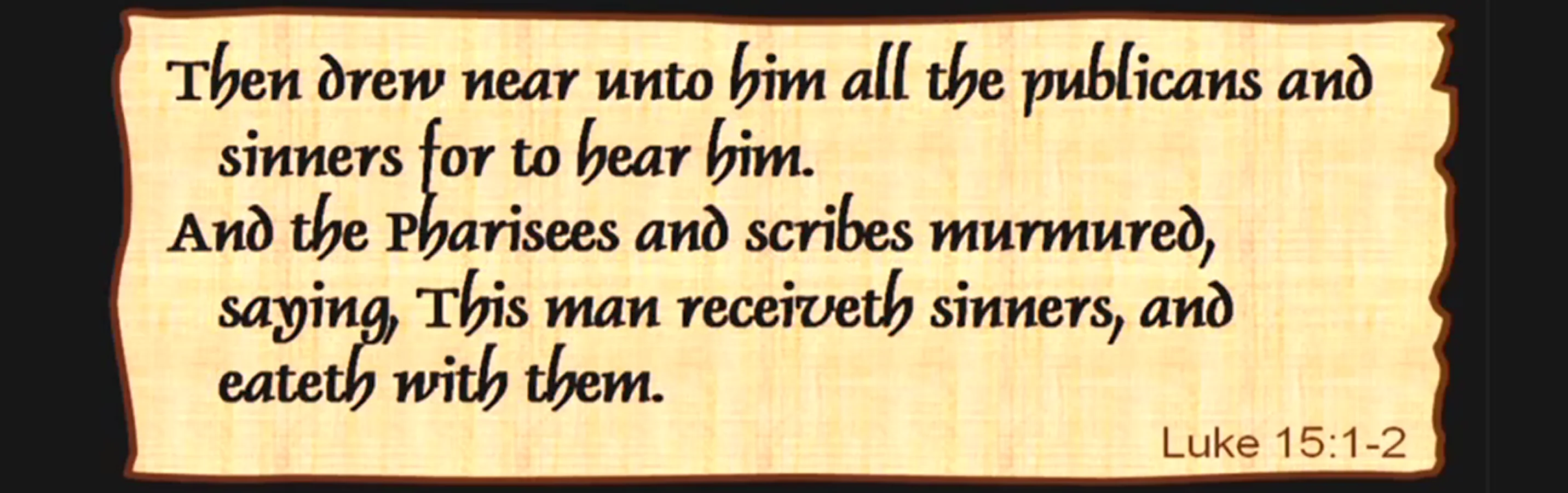
- They always have something to complain about
- Jesus spoke these parables to answer the scribes and Pharisees:
— He not only welcomed these outcasts, He was eating with them
— The Son of Man had “come to seek and to save that which was lost” (Luke 19:10)
— Pharisees and scribes were blind to the fact that they themselves were among the lost!

Luke 15:3-4 The Parable of the Lost Sheep
- Sheep have a tendency to go astray (Isa 53:6, 1 Pet 2:25)
— They are not very bright, but if there’s a hole in the fence, they’ll find it
— Lord referring to us as a sheep is a very well chosen metaphor
- A shepherd had to pay for any lost unless he could prove it was killed by a predator
(cf. Gen 31:38-39, Exo 22:10-13, Amos 3:12)
Luke 15:5-6
- Such rejoicing when we repent and turn to Christ
Luke 15:7

Luke 15:8 The Parable of the Lost Drachma
- “…piece of silver” — a drachma: a Greek silver coin that equaled about a day’s wage
- Jesus’ Point: Even a single sinner is extremely valuable to God (cf. similar wording in vv. 6, 9)
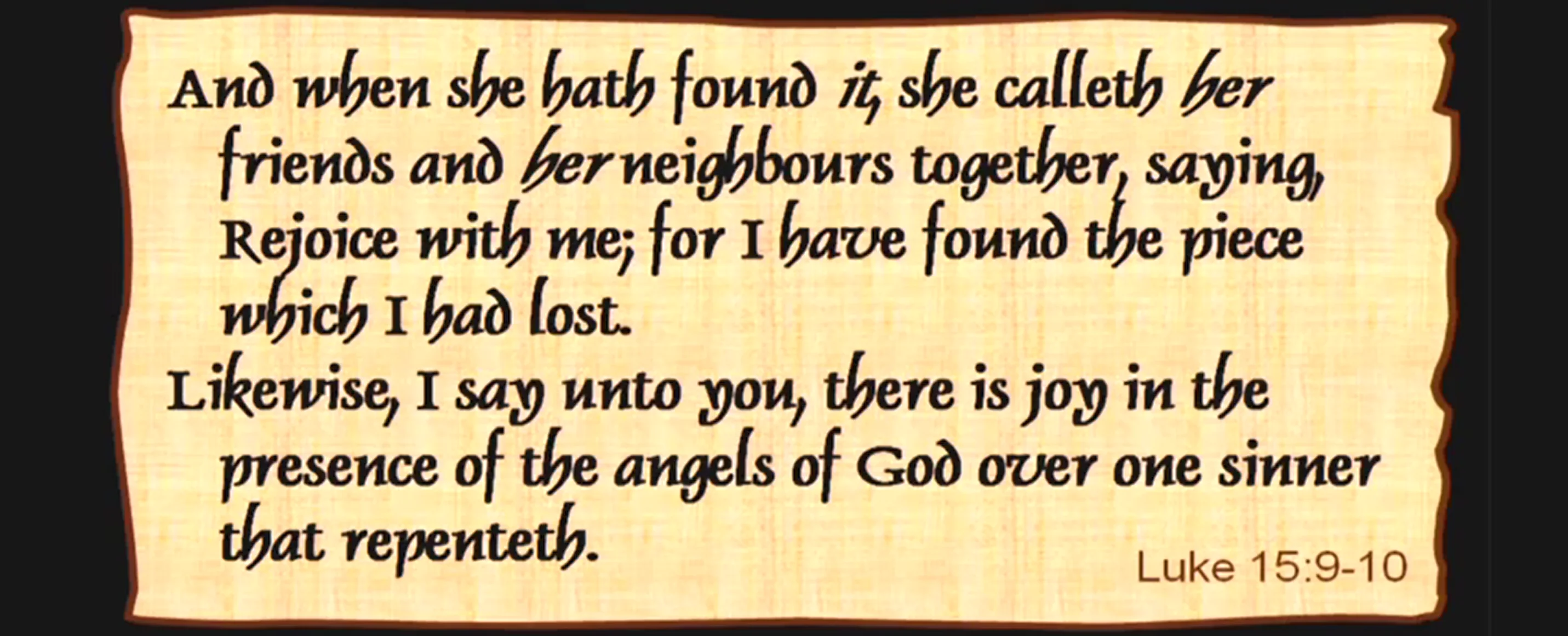
Luke 15:9-10
- They had forgotten that God had sought out Adam and Eve when they had sinned and attempted to hide from God (Gen 3:8-9)
- God is portrayed as a father who pities His wayward children (Ps 103:8-14)

Luke 15:11 The Parable of the Prodigal Son

Luke 15:12
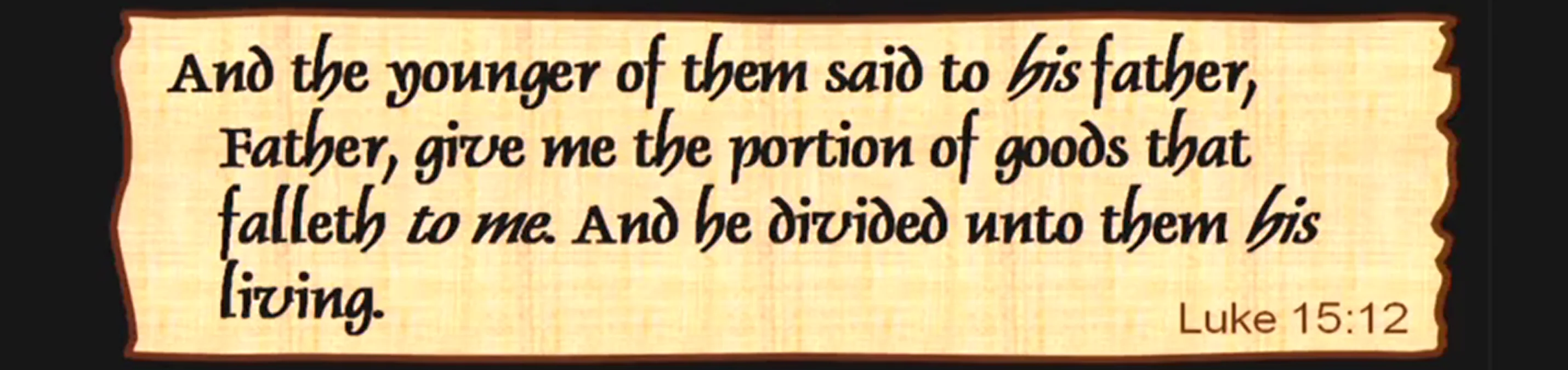
- Normally an estate was not divided and given to the heirs until the father could no longer manage it well
— This father acquiesced to his son’s demand and gave him his share of the inheritance
— The younger son’s portion would approximate ⅓ — the eldest son gets a double portion (Deut 21:17)
Luke 15:13
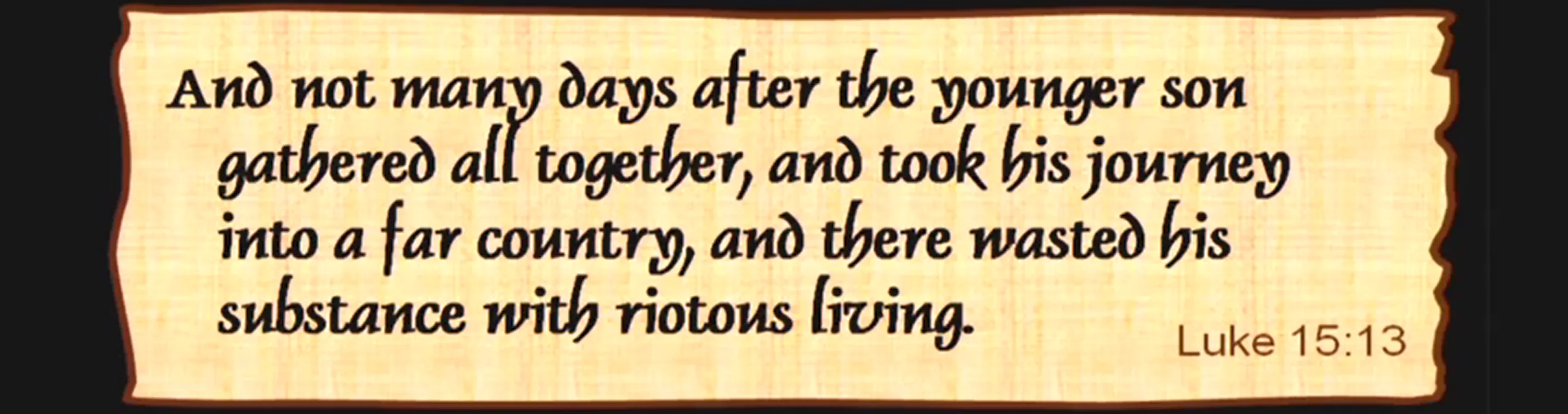
- The younger son took that wealth, went far away (eastward) and squandered it in wild living
— involving himself presumably, as his older brother said, with prostitutes (v. 30)
- “A man’s worst difficulties begin when he is able to do as he likes.” —Thomas Huxley (1825-1895, aged 70)
(Thomas Henry Huxley was an English biologist and anthropologist who specialized in comparative anatomy. He has become known as "Darwin's Bulldog" for his advocacy of Charles Darwin's theory of evolution)
— Sometimes, restrictions are really a blessing. We may not see it that way, but that certainly is human nature
- “Liberty is not the freedom to do as one likes; it is the empowerment to do what one ought.” —Dr. William Welty (1953-2019, aged 66) (William P. Welty, Ph.D. was the Executive Director of the ISV Foundation of La Mirada, California, producers of the Holy Bible: International Standard Version (ISV, https://isvbible.org/). He was one of Chuck Missler’s dearest friends. He was on the board of Directors of Koinonia House from 2009-2016. He taught New Testament Greek for 10 years at Simon Greenleaf University. He and Chuck co-authored the book: I, Jesus: an Autobiography)
- We are always heading for trouble when we value…
— things more than people
— pleasure more than duty
— distant scenes more than the blessings of home
- Parables of “the lost”: (examples of 3 evils)
— The sheep was lost through foolishness
— The coin probably through carelessness
— The son was lost because of willfulness
- The hearers would have understood the point of the story
— Jesus had been criticized for associating with sinners
— The sinners were considered people who were far away from God, squandering their lives in riotous living
— In contrast with the younger son, the older son continued to remain with the father and did not engage in such practices
Luke 15:14-15
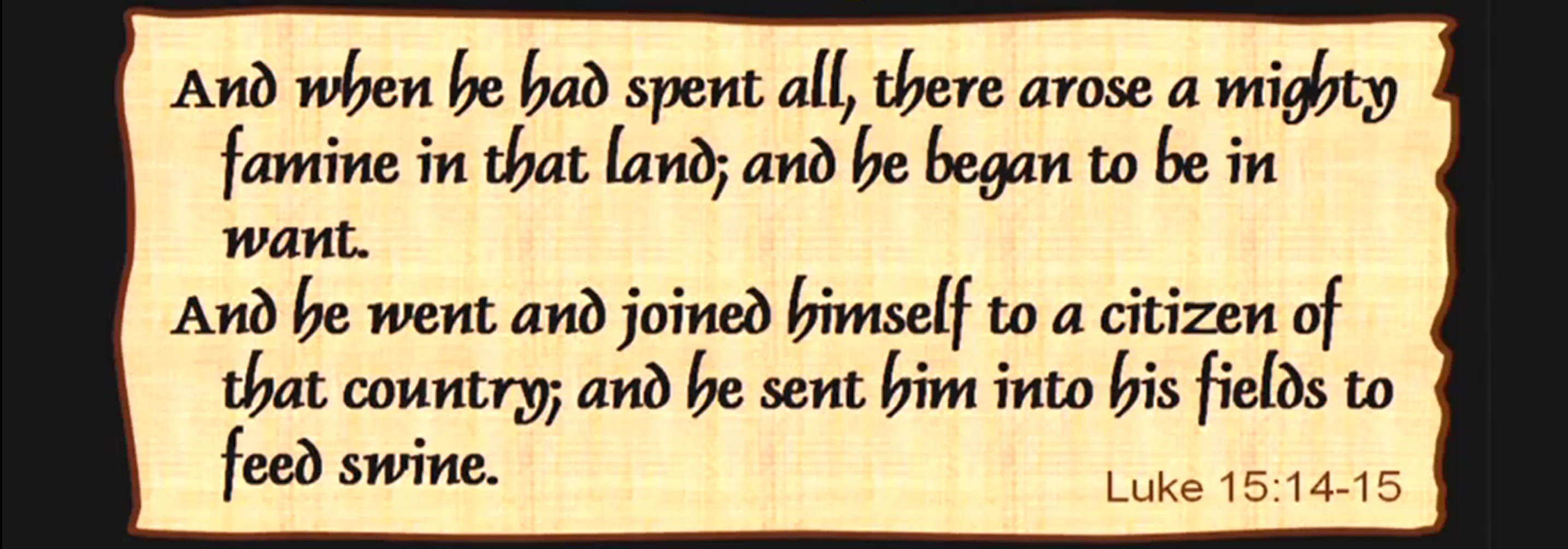
- A highly undesirable predicament to be in for a young Jewish man, no matter how liberal he might have been
- Commentators presume the far country was east of the Sea of Galilee where Gentiles tended pigs (Luke 8:26-37)
— In his hunger he longed for the very pods—the food he fed the pigs
Luke 15:16
- “…would fain” — would gladly, would happily…
- The Contradiction in Man
“What a piece of work is a man!
How noble in reason!
How infinite in faculties!
In form and moving, how express and admirable!
In action, how like an angel!
In apprehension, how like a god!” —Shakespeare, Hamlet, Act #2, Scene 2
- In another work by Shakespeare
“When he is best, he is a little worse than a man;
and when he is worst, he is little better than a beast.” —Shakespeare, The Merchant of Venice, Act #1, Scene 2
Luke 15:17
- In this low condition, he came to his senses
— He decided to go back to his father and work for him
— Surely he would be better off to work for his father than for a foreigner
Luke 15:18
- True repentance requires action
Luke 15:19

- He fully expected to be hired by his father as a servant, not to be taken back as his son
Luke 15:20
- The father had been waiting for his son to return…
— The father ran to him, and hugged and kissed him
Luke 15:21

- The son had brought disgrace to his family and village and was eligible to have been stoned to death! (Deut 21:18-21)
Luke 15:22
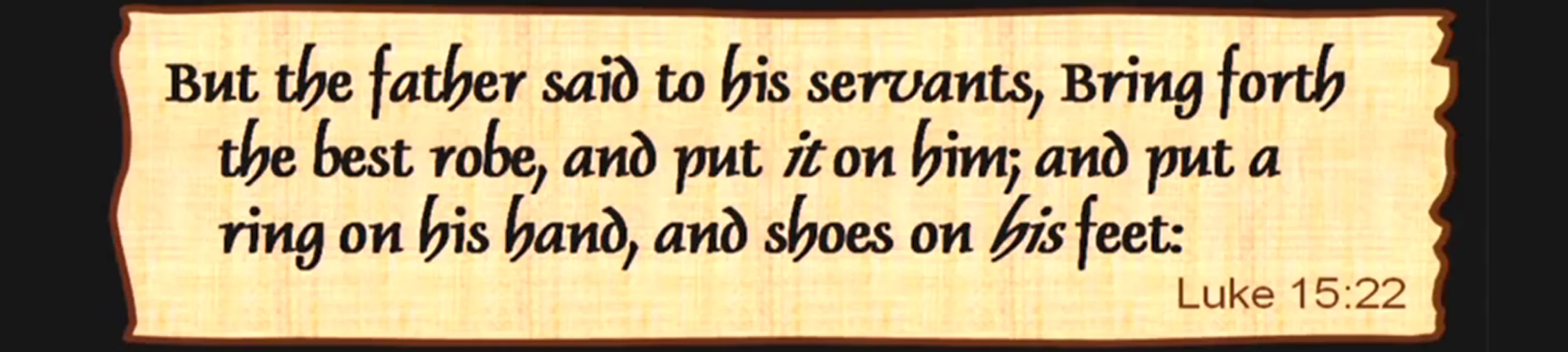
- Instead, the Father
— prepared a banquet to celebrate the son’s return
— gave the son a new position
— gave him a robe, a ring (emblem of his sonship) and sandals
- He may have lost his inheritance, but he didn’t lose his sonship
- Compare or consult (cf.):
— In Genesis 41:42: Pharaoh established Joseph as prime minister of all Egypt and gave him a robe and a signet
— In Isaiah 61:10: God has clothed us with garments of salvation (cf. 2 Cor 5:21)
- Servants don’t wear rings or expensive garments — he had not lost his sonship
“ 10 He has not dealt with us according to our sins,
And He has not rewarded us according to our iniquities.
11 For as high as the heavens are above the earth,
So great is His lovingkindness toward those who fear Him.
12 As far as the east is from the west,
So far has He removed our transgressions from us.
13 As a father has compassion on his children,
So Yahweh has compassion on those who fear Him.
14 For He Himself knows our form;
He remembers that we are but dust.” (Ps 103:10-14 LSB)
- Banquet = coming kingdom (cf. Luke 13:29, Luke 14:15-24)
- Significance To Jesus’ Hearers:
— Sinners were entering into the kingdom because they were coming to God
— They believed they needed to return to Him and be forgiven by Him
Luke 15:23

- The father did not ask him to “earn” his forgiveness
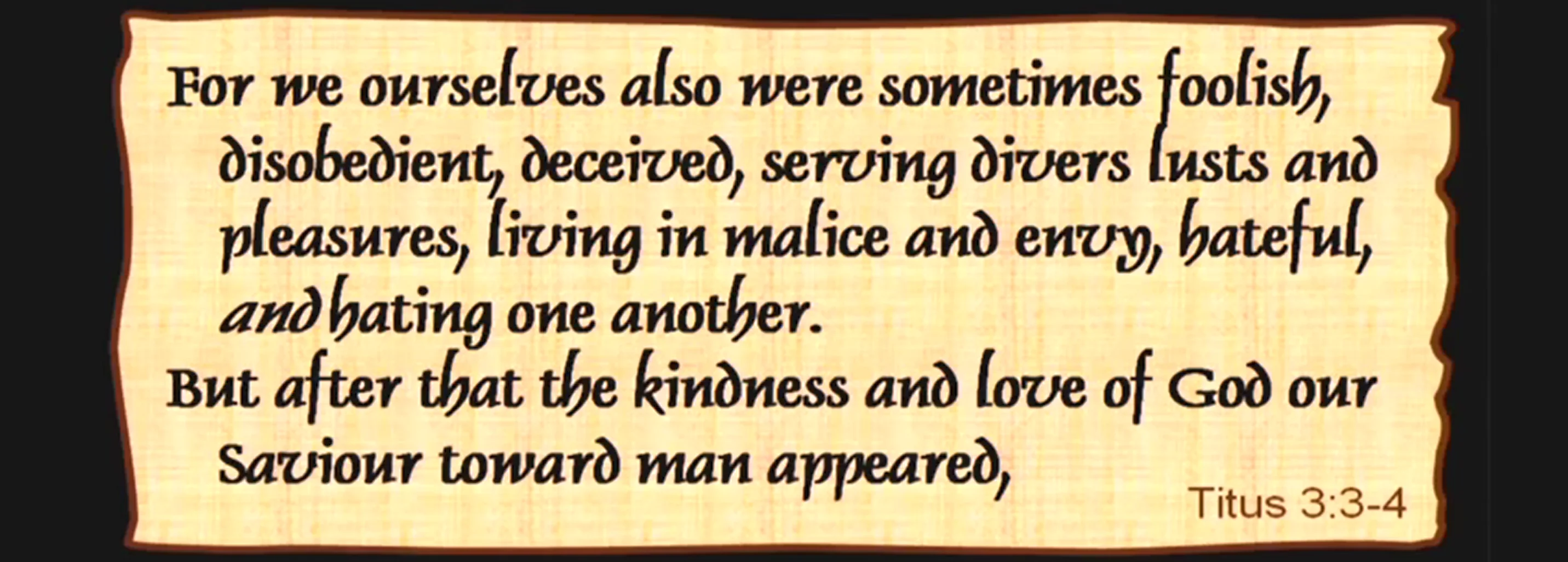
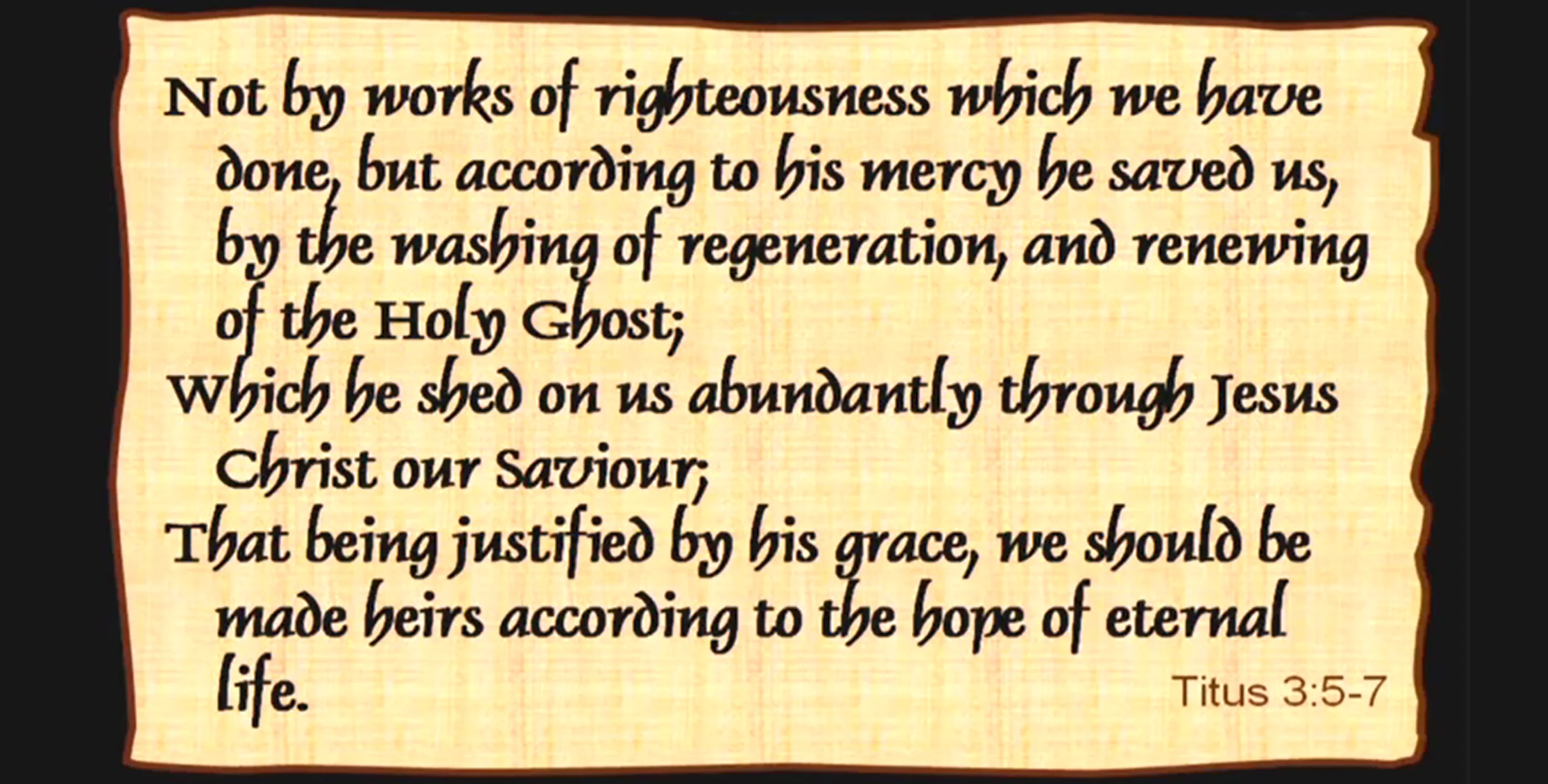
— No amount of good works can save us from our sins (Eph 2:8-9, Titus 3:3-7)
— We are saved only by the grace of God
💠 Titus 3:3-4
💠 Titus 3:5-7
Luke 15:24

- “…my son was dead” — a figure of speech we don’t want to miss — the son was “dead” to him
— In our case, it is not figurative — we are dead in our sins — dead, and now alive again
- Jewish Idiom: Abraham and Isaac (Akedah)
— When Abraham was instructed in Genesis 22 to take his promised son Isaac and offer him on a mountain (Gal 3, Rom 4, Heb 11), as far as Abraham was concerned, Isaac was dead when the commandment came
— Abraham had no problem with offering up Isaac. God had promised him that Isaac would have children. From Abraham’s point of view, it was God’s problem. God would simply have to raise him back from the dead (Heb 11:19) and that was taken for granted by Abraham (we tend to miss that)
— It was Abraham’s belief in resurrection of Isaac that saved him, which is so well expressed in Heb 11:19
🔊 1 Cor 15:3-4
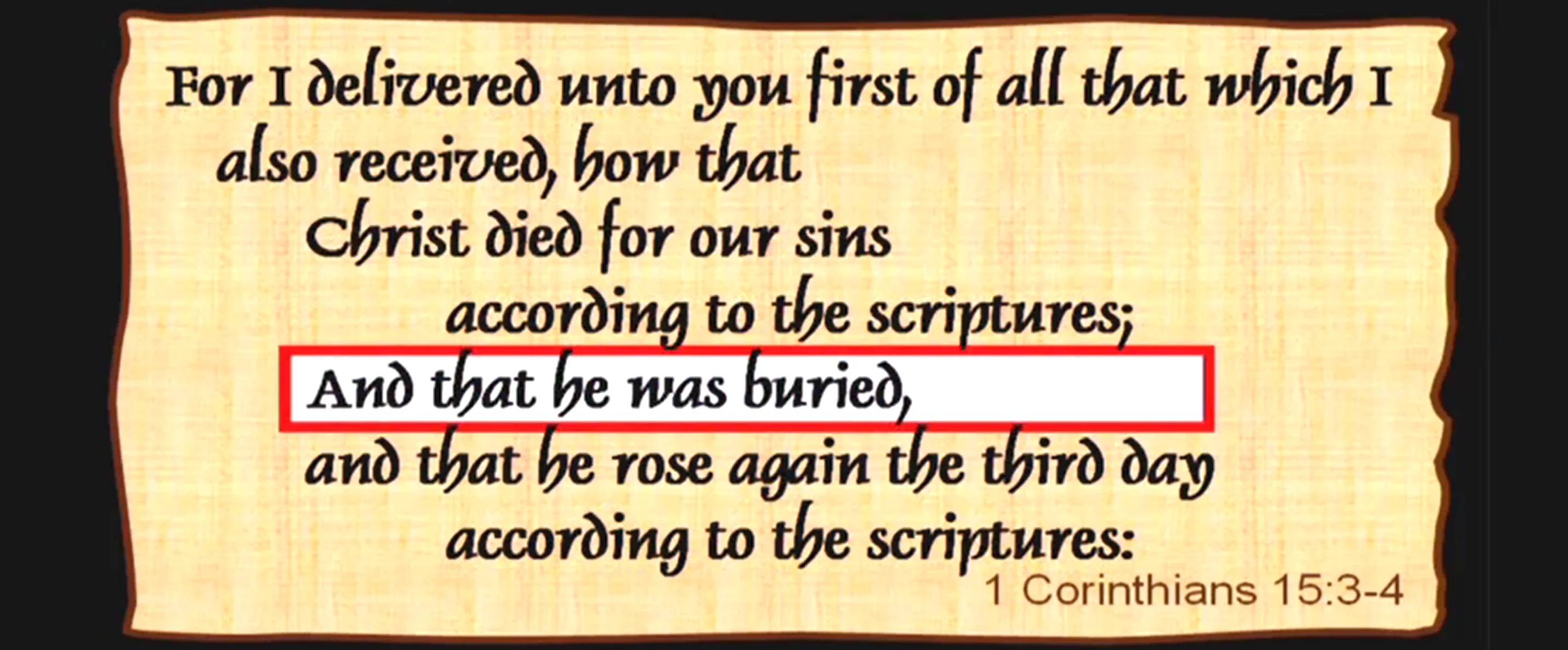
- When Paul defines the Gospel in 1 Cor 15:1-4 he does not mention:
— Christ’s teachings
— Christ’s example
— Christ’s miracles
- The key points:
— “Christ died for our sins according to the Scriptures”
— Only Paul emphasizes “that He was buried” as he builds the whole thing about baptism on that basis
— And finally “that He rose again the third day according to the Scriptures”
- Where in the Scriptures does it say that He is going to rise Him the third day?
— One of the places, and there are several, is Gen 22:14
— From Abraham’s point of view, Isaac died when the commandment came, then they travelled for three days and through substitution, Isaac was restored back to Abraham, so there is a three-days model very precisely
— Also, there is Jonah: three days and three nights in the belly of the whale (Jonah 1:17)
- Abraham knew he was acting up prophecy
— Abraham may not have realized that another Father would offer His Son on that very spot 2,000 years later
🌄 Gen 22:14
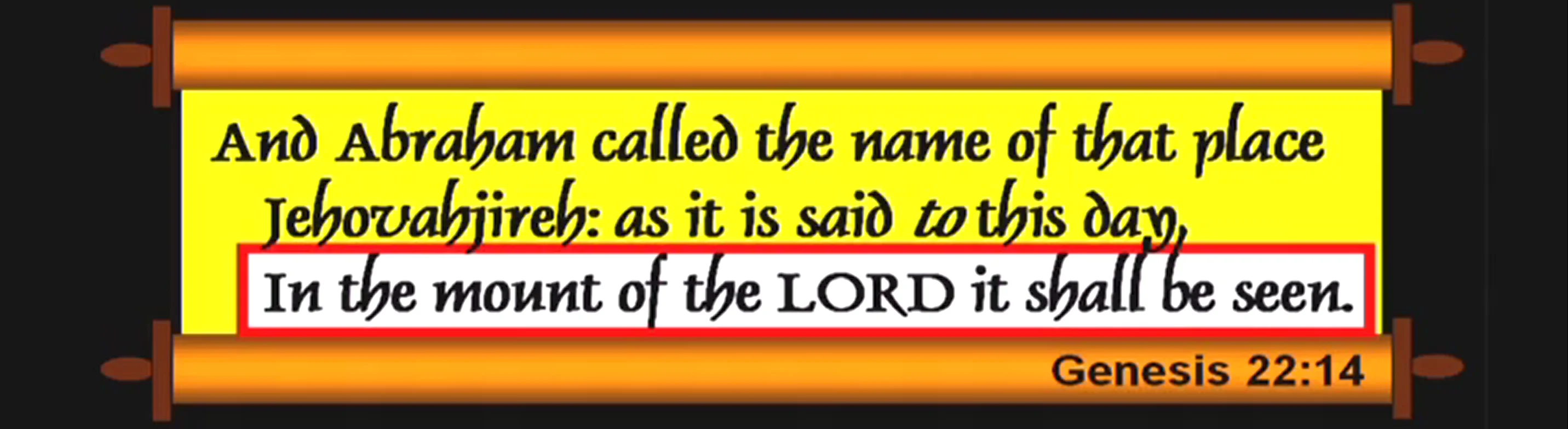
- “…“In the mount of Yahweh it will be provided.”” LSB with a note: Lit be seen — so KJV is literal here
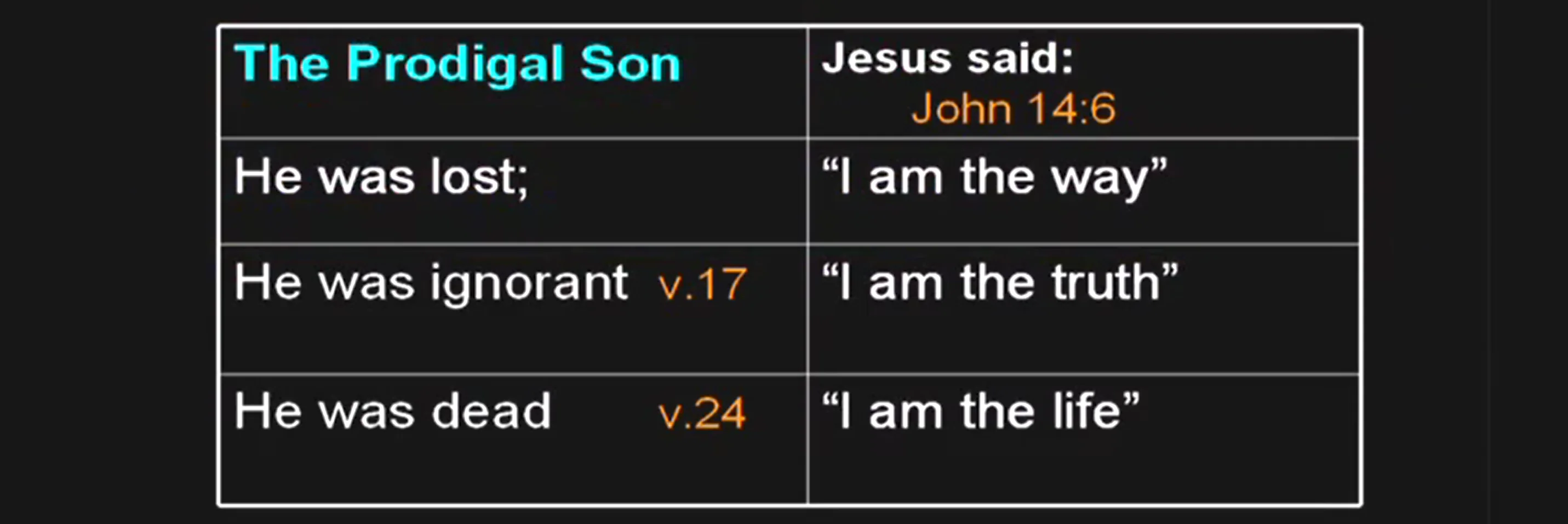
And Luke 15:24 again — John 14:6 parallel with the prodigal son:

- What thing in common do these have:
— Pharisees and scribes (who are listening to this story)
— Jonah and
— the older son?
ANSWER ⫸ They are all guilty of a bad attitude 👎

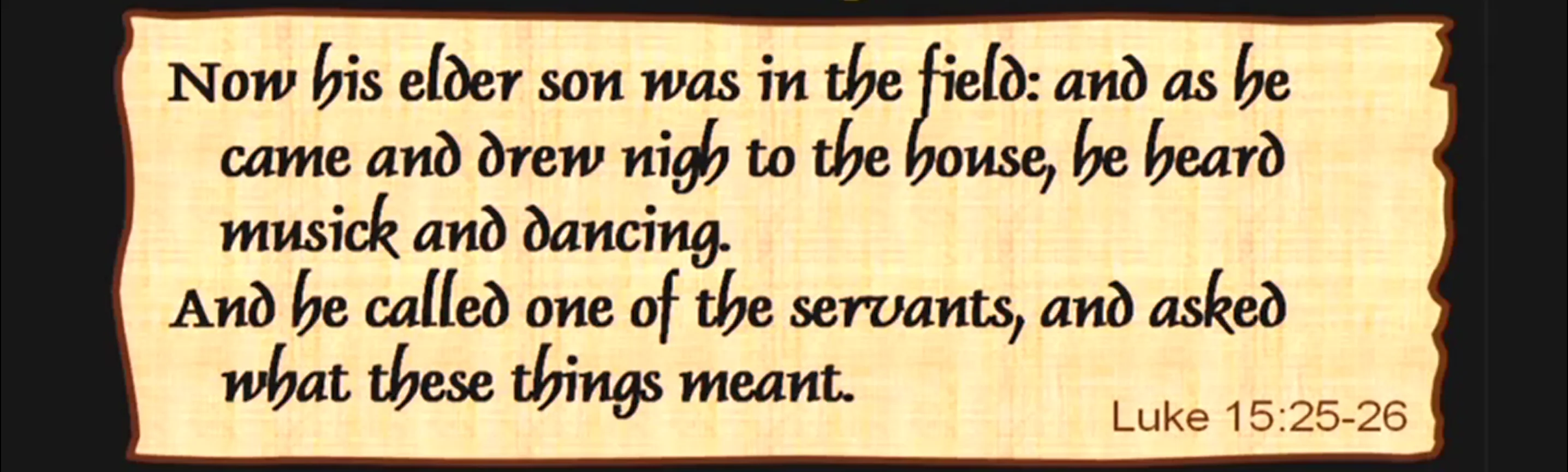
Luke 15:25-26
Luke 15:27-28
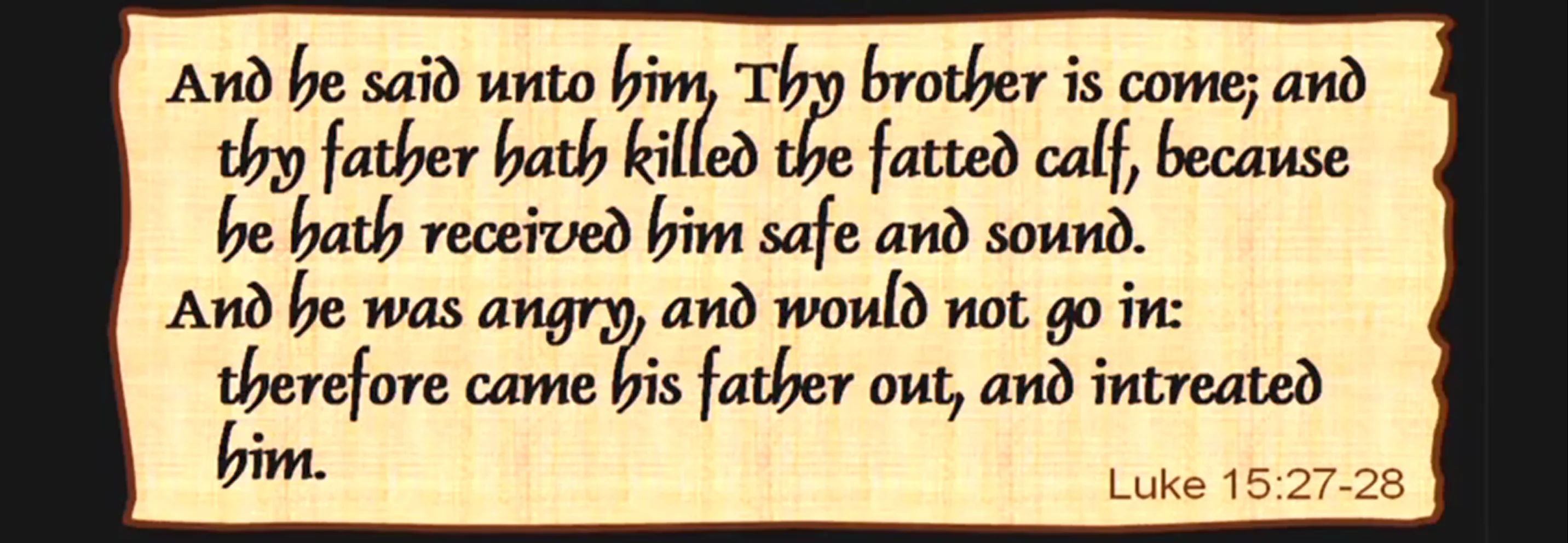
- Similarly the scribes and Pharisees were angry with the message Jesus was preaching
— They did not like the idea that people from outside their nation as well as outcasts and sinners in the nation were to be a part of the kingdom
— The fact that Gentiles would be reached was, from the very beginning, part of the mission of Israel
— The salvation of the Gentiles is very well present all through the OT
— (Church was not revealed in the OT because of the indwelling of the Holy Spirit and other unique things that are highlighted in Ephesians 3)
- Jesus had previously warned about the two disputing brothers “…Take heed and beware of covetousness: for a man’s life consisteth not in the abundance of the things which he possesseth.” (Luke 12:15)
- Like the older son who refused to go to the feast, the Pharisees refused to enter the kingdom Jesus offered to the nation (the parallel there is disturbing — the point of the parable is targeting Pharisees who are listening)
— The same loving father that ran to meet the prodigal son came out of the house of feasting to entreat the older brother! God is calling Pharisees despite their rejection
Luke 15:29
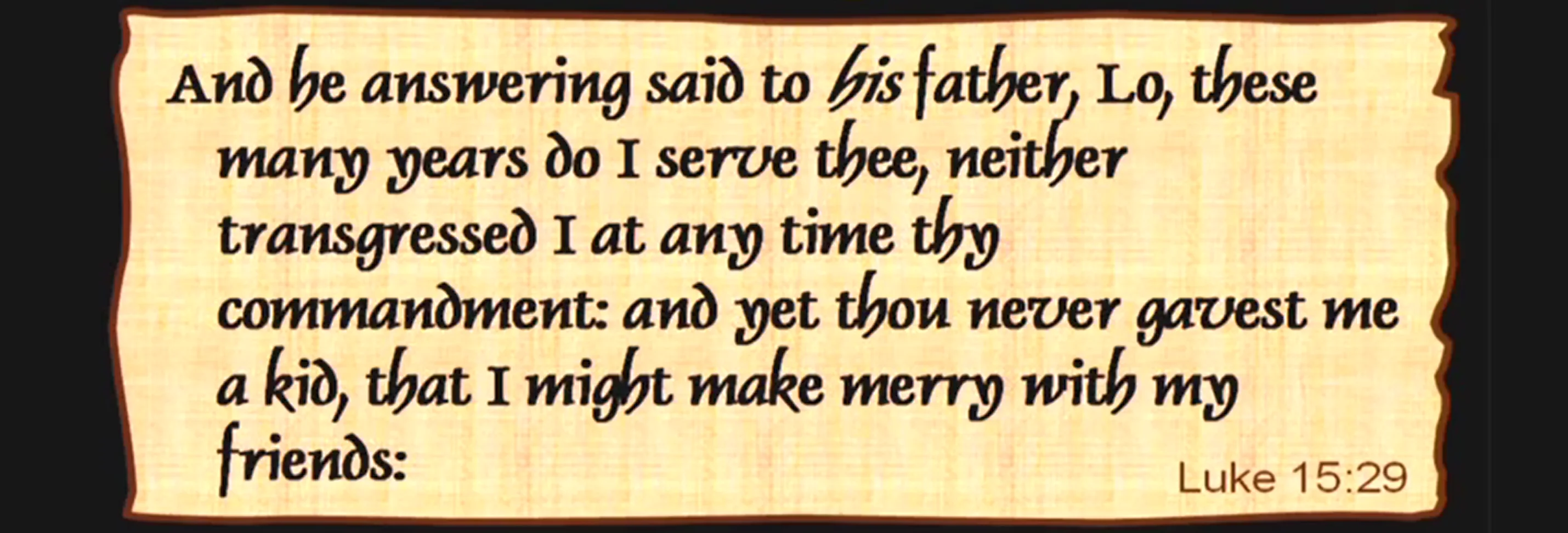
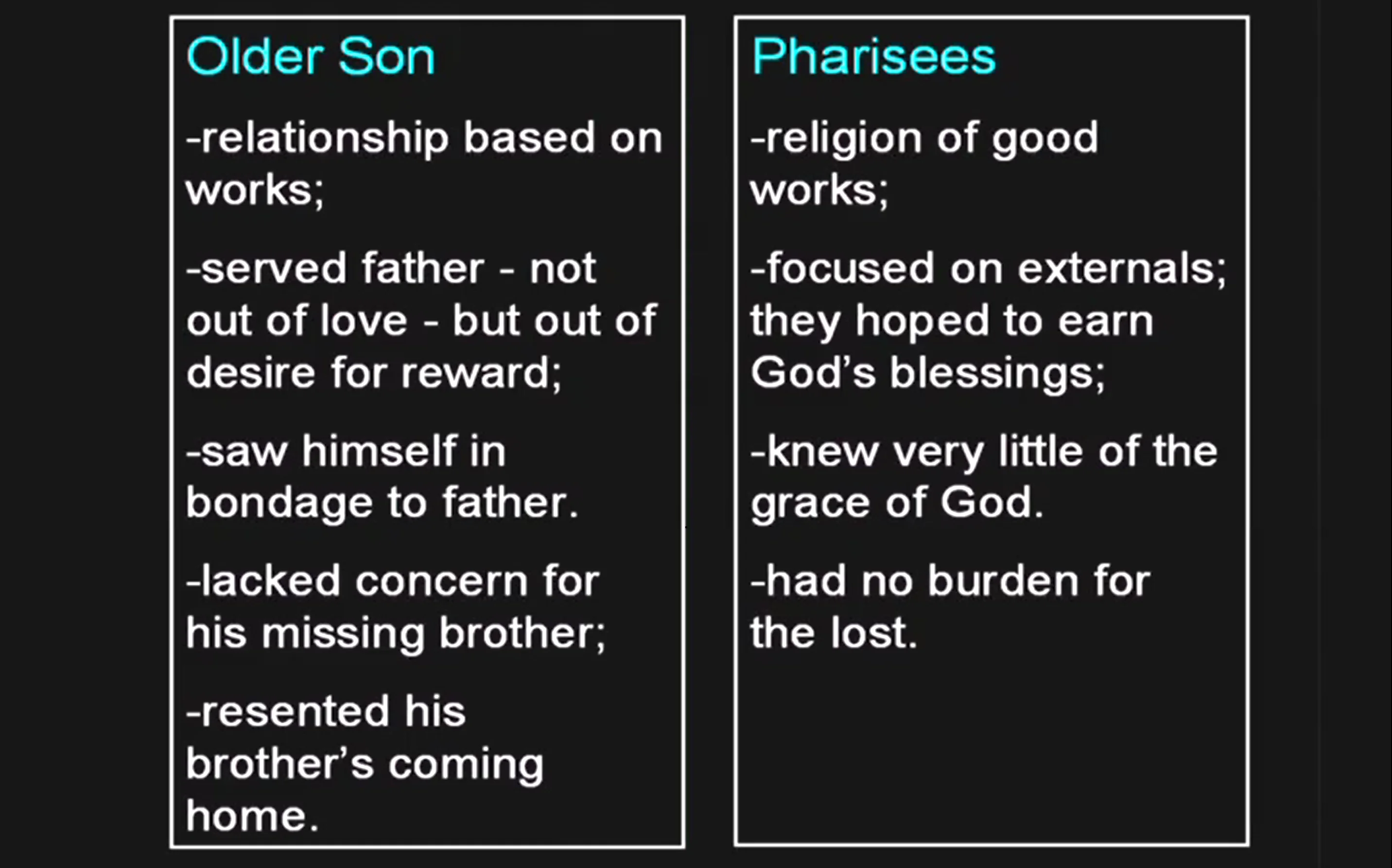
- We can understand his attitude, yet it is still a bad attitude
Luke 15:30
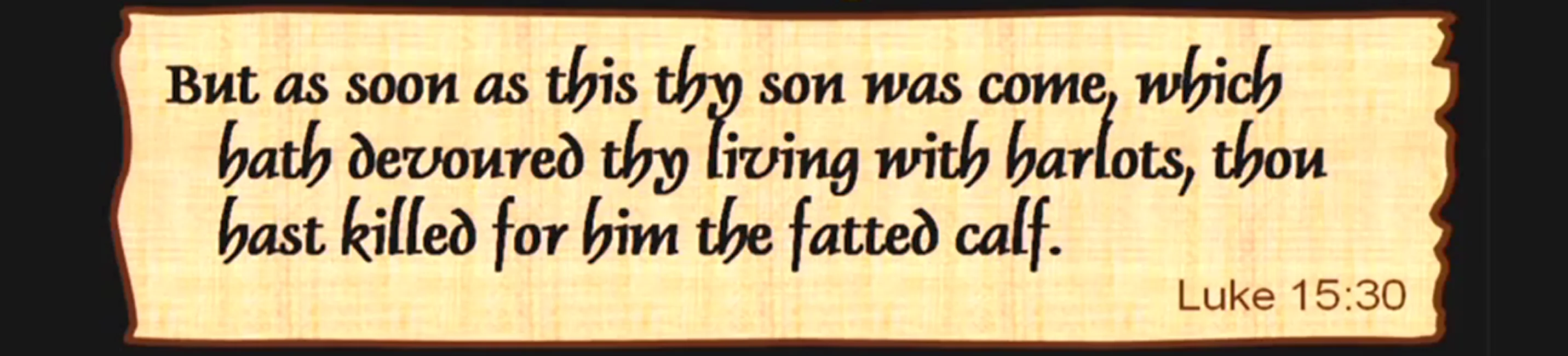
- He keeps griping (complaining in a persistent, irritating way)
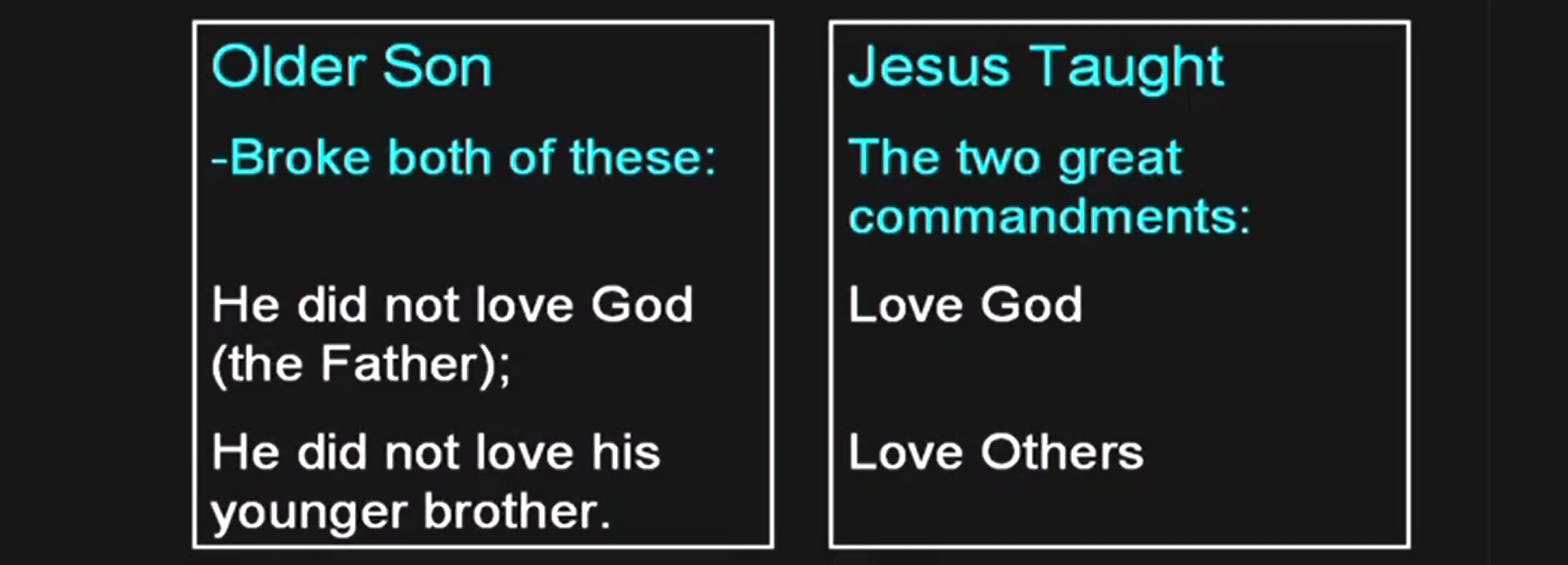
- Jesus thought two Great Commandments: Love God and Love Others
— In fact, He summarized the entire Bible by quoting from two passages in the Torah (Deut 6:5, Lev 19:18)
Luke 15:31

- The religious leaders had a privileged position as members of God’s Chosen People
— The scribes and the Pharisees were the recipients and guardians of the covenants and the Law (Rom 3:1-2, 9:4)
Luke 15:32
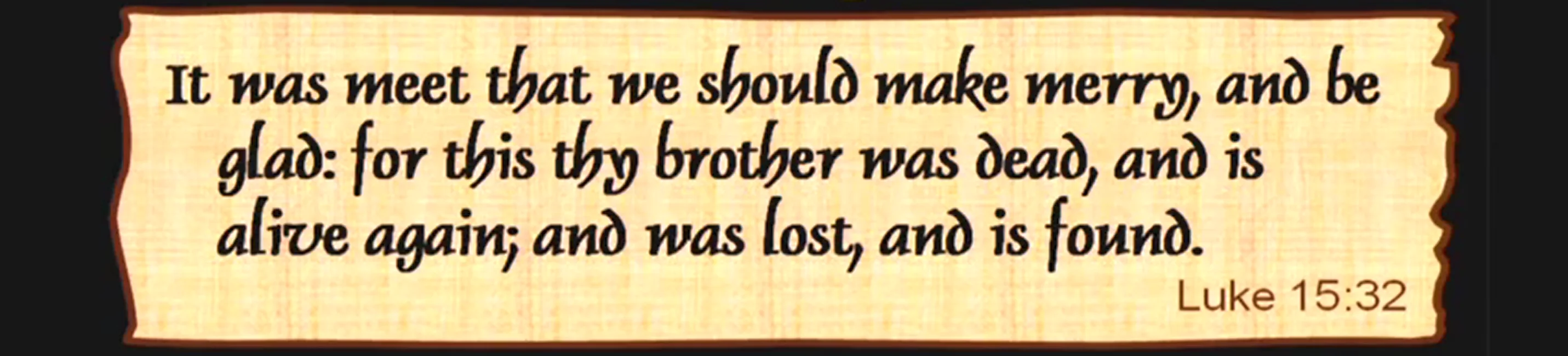
- The father had the last word
— Yet, we don’t really know how it ended (much like Jonah 4)

- Everybody in this chapter had a good time:
— the shepherd who found the lost sheep
— the woman who found the coin
— the younger son, the father, the guests… all except one: the older brother
- There are two aspects to salvation:
1) God’s part: the shepherd seeks the lost sheep, the woman searches for the coin, the father receives the son
2) Man’s part: the wayward son willingly repented and went home (it took an action on his part for the repair)

- “All that the Father giveth me shall come to me; and him that cometh to me I will in no wise cast out.” (John 6:37)
- “But we are bound to give thanks alway to God for you, brethren beloved of the Lord, because God hath from the beginning chosen you to salvation through sanctification of the Spirit and belief of the truth: 14 Whereunto he called you by our gospel, to the obtaining of the glory of our Lord Jesus Christ.” (2 Thess 2:13-14)
- See our briefing pack, The Sovereignty of Man (several hours to unpack these very pregnant concepts)
- God has sovereignty, but so do we
— Stemming from the sovereignty we have, we also have the responsibility

- Judas:
— Judas’ betrayal was predicted, yet he was personally responsible
(Ps 41:9, John 13:18, John 17:9-12, Cf. Matt 18:7, Matt 26:21, Mark 14:21, Luke 17:1, Luke 22:22)
- Moses:
— Failure at Meribah (Num 20:7-13)
— The entire history of Israel in the Old Testament: courtship, rejection, and yet ultimate restoration, involves the responsibility to respond to God
- Joshua:
— A warrior whose days were not long enough for some of his battles
— His “Long Day” was prayed for and yet prepared eons before (Josh 10 meteors—some marksmanship!)
- Hezekiah:
— Prays for his life to be extended → the sun dial set back to certify God’s response (2 Kgs 20:6, 2 Chr 32:24, Isa 38)

- Grappling with the concept of predestination and the free will
— That predicament, that apparent paradox, has confused and puzzled analysts and philosophers for hundreds of years: if things are prophesied, they are predestined, and if they are predestined, is there a variability there?
— It seems like a contradiction, but it really isn’t: you do have free choice, but God is not surprised, God just knows the choice you are going to make
- Henry Allen Ironside (1876-1951, aged 74) (1st mentioned in Luke Chapter 1 note) — he had a very colorful way of communicating this:
— You are walking down the hallway and you come to a door
— The door is closed and from the outside, it says: “Whosoever will may enter” — Your free choice
— There is nothing preventing one entering in, but you have to decide
— If you do get in, you discover that there is a chair with your name on it, waiting for you (you were expected)
— It says: “Foreordained before the foundation of the world!”
- When did God first start thinking about you?
— Long before you were born, He had you on His mind

- It is we ourselves who choose whether God will judge us
- It is we ourselves who decide either to accept or refuse His grace, love and forgiveness
- It is we ourselves who choose everlasting life — or everlasting separation from God

- A guy by the name of Solomon
— One of the wisest and most gifted men who ever walked the earth
— Solomon failed at his hour of greatest need and the hour of his greatest opportunity
- Solomon:
— inherited great position
— was not only the choice of David, but the choice of God as well
— he had the ability to fill that lofty position (he was gifted with wisdom, riches, power…)
— was enriched by having a consecrated father:
✡ David with all his faults was still a good example
✡ “A man after God’s own heart”
✡ David had greatly sinned, he had greatly repented, and had been greatly forgiven
- Solomon – Positives:
— had at least two personal experiences of God Himself (that were recorded)
— an able ruler in many ways
— a magnificent monarch (when Queen of Sheba checked him out: “the half was not told me”) 1 Kgs 10:7
— a shrewd and successful merchant (his negotiating skills setup international trade)
— a man of peace (in contrast to David who was a warrior)
— a great builder (built the Temple)
- Solomon – Negatives:
— foolishly fond of display
— garnered a pampered court and lived extravagantly (gotta watch for that one — there are things that are permissible, but probably improper if you are in the ministry, that may send a wrong message)
— accumulated wives: 700, plus 300 concubines!
— Solomon had become so powerful that he felt himself above the moral law (cf. “CEO fever”…)
- Solomon’s self-indulgent blindness wrecked his own son and his kingdom
— Finishing well is the real challenge (find God, get saved, discover & pursue His calling for you and finish well)
— “…No man, having put his hand to the plough, and looking back, is fit for the kingdom of God.” (Luke 9:62)
🏁 2 Tim 4:7

- “but I discipline my body and make it my slave, so that, after I have preached to others, I myself will not be disqualified.” (1 Cor 9:27) NASB
— “…castaway” in KJV is better translated as “…disqualified”
— Paul had a fear of losing his inheritance and his rewards (not losing salvation)
— Chuck has a whole study on Eternal Security, which is very controversial even though the Scripture is very clear
— Related to that is a whole another subject: Inheritance & Rewards
— Both these studies are departures from Chuck & Nancy’s book: The Kingdom, Power & Glory
— Do not forfeit God’s awesome rewards


- The Unrighteous Steward (Who is commended!?)
— A parable about a steward who cheats, embezzles… and uses dishonesty to feather his nest because he knows he is going to get fired and ingratiates himself to his master’s debtors
— Jesus commends the steward!
- The Afterlife (Hell, Hades, Sheol, Gehenna, Abuso)
— Most of what we know about what happens after death appears in this chapter
— Not a parable, but an actual event (where people have names)
- People say: How can a loving God condemn someone to Hell?
— They are failing to understand what a loving God is
— They are failing to understand the seriousness of sin
